RSS
Facebook
Twitter

Monday, April 2, 2012

This starts with the Procession coming into the church - certainly a good public witness in Manhattan. (Perhaps they begin at St. Paul's Chapel? Not sure.)

And , with procession music and a sung Passion they've composed themselves, it looks like. It's really worth seeing, even though I personally prefer the simple plainchant version of the passion we sang at St. Mary's (the congregation sings the part of Jesus, so we learn to sing that tone, and now I know all the various tones as well). In this video, the Passion narrative is a kind of alternatim, with the choir singing the composed part, and (I think) the whole congregation singing verses, in refrain, of "Ah, Holy Jesus." Here's what the blurb at the site says:

The traditional scripture text from the Gospel of Mark will be used in the reading of the Passion, which will be chanted in an improvisational style by members of the Trinity Choir, with participation by the congregation in a sung refrain.


The Passion starts at around 17:00, right after the singing of another composed version of Christus Factus Est (called here "A song of Christ's humility"). Very interesting, really.


TWS is doing some really interesting things in terms of music these days. For instance, a few years ago they sang a composed (and choral!) version of the Exsultet at Easter Vigil. Again, I prefer the simpler stuff, just because the tunes stick in my head and become part of my psychic world; composed stuff is often too difficult to do this with - but it is dramatic and can be very lovely. It seems to veer off into a kind of interesting "Orthodox chant" style, which I do really like. This passion is very long, because they start it from the story of the woman anointing Jesus' feet; a nice touch, I think. Here's the service bulletin, in PDF.

TWS has some priests with really excellent singing voices!

Saturday, March 31, 2012

The Palm Sunday Tract: Deus, Deus Meus

Here's over 9 minutes of plaintive Tract/Psalm-singing from the Choeur Gregorien de Paris:


Here's the translation from "Corpus Christi Watershed" of the text, which comes from the familiar Psalm 22 (vv 2-9, 18, 19, 22, 24, and 32):
Deus, Deus meus, réspice in me: quare me dereliquísti? 2. Longe a salúte mea verba delictórum meórum. 3. Deus meus, clamábo per diem, nec exáudies: in nocte, et non ad insipiéntiam mihi. 4. Tu autem in sancto hábitas, laus Israël. 5. In te speravérunt patres nostri: speravérunt, et liberásti eos. 6. Ad te clamavérunt, et salvi facti sunt: in te speravérunt, et non sunt confusi. 7. Ego autem sum vermis, et non homo: oppróbrium hóminum et abjéctio plebis. 8. Omnes, qui vidébant me, aspernabántur me: locúti sunt lábiis et movérunt caput. 9. Sperávit in Dómino, erípiat eum: salvum fáciat eum, quóniam vult eum. 10. Ipsi vero consideravérunt et conspexérunt me: divisérunt sibi vestiménta mea, et super vestem meam misérunt sortem. 11. Líbera me de ore leónis: et a córnibus unicórnium humilitátem meam. 12. Qui timétis Dóminum, laudáte eum: univérsum semen Jacob, magnificáte eum. 13. Annuntiábitur Dómino generátio ventúra: et annuntiábunt coeli justítiam ejus. 14. Pópulo, qui nascétur, quem fecit Dóminus.
O God, my God, look upon me; why hast Thou forsaken me? 2. Far from my salvation are the words of my sins. 3. O my God, I shall cry by day, and Thou wilt not hear; and by night, and it shall not be reputed as folly in me. 4. But Thou dwellest in the holy place, the praise of Israel. 5. In Thee have our fathers hoped; they have hoped, and Thou hast delivered them. 6. They cried to Thee, and they were saved; they trusted in Thee, and were not confounded. 7. But I am a worm, and no man: the reproach of men and the outcast of the people. 8. All they that saw Me have laughed Me to scorn; they have spoken with the lips and wagged the head. 9. He hoped in the Lord, let Him deliver Him; let Him save Him, seeing He delighteth in Him. 10. But they have looked and stared upon Me; they parted My garments amongst them, and upon My vesture they cast lots. 11. Deliver me from the lion's mouth, and my lowness from the horns of the unicorns. 12. Ye that fear the Lord, praise Him; all ye the seed of Jacob, glorify Him. 13. There shall be declared to the Lord a generation to come; and the heavens shall show forth His justice. 14. To a people that shall be born, which the Lord hath made.
Powerful and beautiful stuff.

Here's the chant propers lineup for Palm Sunday from JoguesChant  - the ordinary form, that is, which I believe St. Mary's will be using in its entirety.  As you can see, the order of the Graduale and Tract has been reversed, probably so that the powerful Christus Factus Est can be sung just before the reading (or singing) of the Passion:
Antiphon:  Hosanna Filio David    
Antiphon:  Pueri Hebraeorum     
Introit:  Ingrediente Domino    
Chant after 1st Reading:  Deus Deus Respice      (another option is also available)
Chant after 2nd Reading:  Christus Factus        
Offertory:  Improperium Exspectavit    
Communion:  Pater Si    

Here's the schedule for Palm Sunday in the Extraordinary Form; as you can see, this is quite a bit simpler, with no introductory antiphons (or procession, evidently), and no Christus Factus Est (that gets sung as the Graduale on Maundy Thursday):
Introit:  Domine Ne Longe
Gradual:  Tenuisti manum        
Tract:  Deus Deus meus respice         
Offertory:  Improperium exspectavit
Communion:  Pater Si Non Potest

And the Brazilian Benedictines go all out:
Antiphona: Hosanna filio David 

Ad processionem
Procedamus 
Antiphona: Pueri Hebraeorum portantes 
Antiphona: Pueri Hebraeorum vestimenta 
Hymnus ad Christum Regem: Gloria, laus 
Responsorium: Ingrediente Domino 

Ad Missam
Tractus:   Deus, Deus meus 
Graduale:  Christus factus est
Offertorium:  Improperium exspectavit et dederunt
Communio:  Pater, si non potest 
Here's some of (well, most of, really!) New Advent's entry on Palm Sunday:

The sixth and last Sunday of Lent and beginning of Holy Week, a Sunday of the highest rank, not even a commemoration of any kind being permitted in the Mass.....The Greeks celebrate the day with great solemnity; they call it kyriake or heorte ton baion or heorte baiophoros or also Lazarus Sunday, because on the day before they have the feast of the resuscitation of Lazarus. The emperors used to distribute branches of palm and small presents among their nobles and domestics. The Latin liturgical books call it Dominica in Palmis, Dominica or Dies Palmarum. From the cry of the people during the procession the day has received the name Dominica Hosanna or simply Hosanna (Ozanna). Because every great feast was in some way a remembrance of the resurrection of Christ and was in consequence called Pascha, we find the names Pascha floridum, in French Pâques fleuries, in Spanish Pascua florida, and it was from this day of 1512 that our State of Florida received its name (Nilles, II, 205). From the custom of also blessing flowers and entwining them among the palms arose the terms Dominica florida and dies floridus. Flower-Sunday was well known in England, in Germany as Blumensonntag or Blumentag, as also among the Serbs, Croats, and Ruthenians, in the Glagolite Breviary and Missal, and among the Armenians. .... Since this Sunday is the beginning of Holy Week, during which sinners were reconciled, it was called Dominica indulgentioe, competentium, and capitilavium from the practice of washing and shaving of the head as a bodily preparation for baptism. During the early centuries of the Church this sacrament was conferred solemnly only in the night of Holy Saturday, the text of the creed had been made known to the catechumens on the preceding Palm Sunday. This practice was followed in Spain (Isidore, "De off. eccl.", I, 27), in Gaul (P.L., LXXII, 265), and in Milan (Ambrose, Ep. xx). In England the day was called Olive or Branch Sunday, Sallow or Willow, Yew or Blossom Sunday, or Sunday of the Willow Boughs. Since the celebration recalled the solemn entry of Christ into Jerusalem people made use of many quaint and realistic representations; thus, a figure of Christ seated on an ass, carved out of wood was carried in the procession and even brought into the church. Such figures may still be seen in the museums of Basle, Zurich, Munich, and Nürnberg (Kellner, 50).

In some places in Germany and France it was customary to strew flowers and green boughs about the cross in the churchyard. After the Passion had been recited at Mass blessed palms were brought and this cross (in consequence sometimes called the Palm cross) was wreathed and decked with them to symbolize Christ's victory. In Lower Bavaria boys went about the streets singing the "Pueri Hebræorum" and other carols, whence they received the name of Pueribuben ("Theologisch-praktische Quartalschrift", 1892, 81). Sometimes an uncovered crucifix, or the gospel-book, and often the Blessed Sacrament, was carried in recession. In many parts of England a large and beautiful tent was prepared in the churchyard. Two priests accompanied by lights brought the Blessed Sacrament in a beautiful cup or pyx hung in a shrine of open work to this tent. A long-drawn procession with palms and flowers came out of the church and made four stations at the Laics' cemetery north of the church, at the south side, at the west door, and before the church-yard cross, which was then uncovered. At each of these stations Gospels were sung. After the singing of the first Gospel the shrine with the Blessed Sacrament was borne forward. On meeting, all prostrated and kissed the ground. The procession then continued. The door of the church was opened, the priests held up on high the shrine with the Blessed Sacrament, so that all who went in had to go under this shrine, and thus the procession came back into the church. The introduction of the Blessed Sacrament into the Palm Sunday procession is generally ascribed to Bl. Lanfranc who ordered the ceremony for his Abbey of Bec.

Liturgical writers differ in assigning a time for the introduction of the benediction of palms and of the procession. Martène, "De antiq. eccl. discipl." xx, 288, finds no mention of them before, the eighth or ninth century. Peliccia, "Christian. eccl. politia", II, 308, is of the same opinion and mentions Amularius, "De div. off.", I, x, as the first to speak of them. Binterim, V, i, 173, on the authority of Severus, Patriarch of Antioch, and of Josue Stylites, states that Peter Bishop of Edessa, about 397 ordered the benediction of the palms for all the churches of Mesopotamia. The ceremonies had their origin most probably in Jerusalem. In the "Peregrinatio Sylviæ", undertaken between 378 and 394, they are thus described: On the Lord's Day which begins the Paschal, or Great, Week, after all the customary exercises from cook-crow till morn had taken place in the Anastasia and at the Cross, they went to the greater church behind the Cross on Golgotha, called the Martyrium, and here the ordinary Sunday services were held. At the seventh hour (one o'clock p. m.) all proceeded to the Mount of Olives, Eleona, the cave in which Our Lord used to teach, and for two hours hymns, anthems, and lessons were recited. About the hour of None (three o'clock p. m.) all went, singing hymns, to the Imbomon, whence Our Lord ascended into heaven. Here two hours more were spent in devotional exercises, until about 5 o'clock, when the passage from the Gospel relating how the children carrying branches and Palms met the Lord, saying "Blessed is He that cometh in the Name of the Lord" is read. At these words all went back to the city, repeating "Blessed is He that cometh in the Name of the Lord." All the children bore branches of palm or olive. The faithful passed through the city to the Anastasia, and there recited Vespers. Then after a prayer in the church of the Holy Cross all returned to their homes.

In the three oldest Roman Sacramentaries no mention is found of either the benediction of the palms or the procession. The earliest notice is in the "Gregorianum" used in France in the ninth and tenth centuries. In it is found among the prayers of the day one that pronounces a blessing on the bearers of the palms but not on the palms. The name Dominica in palmis, De passione Domini occurs in the "Gelasianum", but only as a superscription and Probst ("Sacramentarien und Ordines", Münster, 1892, 202) is probably correct in suspecting the first part to be an addition, and the De passione Domini the original inscription. It seems certain that the bearing of palms during services was the earlier practice, then came the procession, and later the benediction of the palms.

The principal ceremonies of the day are the benediction of the palms, the procession, the Mass, and during it the singing of the Passion. The blessing of the palms follows a ritual similar to that of Mass. On the altar branches of palms are placed between the candlesticks instead of flowers ordinarily used. The palms to be blessed are on a table at the Epistle side or in cathedral churches between the throne and the altar. The bishop performs the ceremony from the throne, the priest at the Epistle side of the altar. An antiphon "Hosanna to the Son of David" is followed by a prayer. The Epistle is read from Exodus 15:27-16:7, narrating the murmuring of the children of Israel in the desert of Sin, and sighing for the fleshpots of Egypt, and gives the promise of the manna to be sent as food from heaven. The Gradual contains the prophetic words uttered by the high-priest Caiphas, "That it was expedient that one man should die for the people"; and another the prayer of Christ in the Garden of Olives that the chalice might pass; also his admonition to the disciples to watch and pray. The Gospel, taken from St. Matthew, xvi, 1-9, describes the triumphant entry of Christ into Jerusalem when the populace cut boughs from the trees and strewed them as He passed, crying, Hosanna to the Son of David; blessed is he that cometh in the name of the Lord. (In private Masses this Gospel is read at the end of Mass instead of that of St. John.) Then follow an oration, a preface, the Sanctus, and Benedictus.

In the five prayers which are then said the bishop or priest asks God to bless the branches of palm or olive, that they may be a protection to all places into which they may be brought, that the right hand of God may expel all adversity, bless and protect all who dwell in them, who have been redeemed by our Lord Jesus Christ. The prayers make reference to the dove bringing back the olive branch to Noah's ark and to the multitude greeting Our Lord; they say that the branches of palms signify victory over the prince of death and the olive the advent of spiritual unction through Christ. The officiating clergyman sprinkles the palms with holy water, incenses them, and, after another prayer, distributes them. During the distribution the choir sings the "Pueri Hebræorum". The Hebrew children spread their garments in the way and cried out saying, "Hosanna to the Son of David; Blessed is he that cometh in the name of the Lord." Then follows the procession, of the clergy and of the people, carrying the blessed palms, the choir in the mean time singing the antiphons "Cum appropinquaret", "Cum audisset", and others. All march out of the church. On the return of the procession two or four chanters enter the church, close the door and sing the hymn "Gloria, laus", which is repeated by those outside. At the end of the hymn the subdeacon knocks at the door with the staff of the cross, the door is opened, and all enter singing "Ingrediente Domino". Mass is celebrated, the principal feature of which is the singing of the Passion according to St. Matthew, during which all hold the palms in their hands.

Palm branches have been used by all nations as an emblem of joy and victory over enemies; in Christianity as a sign of victory over the flesh and the world according to Psalm 91:13, "Justus ut palma florebit"; hence especially associated with the memory of the martyrs. The palms blessed on Palm Sunday were used in the procession of the day, then taken home by the faithful and used as a sacramental. They were preserved in prominent places in the house, in the barns, and in the fields, and thrown into the fire during storms. On the Lower Rhine the custom exists of decorating the grave with blessed palms. From the blessed palms the ashes are procured for Ash Wednesday. In places where palms cannot be found, branches of olive, box elder, spruce or other trees are used and the "Cæremoniale episcoporum", II, xxi, 2 suggests that in such cases at least little flowers or crosses made of palm be attached to the olive boughs. In Rome olive branches are distributed to the people, while the clergy carry palms frequently dried and twisted into various shapes. In parts of Bavaria large swamp willows, with their catkins, and ornamented with flowers and ribbons, were used.

Palm Sunday may be my favorite feast day of the whole year. It's a crazy mash-up of delirium and shock and sorrow - and the frisson that is Holy Week itself. This is a powerful, spooky, awful, shattering, glorious time of the year....


Here's the chant score for Deus, deus meus (gigantic but minimized by Google!):

Friday, March 30, 2012

From SpiegelOnline:


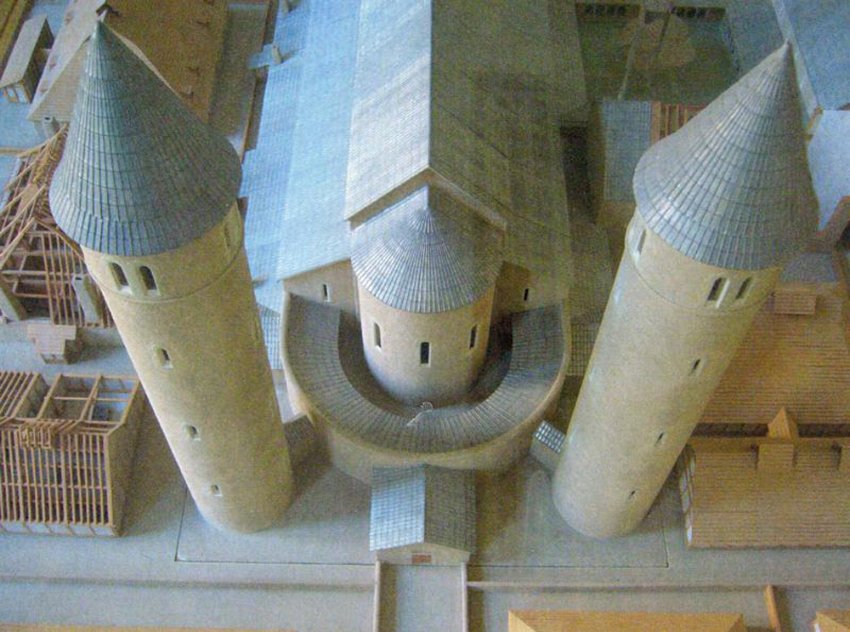
What did a medieval stonemason do when heavy rainfall interrupted his work? Umbrellas are impractical at construction sites. Gore-Tex jackets weren't yet invented, nor were plastic rain jackets. "He donned a jacket made of felted loden cloth," says Bert Geurten, the man who plans to build an authentic monastery town the old-fashioned way.

Felted loden jackets will also be present on rainy days at Geurten's building site, which is located near Messkirch, in the southwestern German state of Baden-Württemberg, between the Danube River and Lake Constance. Beginning in 2013, a Carolingian monastery town will be built here using only the materials and techniques of the 9th century. From the mortar to the walls, the rain jackets to the menu, every aspect of the operation will be carried out as just as it was in the days of Charlemagne. "We want to work as authentically as possible," says Geurten.

The building contractor from the Rhineland region has long dreamt of carrying out his plan. When he was a teenager, the now 62-year-old was inspired by a model of the St. Gallen monastery plan in an exhibition in his home city of Aachen. The plan, dating from the beginning of the 9th century, shows the ideal monastery, as envisioned by Abbot Haito of Reichenau.

Haito dedicated his drawing to his colleague Abbot Gozbert of St. Gall, who presided over the monastery from 816 to 837. He meticulously recorded everything that he believed was necessary for a monastic city, from a chicken coop to a church for 2,000 worshipers. Altogether he envisaged 52 buildings -- but they were never built. That will change in spring 2013, though, when ox-pulled carts wil begin carrying the first stones to the building site in the forest near Messkirch. It won't be finished until about 2050, according to estimates.

A Glimpse of the Middle Ages

The lengthy time frame betrays the ambitious dimensions of the project, which is not just a tourist attraction, but also a meticulous scientific undertaking. Twelve experts, including historians, architects and archaeologists, form the scientific council that oversees the monastic town. Their job is to advise the artisans while simultaneously learning from their experiences.

Such experiments offer a rare glimpse into the everyday life of past centuries. Often there is only one way to find out how people once built their homes, prepared their food or sewed their clothes -- by recreating the historic experience. Experimental archeology researchers have discovered that antique linen armor offers as much protection as kevlar vests, how beer was brewed in the Bronze Age and how Stone Age people sharpened blades.

The 9th century -- the era which will be recreated by the Carolingian monastery town project -- is a particularly interesting focus for such experiments. There are few surviving documents from the period some 1,100 to 1,200 years ago. "Our goal is not to end up having a monastery town, but to build it," says Geurten.

The first building will be a small wooden church. "Of course, in the Middle Ages, they didn't build the large stone church first," says Geurten. The craftsmen at that time did not want to postpone their prayers until the stone church was finished, so they constructed a simple wooden church as an interim arrangement until they could move into the magnificent stone building decades later.

Harsh Conditions

Carts carrying building materials will be pulled by Hinterwald cows. With a height of around 115 to 125 centimeters (3' 9" to 4' 1")and weighing between 172 and 218 kilograms (380 and 480 pounds), these working animals come the closest to those used during the time of Charlemagne. "They are descended from the Celts' cattle," says Geurten.

Not just workers will have to adjust to medieval conditions, though. The plan also includes a special experience for visitors, who will walk a lengthy distance from the parking lot before reaching the construction site. "They should feel like they journey in time and leave the present behind them," says Geurten. If they get hungry, the monastery town will have a 9th-century menu. "The potato was unknown," says Geurten. "And there will be no coffee around to drink." Everything that the tradesmen and visitors will eat will be grown in the soil near the construction site.

The example of the French castle Guédelon proves that visitors will not be deterred by such a strict approach. In Burgundy, builders are constructing the 13th-century castle with medieval techniques. Every year the site attracts hundreds of thousands of visitors. "A Guédelon visitors' survey has shown that people want to return on average every three years," explains Geurten. "They want to see the castle grow and follow its progress."
He hopes for similar success at his monastic town. The project has initial funding of around €1 million ($1.3 million) from city, state and European Union sources, but that will only sustain it for the first few years. After that, the project will have to fund itself.

A Flood of Volunteers

Given the tight budget, craftsmen salaries will remain low. "The net wage is about €1,200 (per month)," says Geurten. "I can't pay more." The working hours are also a long way from what German trade unions recommend these days. They will work from April 2 -- Charlemagne's birthday -- almost without break until St. Martin's Day, on Nov. 11. During those eight months, there will be one single weekend off. "In the Middle Ages, the rent for the year was always paid on St. Martin's Day," said Geurten. The winter break lasts until April when the temperatures are warm enough to work again.

Despite the difficult conditions, the project has been swamped with applications. "I've had 85 stone masons apply already," says Geurten. "They all dream of having the chance to work with their hands." This also applies to the blacksmith. "They won't be hammering kitschy horseshoes for tourists. The forge must supply the site with tools," he adds.

Overall, the construction site will have 20 to 30 permanent staff in addition to volunteers. There has already been a lot of interest. "From Lufthansa pilots to a teacher, all kinds of people have applied." One candidate even sent his application written in medieval German on a real roll of parchment. Meanwhile, schools will likely be allowed to join in with the site's work for as long as a week. "We are developing a plan that will enable the children to prepare for their experience in the classroom first," says Geurten.

It will take about 40 years until the final stone is laid in the monastery church. By then it is highly unlikely that Geurten will still be alive. But he doesn't mind. "I just want a founding father's tomb in the crypt. Then they could come and light candles for me," he says.
Here's a photo gallery.

Wednesday, March 28, 2012

In The Washington Post today:

When Jeremy Lin said he harbored no ill feelings over a racially insensitive headline about him that appeared on ESPN, he meant it.

Lin recently had lunch with the editor who was fired for writing the headline during the height of Linsanity with the New York Knicks in February. Anthony Federico apologized after the incident and Newsday’s Anthony Rieber reports that the meeting came at the instigation of the Asian-American point guard.

“The fact that he reached out to me,” Federico said. “The fact that he took the time to meet with me in his insanely busy schedule . . . He's just a wonderful, humble person. He didn't have to do that, especially after everything had kind of died down for the most part.”

Lin’s reaction at the time was low-key; he said there was no intent to offend. In addition to firing Federico, ESPN suspended anchor Max Bretos for 30 days for using the same expression. The matter wasn’t much of a topic at lunch.

“We talked more about matters of faith [and] reconciliation,” Federico said. “We talked about our shared Christian values and what we're both trying do with this situation .. . We didn't talk about the headline for more than three minutes.”

Representatives for the Knicks and Lin declined to comment on the lunch, which, in spite of Twitter and cellphones, remains private.

Tuesday, March 27, 2012

The first song on this video is a beautiful "Lazarus Saturday & Palm Sunday Troparion" - and it includes some interesting theology! ("By raising Lazarus from the dead before Thy passion, Thou didst confirm the universal resurrection, O Christ God!"). The singer is Vassilis Hadjinicolaou - he may also be the composer/arranger, I'm not sure - and this song is followed by two others: "Six days before the Feast of Passover" and "Behold the Bridegroom." They all come from a recording called "Holy Week."


Here's a page about this recording at Liturgica.com; here's the blurb there about it:

Holy Week is the fourth recording to appear under the general title Byzantine Music in the New World. It is an effort to place the Byzantine musical tradition of the Orthodox Church within an English-language context and it is directed mainly to English-speaking Christians around the world. The composer and performer, Vassilis Hadjinicolaou, is a talented musician who hails from Thessaloniki (Greece) and who resided for many years in Montreal (Canada). While there, he witnessed the great need amongst North American Orthodox for a Byzantine musical expression in their own language. This recording features selections from Holy Week (the week between Palm Sunday and Pascha or Easter) sung in traditional Byzantine melodies.

He's great, isn't he?

Here's a page from OCA.org about Lazarus Saturday and Palm Sunday, plus an excerpt:

The week following the Sunday of St Mary of Egypt is called Palm or Branch Week. At the Tuesday services of this week the Church recalls that Jesus’ friend Lazarus has died and that the Lord is going to raise him from the dead (Jn 11). As the days continue toward Saturday, the Church, in its hymns and verses, continues to follow Christ towards Bethany to the tomb of Lazarus. On Friday evening, the eve of the celebration of the Resurrection of Lazarus, the “great and saving forty days” of Great Lent are formally brought to an end:

Having accomplished the forty days for the benefit of our souls, we pray to Thee, O Lover of Man, that we may see the holy week of Thy passion, that in it we may glorify Thy greatness and Thine unspeakable plan of salvation for our sake. ...(Vesper Hymn)

Lazarus Saturday is a paschal celebration. It is the only time in the entire Church Year that the resurrectional service of Sunday is celebrated on another day. At the liturgy of Lazarus Saturday, the Church glorifies Christ as “the Resurrection and the Life” who, by raising Lazarus, has confirmed the universal resurrection of mankind even before his own suffering and death.

By raising Lazarus from the dead before Thy passion, Thou didst confirm the universal resurrection, O Christ God! Like the children with the branches of victory, we cry out to Thee, O Vanquisher of Death: Hosanna in the highest! Blessed is he that comes in the name of the Lord! (Troparion).

Christ —the Joy, the Truth and the Light of All, the Life of the world and its Resurrection—has appeared in his goodness to those on earth. He has become the Image of our Resurrection, granting divine forgiveness to all (Kontakion).

At the Divine Liturgy of Lazarus Saturday the baptismal verse from Galatians: As many as have been baptized into Christ have put on Christ (Gal 3:27) replaces the Thrice-holy Hymn thus indicating the resurrectional character of the celebration, and the fact that Lazarus Saturday was once among the few great baptismal days in the Orthodox Church Year. Because of the resurrection of Lazarus from the dead, Christ was hailed by the masses as the long-expected Messiah-King of Israel. Thus, in fulfillment of the prophecies of the Old Testament, he entered Jenrsalem, the City of the King, riding on the colt of an ass (Zech 9:9; Jn 12:12). The crowds greeted him with brancfies in their hands and called out to him with shouts of praise: Hosanna! Blessed is he who comes in the name of the Lord! The Son of David! The King of Israel! Because of this glorification by the people, the priests and scribes were finally driven “to destroy him, to put him to death” (Lk 19:47; Jn 11:53, 12:10).

The feast of Christ’s triumphal Entry into Jerusalem, Palm Sunday, is one of the twelve major feasts of the Church. The services of this Sunday follow directly from those of Lazarus Saturday.

Palm Sunday for the West is this Sunday, April 1 - but in the East it's on our Easter day, April 8.

Thursday, March 22, 2012

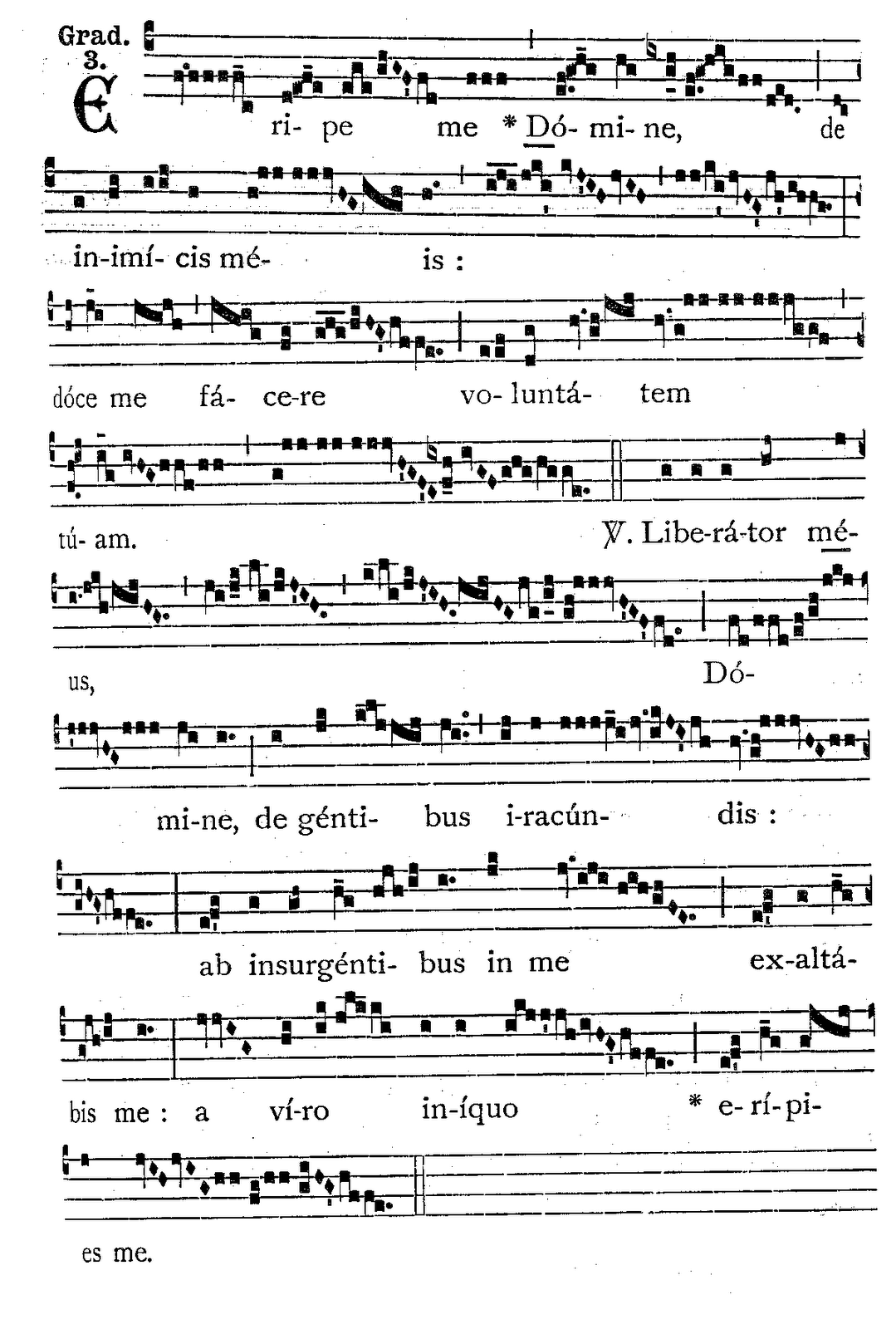
Here is an mp3 of Eripe Me from the website of the Brazilian Benedictines, along with the JoguesChant translation:

Rescue me, Lord, from my enemies; teach me to do your will. O Lord, you who save me from the wrath of the nations, you shall cause me to triumph over my assailants; you will save me from the man of evil.
The text for the Gradual is taken from Psalm 143:9-10 and from Psalm 18:48-49.

Here's the chant score:


And here's Saepe Expugnaverunt (mp3) from Jogues, along with their translation and chant score:

Often have they fought against me from my youth. Let Israel now say: Often have they fought against me from my youth. Yet, they have not prevailed against me: my back has become an anvil for the hammering of sinners. They have long oppressed me with their iniquities. But the Lord of justice will break the neck of sinners.

The text for the Tract comes from Psalm 129, verses 1-4, another of the "Songs of Ascents."  Verse 4 is translated "The Lord who is just will cut the necks of sinners" only in the Douay-Rheims version of this Psalm; the King James translates it this way:  "The LORD is righteous: he hath cut asunder the cords of the wicked," as do most other versions.  (The Good News Bible does it this way:  "But the Lord, the righteous one, has freed me from slavery," and some others also follow this line about "freeing slaves.")

Here's a polyphonic version of the two chants together, from Romanus Weichlein (1652-1706):


And here's Josef Rheinberger's Eripe Me; Rheinberger lived from 1839-1902:


Thursday, March 15, 2012

The Tract for Lent 4: Qui confidunt in Domino

Here's a (partial) mp3 of this chant from JoguesChant, with the Latin chant score and their English translation below:


Here's a video of the whole thing:


The YouTube blurb says this, in Portuguese:

Ensaio do coro Instituto Gregoriano de Lisboa, gentilmente cedido. Gratias Instituto Gregoriano Olissiponensi quarum voces audiuntur.

The text for this tract is taken from Psalm 125, another of the "Songs of Ascents."
Those who trust in the Lord are like Mount Zion; the inhabitants of Jerusalem shall never be shaken. As the mountains are round about Jerusalem, so the Lord is round about his people, from this time forth and for evermore.
Here's an explanation from Chabad.org about the "Songs of Ascents":
Question: Why do certain psalms begin with the words, "A song of ascents"? What sort of ascent is this referring to?

Answer: Fifteen psalms, chapters 120-134 of the Book of Psalms, begin with the words, "A song of ascents."

Many interpretations have been given for these ambiguous words. Here are a few of them:

a) In the Holy Temple courtyard, there was an ultra wide stairway that consisted of fifteen large, semi-circular steps that "ascended" into the inner section of the courtyard. The Levites, whose job it was to accompany the Temple service with song and instrumental music, would stand on these steps and sing these fifteen psalms.

b) These psalms were sung on a high "ascendant" musical note.

c) These psalms were sung starting in a low tone of voice and steadily ascending to a higher one.

d) These psalms were sung by the Jews who ascended from Babylon to Israel in the times of Ezra the Scribe.

e) These psalms were sung by the Jews when they would "ascend" to visit the Holy Temple three times annually for the festivals.

f) These psalms praise, exult and "elevate" G‑d.

g) The Talmud gives an aggadaic explanation:

"When King David was digging the Shitin [a stream that ran beneath the Holy Temple, into which the wine libations were poured], the water of the depths arose and threatened to flood the world. David said, 'Is there someone who knows whether it is permitted to write [G‑d's] name on an earthenware shard and we will throw it into the depths and it will subside?' . . . Ahitophel responded, 'It is permitted.' [David] wrote the name on earthenware and threw it into the depths. The depths receded 16,000 cubits. When he saw that it receded greatly, he said, 'The higher the depths, the moister is the ground [which benefits agriculture].' He said the fifteen [songs of] ascents, and the depths rose 15,000 cubits."

Rabbi Naftali Silberberg,
Chabad.org editorial team
And here's the Wikipedia entry for "Songs of Ascents".  That article points out about Eastern Christianity that:

In the Eastern Orthodox Church and those Eastern Catholic Churches which follow the Byzantine Rite, the Songs of Degrees (Greek: anabathmoi) make up the Eighteenth Kathisma (division of the Psalter), and are read on Friday evenings at Vespers throughout the liturgical year. The Kathisma is divided into three sections (called stases) of five psalms each.

During Great Lent the Eighteenth Kathisma is read every weekday (Monday through Friday evening) at Vespers, and on Monday through Wednesday of Holy Week. In the Slavic usage this Kathisma is also read from the apodosis of the Exaltation of the Cross up to the forefeast of the Nativity of Christ, and from the apodosis of Theophany up to the Sunday of the Prodigal Son. The reason for this is that the nights are longer in winter, especially in the northern latitudes, so during this season three Kathismas will be chanted at Matins instead of two, so in order to still have a reading from the Psalter at Vespers, the Eighteenth Kathisma is repeated.

In the West, the Tracts for the last three Sundays in Lent are all taken from the "Songs of Ascents," both now and in the past (via the "Extraordinary Form"). Also:

The Western Daily Office was strongly influenced by the Rule of St. Benedict, where these psalms are assigned to Terce, Sext and None on weekdays.


[EDIT: Derek points out via comments that:

The Songs of Ascent are also known as the gradual psalms in the West given the Latin translation of the title (canticum graduum). They became a standard part of the medieval prymers based on earlier early medieval monastic practice. Ardo's life of Benedict of Aniane tells how he had his monks chant the 15 gradual psalms before Matins, five for the living faithful, five for the faithful departed, five for the recently departed.

There was also a Marian connection here because in the apocryphal materials on Mary's early life she sang these psalms when she was dedicated to the Temple. So--in the West, these got tied into two of their favorite themes: Mary and the dead. ]

Here's another version of this Tract, sung by The Florida Schola Cantorum, at the Eglise de la Madeleine in Paris on March 29, 2011, it says.


And here is a polyphonic version from the late 16th or early 17th Century, with the YouTube description below:


Qui confidunt in Domino by Kryštof Harant z Polžic a Bezdružic [1564-1621] as performed by the Prague Chamber Choir in concert conducted by Jaroslav Brych.