RSS
Facebook
Twitter

Showing posts with label introits. Show all posts

Friday, February 1, 2013

Lætetur Cor ("Let their hearts rejoice") is used as the Introit for "the Fourth and Thirtieth Sunday of Ordinary Time" - which is interesting.  I'll have to look into the reasoning for this.
 

The text comes from Psalm (104/)105, verses 3-4, then verse 1.
Laetétur cor quaeréntium Dóminum: quaérite Dóminum, et confirmámini: quaérite fáciem ejus semper. Vs. Confitémini Dómino, et invocáte nomen ejus: annuntiáte inter gentes ópera ejus.

Let the hearts of those who seek the Lord rejoice; seek the Lord and be strengthened; seek his face for evermore. Vs. Give thanks to the Lord and call upon his name; declare his deeds among the gentiles.
Here again is the "universal" theme of Epiphanytide:  the imperative to "declare his deeds among the gentiles," presumably those who "seek his face" to be strengthened "for evermore."

Interestingly, this Psalm is cited as a song of thanks in 1 Chronicles 16, immediately after David had brought the Ark of the Covenant to Jerusalem, "dancing and celebrating":
1And they brought in the ark of God and set it inside the tent that David had pitched for it, and they offered burnt offerings and peace offerings before God. 2 And when David had finished offering the burnt offerings and the peace offerings, he blessed the people in the name of the Lord 3 and distributed to all Israel, both men and women, to each a loaf of bread, a portion of meat,[a] and a cake of raisins.
4 Then he appointed some of the Levites as ministers before the ark of the Lord, to invoke, to thank, and to praise the Lord, the God of Israel. 5 Asaph was the chief, and second to him were Zechariah, Jeiel, Shemiramoth, Jehiel, Mattithiah, Eliab, Benaiah, Obed-edom, and Jeiel, who were to play harps and lyres; Asaph was to sound the cymbals, 6 and Benaiah and Jahaziel the priests were to blow trumpets regularly before the ark of the covenant of God. 7 Then on that day David first appointed that thanksgiving be sung to the Lord by Asaph and his brothers.

David's Song of Thanks

8 Oh give thanks to the Lord; call upon his name;
    make known his deeds among the peoples!
9 Sing to him, sing praises to him;
    tell of all his wondrous works!
10 Glory in his holy name;
    let the hearts of those who seek the Lord rejoice!
11 Seek the Lord and his strength;
    seek his presence continually!
12 Remember the wondrous works that he has done,
    his miracles and the judgments he uttered,
13 O offspring of Israel his servant,
    children of Jacob, his chosen ones!
14 He is the Lord our God;
    his judgments are in all the earth.
15 Remember his covenant forever,
    the word that he commanded, for a thousand generations,
16 the covenant that he made with Abraham,
    his sworn promise to Isaac,
17 which he confirmed to Jacob as a statute,
    to Israel as an everlasting covenant,
18 saying, “To you I will give the land of Canaan,
    as your portion for an inheritance.”
19 When you were few in number,
    of little account, and sojourners in it,
20 wandering from nation to nation,
    from one kingdom to another people,
21 he allowed no one to oppress them;
    he rebuked kings on their account,
22 saying, “Touch not my anointed ones,
    do my prophets no harm!”
23 Sing to the Lord, all the earth!
    Tell of his salvation from day to day.
24 Declare his glory among the nations,
    his marvelous works among all the peoples!
25 For great is the Lord, and greatly to be praised,
    and he is to be feared above all gods.
26 For all the gods of the peoples are worthless idols,
    but the Lord made the heavens.
27 Splendor and majesty are before him;
    strength and joy are in his place.
28 Ascribe to the Lord, O families of the peoples,
    ascribe to the Lord glory and strength!
29 Ascribe to the Lord the glory due his name;
    bring an offering and come before him!
Worship the Lord in the splendor of holiness;[b]
30     tremble before him, all the earth;
    yes, the world is established; it shall never be moved.
31 Let the heavens be glad, and let the earth rejoice,
    and let them say among the nations, “The Lord reigns!”
32 Let the sea roar, and all that fills it;
    let the field exult, and everything in it!
33 Then shall the trees of the forest sing for joy
    before the Lord, for he comes to judge the earth.
34 Oh give thanks to the Lord, for he is good;
    for his steadfast love endures forever!
35 Say also:
“Save us, O God of our salvation,
    and gather and deliver us from among the nations,
that we may give thanks to your holy name
    and glory in your praise.
36 Blessed be the Lord, the God of Israel,
    from everlasting to everlasting!”
Then all the people said, “Amen!” and praised the Lord.

Worship Before the Ark

37 So David left Asaph and his brothers there before the ark of the covenant of the Lord to minister regularly before the ark as each day required, 38 and also Obed-edom and his[c] sixty-eight brothers, while Obed-edom, the son of Jeduthun, and Hosah were to be gatekeepers. 39 And he left Zadok the priest and his brothers the priests before the tabernacle of the Lord in the high place that was at Gibeon 40 to offer burnt offerings to the Lord on the altar of burnt offering regularly morning and evening, to do all that is written in the Law of the Lord that he commanded Israel. 41 With them were Heman and Jeduthun and the rest of those chosen and expressly named to give thanks to the Lord, for his steadfast love endures forever. 42 Heman and Jeduthun had trumpets and cymbals for the music and instruments for sacred song. The sons of Jeduthun were appointed to the gate.


Here's a PDF, via CCWatershed, of the Simple English propers for today - and here's a video of the Introit:


The Gospel for today picks up where last week's ended, at Luke 4:21-30:

In the synagogue at Nazareth, Jesus read from the book of the prophet Isaiah, and began to say, "Today this scripture has been fulfilled in your hearing." All spoke well of him and were amazed at the gracious words that came from his mouth. They said, "Is not this Joseph's son?" He said to them, "Doubtless you will quote to me this proverb, 'Doctor, cure yourself!' And you will say, 'Do here also in your hometown the things that we have heard you did at Capernaum.'" And he said, "Truly I tell you, no prophet is accepted in the prophet's hometown. But the truth is, there were many widows in Israel in the time of Elijah, when the heaven was shut up three years and six months, and there was a severe famine over all the land; yet Elijah was sent to none of them except to a widow at Zarephath in Sidon. There were also many lepers in Israel in the time of the prophet Elisha, and none of them was cleansed except Naaman the Syrian." When they heard this, all in the synagogue were filled with rage. They got up, drove him out of the town, and led him to the brow of the hill on which their town was built, so that they might hurl him off the cliff. But he passed through the midst of them and went on his way.
I never noticed that last part until recently!  Not sure exactly what's happening there;  impressive Jesus, or invisible Jesus?

The Collect for today is this one:
Almighty and everlasting God, you govern all things both in heaven and on earth: Mercifully hear the supplications of your people, and in our time grant us your peace; through Jesus Christ our Lord, who lives and reigns with you and the Holy Spirit, one God, for ever and ever. Amen.
Hatchett's Commentary says, about this Collect:
This collect is found in the Gregorian sacramentary among the daily prayers (no. 922), and in the supplement (no. 1099), as well as in previous editions of the Prayer Book, as the collect for the second Sunday after the Epiphany. The Sarum missal appoints it for the second Sunday after the octave of the Epiphany. Cranmer translated the petition "grant us thy peace all the days of our life," but this revision restores the original wording.

Remembering Hatchett's note on the collect two weeks back, that "many of the post-Epiphany collects ... [relate] to the Gospel of the day," it's interesting to note that this one doesn't appear to.  (I'm actually not sure if Hatchett was referring in that comment to all versions of the Prayer Book, or to the 1979 US Book in particular. That would be an interesting thing to look at, in fact.)

But this collect is where Neville Chamberlain picked up on "peace in our time," I'm fairly sure.

Remembering, too, the old numbering system for this season, here are some great notes about what's happening right now in the Great Church Year, from the website of St. Thomas Church Fifth Avenue:
The Gesima Sundays
The purpose of the three Gesima Sundays is to provide a transition from Christmastide to Lent.

On February 2, we celebrate Candlemas, the 40th and final day of Christmas, a season of the year which overlaps with Epiphanytide (still on-going through February 12, Shrove Tuesday). Over the course of the 40 days of Christmastide, we have the naming of Christ at his circumcision (The Feast of the Holy Name, always January 1), the visit of the Magi on the Feast of the Epiphany (always January 6) after the twelve days of Christmas, and then finally the presentation of Christ in the Temple (Candlemas, always February 2). Therefore, these forty days celebrate the early life of Jesus.

But there is another forty day period to come, called Lent. Beginning with Ash Wednesday, the church calendar switches over to its paschal cycle, which is determined not by fixed calendar dates (such as December 25, January 6 and February 2), but rather by the movable date of Easter, which the First Council of Nicaea in AD 325 established as the first Sunday after the full moon (the Paschal Full Moon) following the northern hemisphere's vernal equinox. The date of Easter can fall as early as March 22 or as late as April 25. That's quite a wide range.

So, there is a period of three Sundays in late Epiphanytide which transition us from Christmas to Lent in two ways:
  1. The three Gesima Sundays transition us from one calendar to the next. Quiquagesima Sunday is always the Sunday before Ash Wednesday and is always 50 days before Easter. (Quinquagesima means “fifty days”). Working backwards, Sexagesima is two Sundays before Ash Wednesday and Septuagesima is three Sundays before Ash Wednesday. It’s true that Sexagesima and Septuagesima are not exactly 60 and 70 days before Easter, but the Church nevertheless uses these terms to warn the faithful that Lent is coming soon. Since this year Easter falls on March 31, Ash Wednesday falls 40 days before (excluding Sundays, which don’t count) which is February 13. So that means Quinquagesima is Febraury 10, Sexagesima is February 3, and Septuagesima is January 27.
  2. The three Gesima Sundays also transition our attention away from Christ’s childhood (Christmas, Epiphany, etc) and towards an understanding of the fulfillment of his mission. Candelmas (February 2) occurred forty days after his birth and, as stated earlier, ends the Christmastide season. So, look at the assigned lessons for the morning services on Sunday, February 3, which is the day after Candlemas and the second of the three Gesima Sundays, and you’ll perceive the transition happening. The lessons are Jeremiah 1:4-10, 1 Corinthians 13:1-13, and Luke 4:21-30. In Jeremiah, the prophet, though just a child, is given his mission as a man. In Corinthians, we are exorted to put away our childish ways and to love one another as adults. In Luke, we hear of Jesus in his childhood hometown of Nazareth, speaking the truth and yet being rejected. His own townsfolk wanted to hold on to their understanding of him as a child. But he did not come into this world for that purpose.

Thursday, January 24, 2013

Wow, this is a beautiful introit, and here's a great rendering of it:


Here's a translation of the text, which comes from Psalm (96/)97, verses 7-8 and then verse 1; the chant score is below:
Worship God, all you angels: Sion has heard and is glad.  The Lord reigns, let the earth rejoice: let the many coastlands be glad.


Easter is very early this year - it's on March 31 - and this Sunday is already Septuagesima (the third Sunday before Ash Wednesday).   The Extraordinary Form uses a completely different set of propers for these last weeks before Lent begins; you can listen to the Introit for Septuagesima Sunday at that last link.

But I'm happy to highlight the modern Introit here - it's beautiful!  This is the Introit only for Year C, according to the Brazilian Benedictines. The Year C Gospel is Luke's story of Jesus' announcement in the synagogue that he himself is the fulfillment of Isaiah's prophecy:
Jesus, filled with the power of the Spirit, returned to Galilee, and a report about him spread through all the surrounding country. He began to teach in their synagogues and was praised by everyone.

When he came to Nazareth, where he had been brought up, he went to the synagogue on the sabbath day, as was his custom. He stood up to read, and the scroll of the prophet Isaiah was given to him. He unrolled the scroll and found the place where it was written:

"The Spirit of the Lord is upon me,
because he has anointed me
to bring good news to the poor.
He has sent me to proclaim release to the captives
and recovery of sight to the blind,
to let the oppressed go free,
to proclaim the year of the Lord's favor."

And he rolled up the scroll, gave it back to the attendant, and sat down. The eyes of all in the synagogue were fixed on him. Then he began to say to them, "Today this scripture has been fulfilled in your hearing."
This story comes immediately after Luke's version of Jesus' temptation in the wildnerness.

Years A and B actually have their own Introit: Dominus secus mare ("The Lord by the sea"), the text of which comes from Matthew. Here's that one, sung by the "Schola Antiqua (Juan Carlos Asensio Palacios)":


Dominus secus mare Galilææ vidit duos fratres,
Petrum et Andream, et vocavit eos:
Venite post me: faciam vos fieri piscatores hominum.

Coeli enarrant gloriam Dei:
et opera manuum ejus annuntiat firmamentum.


The Lord saw two brothers, Peter and Andrew, by the seaside of Galilee, and He called them; Come ye after Me, I will make you to be fishers of men.

The Heavens show forth the glory of God, and the firmament declareth the works of His hands .

Also very pretty.   The Gospel reading for Year A does contain the story from Matthew that makes up the first part of the Introit; the Year B Gospel is the same story from Mark.  I'm not sure, though, why some Sundays have alternating propers like this; something else to find out about, then.

The Collect for this week is this new one:
Give us grace, O Lord, to answer readily the call of our Savior Jesus Christ and proclaim to all people the Good News of his salvation, that we and the whole world may perceive the glory of his marvelous works; who lives and reigns with you and the Holy Spirit, one God, for ever and ever. Amen.
Hatchett's Commentary notes that the Collect  contains references to all three different Gospel readings for today:
The Rev. Dr. Massey H. Shepherd, Jr. drafted this collect which recalls phrases from the collect for the feast day of Saint Andrew, the story of whose calling by Christ is the Gospel of Years A and B.  The Gospel for Year C is the story of our Lord's sermon at Nazareth which is also echoed by the collect.  We pray that we may not only answer His call but also proclaim the Good News, and that "we and all the whole world may perceive the glory of his marvelous works."
Which does again echo Epiphany's "universal" theme.  Interestingly,  Hatchett notes on that same page that "many of the post-Epiphany collects ... [relate] to the Gospel of the day."  And that, too, is a way to drive home the "universal" theme - that the Gospel - the "manifestation" of Christ in his Incarnation - is for all the world.

As, of course, is the "many coastlines" of the Adorate Deum Introit itself.  I suppose, in fact, that the great theme in all three Gospels is that these are some of the opening notes of Christ's ministry.

Interestingly, the Gospel in the 1928 Book of Common Prayer (and also in the original 1662 BCP) told the stories of the healing of the leper, and the healing of the Centurion's servant, from Matthew 8.  (It was the same reading in the pre-1970 Roman Catholic Lectionary, too, according to this site - although the Septuagesima reading is Matthew 20:1-16, the parable of the workers in the vineyard.  One of these days I'm really going to try to compare and contrast some of the various lectionary systems to see what's been going on for the past 2,000 years!)

Here's a wonderful tempera with gold leaf of the calling of Peter and Andrew, from Duccio di Buoninsegna, from about 1310:

Friday, January 11, 2013

I'm very happy to post this terrific video of "the Choristers of St. Paul's Church Harvard Square" singing the Introit. They're really good!


The text for the Introit comes from Psalm (44/)45, verse 8 and then verse 2. Here's a translation from CPDL:
Thou lovest righteousness, and hatest wickedness: therefore God, thy God, hath anointed thee with the oil of gladness.

Here's the chant score:


Here's the full complement of today's propers, including links to chant scores and audio files, from the Brazilian Benedictines. 
In Baptismate Domini
Introitus: Ps. 44, 8 et 2 Dilexisti iustitiam (2m43.2s - 1117 kb) 
Ad aspersionem aquæ benedictæ (In dominicis extra tempus paschale): 
                                Ps. 50, 9 et 3 Asperges me (I) (1m31.0s - 623 kb) 
Graduale: Ps. 71, 18. V. 3 Benedictus Dominus (3m48.5s - 1563 kb) 

                         vel Ps. 44, 8 Dilexisti iustitiam (not yet available)
Alleluia: Ps. 117, 26 Benedictus qui venit (2m19.2s - 952 kb)

                      vel Ps. 88, 21 Inveni David servum meum (not yet available)
Offertorium: Ps. 117, 26.27 Benedictus qui venit (2m01.2s - 830 kb) 
Communio: Gal. 3, 27 Omnes qui in Christo baptizati estis (47.4s - 325 kb) 

I'm not sure why they are making a point to include the Asperges Me here; it seems to me to be no different from the usual "Outside of Paschal Time" sprinkling-of-water chant (and is labeled that way besides).  Perhaps the idea is that this is to be done on this particular day, even in parishes that don't ordinarily do the Asperges?   I guess I should check the rubrics (although I'm not sure how to do it for the Catholic Church!).

I'm also not sure why the score includes the "T.P. Alleluia alleluia"  measures (not sung here).  I'm assuming "T.P." is Tempus Paschale - Easter time, which explains the Alleluias;  to me this implies that this chant is used again during Easter season at some point.  I'll have to check that.

Psalm (44/)45 is a love song (the note to the choirmaster - not in the BCP version below - says "To the choirmaster: according to Lilies. A Maskil[a] of the Sons of Korah; a love song."), and one of my favorites; I especially always like that reference to "cloth-of-gold."
Psalm 45 Eructavit cor meum

1

My heart is stirring with a noble song;
let me recite what I have fashioned for the king; *
my tongue shall be the pen of a skilled writer.

2

You are the fairest of men; *
grace flows from your lips,
because God has blessed you for ever.

3

Strap your sword upon your thigh, O mighty warrior, *
in your pride and in your majesty.

4

Ride out and conquer in the cause of truth *
and for the sake of justice.

5

Your right hand will show you marvelous things; *
your arrows are very sharp, O mighty warrior.

6

The peoples are falling at your feet, *
and the king's enemies are losing heart.

7

Your throne, O God, endures for ever and ever, *
a scepter of righteousness is the scepter of your kingdom;
you love righteousness and hate iniquity.

8

Therefore God, your God, has anointed you *
with the oil of gladness above your fellows.

9

All your garments are fragrant with myrrh, aloes, and cassia, *
and the music of strings from ivory palaces makes you glad.

10

Kings' daughters stand among the ladies of the court; *
on your right hand is the queen,
adorned with the gold of Ophir.

11

"Hear, O daughter; consider and listen closely; *
forget your people and your father's house.

12

The king will have pleasure in your beauty; *
he is your master; therefore do him honor.

13

The people of Tyre are here with a gift; *
the rich among the people seek your favor."

14

All glorious is the princess as she enters; *
her gown is cloth-of-gold.

15

In embroidered apparel she is brought to the king; *
after her the bridesmaids follow in procession.

16

With joy and gladness they are brought, *
and enter into the palace of the king.

17

"In place of fathers, O king, you shall have sons; *
you shall make them princes over all the earth.

18

I will make your name to be remembered
from one generation to another; *
therefore nations will praise you for ever and ever."

Of course, the Gospel for today is Christ's baptism in the Jordan by John the Forerunner - this year from Luke:
3:15 As the people were filled with expectation, and all were questioning in their hearts concerning John, whether he might be the Messiah,

3:16 John answered all of them by saying, "I baptize you with water; but one who is more powerful than I is coming; I am not worthy to untie the thong of his sandals. He will baptize you with the Holy Spirit and fire.

3:17 His winnowing fork is in his hand, to clear his threshing floor and to gather the wheat into his granary; but the chaff he will burn with unquenchable fire."

3:21 Now when all the people were baptized, and when Jesus also had been baptized and was praying, the heaven was opened,

3:22 and the Holy Spirit descended upon him in bodily form like a dove. And a voice came from heaven, "You are my Son, the Beloved; with you I am well pleased."

Interesting, too, that the reading from Isaiah includes this verse:
43:2 When you pass through the waters, I will be with you; and through the rivers, they shall not overwhelm you; when you walk through fire you shall not be burned, and the flame shall not consume you.
It seems to me that what John says in Luke's gospel about fire and water may hearken back directly to Isaiah; will be looking at this.

This is the collect:
Father in heaven, who at the baptism of Jesus in the River Jordan proclaimed him your beloved Son and anointed him with the Holy Spirit: Grant that all who are baptized into his Name may keep the covenant they have made, and boldly confess him as Lord and Savior; who with you and the Holy Spirit lives and reigns, one God, in glory everlasting. Amen.

I couldn't find a Baptism image I liked, but here's a good one of John pointing out Christ to Andrew: "San giovanni che indica il Cristo a Sant'Andrea."  This is Ottavio Vannini, who painted it sometime in the first half of the 17th Century.  Dramatic - and a great John and Andrew.


Saturday, December 29, 2012

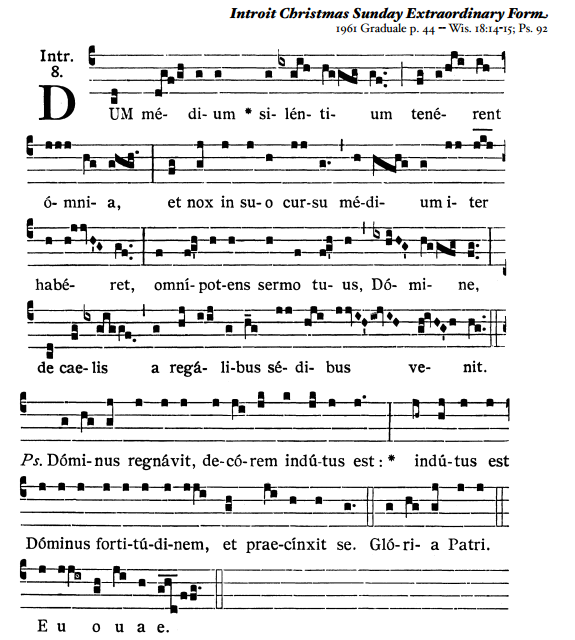
This Sunday's Introit for the Extraordinary Form is Dum Medium: "While a profound silence."  Here's an mp3 of the chant from  ReneGoupil, and below is the chant score from that site, with their English translation below that.  (The Ordinary Form seems to celebrate "Holy Family Sunday" - but I'm not quite sure about that one; the Brazilian Benedictines say it's on December 30, but I'm not clear whether that's a permanent feast day or whether they're referring to this Sunday only.  In any case, Anglicans don't celebrate that feast, so I'm going with the EF this time.)


While a profound silence enveloped all things, and night was in the midst of her course, your all-powerful Word, O Lord, leaped down from your royal throne.   The Lord reigns, he is enrobed with majesty; the Lord is clothed with strength, he has girded himself.

The first part of the introit comes from a beautiful and obscure text I'd never seen until a couple of years ago:  Wisdom 18:14-15.
14 For when peaceful stillness encompassed everything / and the night in its swift course was half spent,

15 Your all-powerful word from heaven’s royal throne / leapt into the doomed land,

Wisdom 18 recounts, once again, the salvation history of the people of Israel - and this section refers to the last of the 10 plagues when the Israelites were captives in Egypt.  Of course, this is a parallel to what's happening in the New Testament and in the Great Church Year- with a twist.   In Exodus, the people are freed from slavery when Pharoah, after the deaths of the Egyptian first-born, finally releases the Israelites from their bondage; here, the Holy Family is escaping into Egypt because Herod has ordered the death of all boys under the age of 2 years in Bethlehem.   (The Feast of the Holy Innocents was this past Wednesday.)

Psalm 92/93 provides the "He has girded himself with strength" portion of the Introit.
1 The LORD is King;
he has put on splendid apparel; *
the LORD has put on his apparel
and girded himself with strength.
2 He has made the whole world so sure *
that it cannot be moved;
3 Ever since the world began, your throne has been established; *
you are from everlasting.
4 The waters have lifted up, O LORD,
the waters have lifted up their voice; *
the waters have lifted up their pounding waves.
5 Mightier than the sound of many waters,
mightier than the breakers of the sea, *
mightier is the LORD who dwells on high.
6 Your testimonies are very sure, *
and holiness adorns your house, O LORD,
for ever and for evermore.

I'm not sure what sort of thing this is; it starts out using this text and then goes someplace else.  It's beautiful, though, so here it is - sung by "Ensemble Gilles Binchois, Dominique Vellard, dir. Le Chant des Cathédrales - Ecole de Notre Dame de Paris" :


And, wow!  The various lectionaries for this Sunday are really all over the place.  The RCL has three different readings for Years A, B, and C; the first is indeed the flight into Egypt - but the others are the Purification (i.e., Simeon and Anna in the temple), and Jesus' adventures as a boy in the temple.   The 1928 and 1662 BCPs both had Matthew's story of Jesus' birth; the 1979 BCP has the Prologue of John on this Sunday for every year (I like this last choice, myself),

Just for the sake of coherence with the chant proper, here's RCL-A: the flight into Egypt from Matthew 2:13-23:
2:13 Now after they had left, an angel of the Lord appeared to Joseph in a dream and said, "Get up, take the child and his mother, and flee to Egypt, and remain there until I tell you; for Herod is about to search for the child, to destroy him."

2:14 Then Joseph got up, took the child and his mother by night, and went to Egypt,

2:15 and remained there until the death of Herod. This was to fulfill what had been spoken by the Lord through the prophet, "Out of Egypt I have called my son."

2:16 When Herod saw that he had been tricked by the wise men, he was infuriated, and he sent and killed all the children in and around Bethlehem who were two years old or under, according to the time that he had learned from the wise men.

2:17 Then was fulfilled what had been spoken through the prophet Jeremiah:

2:18 "A voice was heard in Ramah, wailing and loud lamentation, Rachel weeping for her children; she refused to be consoled, because they are no more."

2:19 When Herod died, an angel of the Lord suddenly appeared in a dream to Joseph in Egypt and said,

2:20 "Get up, take the child and his mother, and go to the land of Israel, for those who were seeking the child's life are dead."

2:21 Then Joseph got up, took the child and his mother, and went to the land of Israel.

2:22 But when he heard that Archelaus was ruling over Judea in place of his father Herod, he was afraid to go there. And after being warned in a dream, he went away to the district of Galilee.

2:23 There he made his home in a town called Nazareth, so that what had been spoken through the prophets might be fulfilled, "He will be called a Nazorean."
Here's the Collect  (which sure seems to parallel the Prologue of John!):
Almighty God, you have poured upon us the new light of your incarnate Word: Grant that this light, enkindled in our hearts, may shine forth in our lives; through Jesus Christ our Lord, who lives and reigns with you, in the unity of the Holy Spirit, one God, now and for ever. Amen.
I don't have Hatchett's commentary on this, but here's a bit about the collect from Trinity Episcopal in Concord, MA:
The familiar theme in this Collect of “the new light that shines forth” was initially part of the Gregorian Sacramentary and later included in the Sarum Rite. It was eventually included in our 1928 BCP revision for the Second Sunday after Christmas. The late Massey Shepherd, who wrote the Commentary on the 1928 Prayer Book, felt that the Collect was more associated with the translation by the Rev. Arwell M.Y. Bayley that was included in his book, “A Century of Collects,” published in 1913. The Petition Clause in the original Latin could be translated as, “Grant that the light which through faith shines in the heart, may shine forth in our works,” thus picking up the relationship between faith and works. The juxtaposition of darkness and light has been with us from the beginning of creation as described in Genesis. The “new light” of Christ is particularly found in this Sunday’s reading from The Gospel of John, as well as our hymns, and our sermons, encouraging and inspiring us to go forth into the world to love and serve God.

Here's the flight into Egypt four ways.  In order:   Giotto (late C13/early C14); Joachim Beuckelaer (2nd half of C16); George Hitchcock (1892); and Henry Ossawa Tanner (1923).


Monday, December 24, 2012

Here's a really wonderful video of the Westminster Cathedral choir singing the introit at the 2009 Midnight Mass; the introit is far more affecting when seen in its liturgical setting.  It's truly majestic and even thrilling here, in a way that just doesn't come across when you listen to a studio recording of the chant.  They're a fantastic choir - and what a setting!


Here's the chant score:


The text is from Psalm 2: verse 7, then 1-2, then 8. The key part of verse 7 is: "The Lord said to me:  You are my son; this day have I begotten you." Here's the whole Psalm:
1  Why do the nations rage[a]
    and the peoples plot in vain?
2 The kings of the earth set themselves,
    and the rulers take counsel together,
    against the Lord and against his Anointed, saying,
3 “Let us burst their bonds apart
    and cast away their cords from us.”
4 He who sits in the heavens laughs;
    the Lord holds them in derision.
5 Then he will speak to them in his wrath,
    and terrify them in his fury, saying,
6 “As for me, I have set my King
    on Zion, my holy hill.”
7 I will tell of the decree: The Lord said to me, “You are my Son;
    today I have begotten you.
8 Ask of me, and I will make the nations your heritage,
    and the ends of the earth your possession.
9 You shall break[b] them with a rod of iron
    and dash them in pieces like a potter's vessel.”
10 Now therefore, O kings, be wise;
    be warned, O rulers of the earth.
11 Serve the Lord with fear,
    and rejoice with trembling.
12 Kiss the Son,
    lest he be angry, and you perish in the way,
    for his wrath is quickly kindled.  Blessed are all who take refuge in him.

Here's CCWatershed's video of the chant:


The Alleluia for Christmas Midnight is also Dominus Dixit Ad Me; here's a video.


Here's the score:


Here's another video of the Alleluia, labeled "Old Roman Chant."  Clearly not the same melody - but sort of the same "feel," with the long melismas:


There are three collects available for use at the Eucharists of Christmas:
O God, you make us glad by the yearly festival of the birth of your only Son Jesus Christ: Grant that we, who joyfully receive him as our Redeemer, may with sure confidence behold him when he comes to be our Judge; who lives and reigns with you and the Holy Spirit, one God, now and for ever. Amen.

or this


O God, you have caused this holy night to shine with the brightness of the true Light: Grant that we, who have known the mystery of that Light on earth, may also enjoy him perfectly in heaven; where with you and the Holy Spirit he lives and reigns, one God, in glory everlasting. Amen.

or this


Almighty God, you have given your only-begotten Son to take our nature upon him, and to be born [this day] of a pure virgin: Grant that we, who have been born again and made your children by adoption and grace, may daily be renewed by your Holy Spirit; through our Lord Jesus Christ, to whom with you and the same Spirit be honor and glory, now and for ever. Amen.
Obviously the second, by virtue of its topic, makes sense for use only at Midnight (or at the cockcrow mass, as below), but the others could  also be used then as well.    Hatchett's Commentary on the Prayer Book says this about these prayers:
The Nativity of Our Lord:  Christmas Day

The first of the collects for Christmas Day is in the Advent Masses of the Gelasian sacramentary (no. 1156) and in the Gregorian sacramentary (no. 33) and the sarum missal as a collect for the vigil Mass of Christmas.  It began, "God, who makes us glad with the annual expectation of our redemption."  Cranmer changed the opening and retained it for use "At the First Communion" on Christmas Day.  The 1552 revision dropped it, retaining only one proper for Christmas Day; in 1892 it was recovered when the 1549 provision was restored for optional use at the first service "if in any Church the Holy Communion be twice celebrated on Christmas-day."  The collect provides a good transition from Advent to the Christmas season.  

The second of the collects was appointed for the vigil in the Gelasian sacramentary (no. 5) and for the midnight stational Mass at St. Mary Major's in the Greogrian (no. 36).  The Sarum missal has it as the collect for the Mass at cockcrow.  Its content recalls the origin of the celebration of the Nativity at the December solstice as a rival festival to the pagan ceremonies of dies natalis Solis Invicti (the Birthday of the Unconquerable Sun).  This is the first Book of Common Prayer to include this collect.  

The third collect was composed for the 1549 Book for use "At the Second Communion."  The revisers in 1662 replaced "this day" with "as at this time."  The substance is closely related to the the new 1549 proper preface for Christmas Day and to the initial paragraph of the note on the second article of the Creed in The King's Book.  Among the ancient collects the one most closely related seems to be in the Gelasian sacramentary (no. 17), the initial collect for the Mass on Christmas Day, and in the gregorian a collect among "Other Prayers for the Birthday of the Lord" (no. 58).  There are also similar collects in several of the fifteenth and sixteenth century German breviaries.  In his Commentary Massey H. Shepherd, Jr. said of this collect:
...it is of all the Prayer Book collects the most notable for its theological content, for the whole of the doctrines of the Trinity and the Incarnation are encased in it.  Specifically, the Collect is woven about three themes:  (1) the birth of the Only-Begotten Son of God in the substance of our human nature is linked with the idea of our rebirth in Baptism by 'pure' water ... and the Holy Spirit;  (2) the eternal Sonship of CVhrist is contrasted with our adoption as sons by the free grace of God; and (3) the historic birth of our Lord at a specific time and place is spiritually renewed in the hearts of his followers daily...
BTW, the "Sol Invictus"/"pagan holiday" question is not necessarily settled, even though Hatchett seems pretty certain of it above; the setting of the date of Christmas probably antedates any such borrowing from pagan customs.  December 25 was already in use prior to Constantine; Christianity was often and widely (if sporadically, depending on the period) persecuted prior to that time.  That would mean that Christians would have been unlikely to try to imitate pagan festivals; why would they have tried to do such "market branding" to attract people to a persecuted sect?  In addition:  the early Church was often specifically concerned with differentiating Christianity from pagan sects.   This article provides a good discussion of the various problems - logical, historical, and otherwise - with the theory, as well as some thoughts about why December 25 was chosen; it may have everything to do with the date of Jesus' own death, in fact:
Around 200 C.E. Tertullian of Carthage reported the calculation that the 14th of Nisan (the day of the crucifixion according to the Gospel of John) in the year Jesus diedc was equivalent to March 25 in the Roman (solar) calendar.9 March 25 is, of course, nine months before December 25; it was later recognized as the Feast of the Annunciation—the commemoration of Jesus’ conception.10 Thus, Jesus was believed to have been conceived and crucified on the same day of the year. Exactly nine months later, Jesus was born, on December 25.d

This idea appears in an anonymous Christian treatise titled On Solstices and Equinoxes, which appears to come from fourth-century North Africa. The treatise states: “Therefore our Lord was conceived on the eighth of the kalends of April in the month of March [March 25], which is the day of the passion of the Lord and of his conception. For on that day he was conceived on the same he suffered.”11 Based on this, the treatise dates Jesus’ birth to the winter solstice.

 Augustine, too, was familiar with this association. In On the Trinity (c. 399–419)  he writes: “For he [Jesus] is believed to have been conceived on the 25th of March, upon which day also he suffered; so the womb of the Virgin, in which he was conceived, where no one of mortals was begotten, corresponds to the new grave in which he was buried, wherein was never man laid, neither before him nor since. But he was born, according to tradition, upon December the 25th.”

Other propers for Christmas Midnight are these:  

And you might like to listen to The Christmas Proclamation, Chanted - traditionally sung as the Midnight mass begins - as well.   A blessed Christmas to all.

Saturday, June 16, 2012

Here's an mp3 of the introit from JoguesChant, and this is how they translate the Latin:
Hearken, O Lord, unto my voice which has called out to you; deign to be my help, forsake me not, do not despise me, O God my Saviour. The Lord is my light and my salvation; whom shall I fear?

Here's the score:


Interestingly, the Benedictines of Brazil note that the text is taken from Psalm 27, verses 7-9 and then 1 - exactly as was the Introit for the Seventh Sunday of Easter, just a few weeks ago.  This one is slightly different, though; the Benedictines call the Easter 7 Introit Exaudi, Domine... tibi dixit, and they call this one Exaudi, Domine....adiutor, because the texts differ in their middle sections - but they are very much alike.

The whole thing is mysterious, to me! I'm trying to do some quick figuring, wondering why this happened - but I've come up with nothing so far. Easter 7 is the Sunday following the Ascension, and this one is the 3rd Sunday after Pentecost - and so?   Well, maybe something will come to me.

The traditional Introit for today was Respice in me, taken from Psalm 25, verses 16, 18, and then 1-2.  Here's the mp3 for that one, from ReneGoupil, and there chant score and translation below:


Look upon me and have mercy on me, O Lord; for I am abandoned and destitute; consider my abjection and my labour, and forgive me all my sins, my dear God. Unto you, O Lord, have I lifted up my soul; O my God, I trust in you; let me not be put to shame.

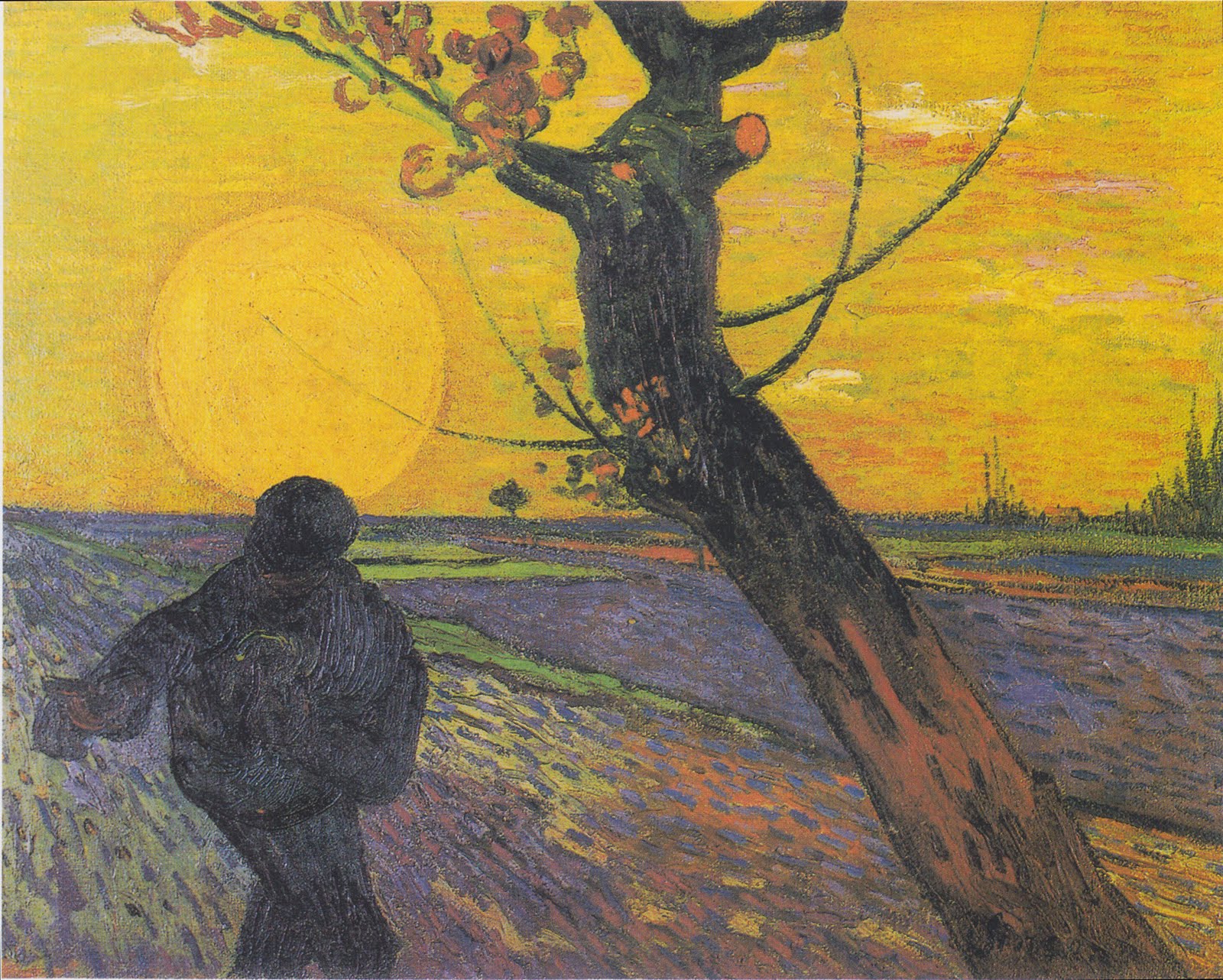
The RCL Gospel reading is Mark 4:26-34 - the parables of the scattered seed and the mustard seed:
Jesus said, "The kingdom of God is as if someone would scatter seed on the ground, and would sleep and rise night and day, and the seed would sprout and grow, he does not know how. The earth produces of itself, first the stalk, then the head, then the full grain in the head. But when the grain is ripe, at once he goes in with his sickle, because the harvest has come."

He also said, "With what can we compare the kingdom of God, or what parable will we use for it? It is like a mustard seed, which, when sown upon the ground, is the smallest of all the seeds on earth; yet when it is sown it grows up and becomes the greatest of all shrubs, and puts forth large branches, so that the birds of the air can make nests in its shade."

With many such parables he spoke the word to them, as they were able to hear it; he did not speak to them except in parables, but he explained everything in private to his disciples.

 Robert Farrar Capon writes, in "Kingdom, Grace, Judgment: Paradox, Outrage, and Vindication in the Parables of Jesus," about the parable of the growing seed:

First and foremost, [the parable] ties the imagery [of seed] expressly, within the parable itself, to the kingdom: "The kingdom of God," Jesus says, "is as if a man should cast seed upon the ground." Note the strength, even the extravagance, of the comparison: the kingdom is presented as the very thing sown. The kingdom is not the result of the sowing of something quite different from itself (in which it would be contained only virtually, as a plant is contained in a seed); rather, the kingdom as such is present, in all its power, right from the start. Moreover, by the very force of the imagery of sowing, the seed is clearly to be understood as having been sownin this world, squarely in the midst of every human and even every earthly condition.  This emphasis on the kingdom as a worldly, not just an otherworldly piece of business was already clear in the Sower; but Jesus' repetition of it here as well as later makes me want to underscore it.

....

The kingdom Jesus proclaims is at hand, planted here, at work in this world.  The Word sown is none other than God himself incarnate.  By his death and resurrection at Jerusalem in A.D. 29, he reconciles everything, everywhere, to himself - whether they be things on earth or things in heaven.  And at the end, when he makes all things new, he makes not just a new heaven but a new earth - a glorified re-creation of nothing less than his old stamping ground.  The Bible's last chapters proclaim a heaven and earth more inextricably intertwined than ever.  Whatever else the "New Jerusalem" may signify, it says plainly that the final "heaven" will be as earthy as the eschatological earth will be heavenly - and that that's the way it is going to be forever.

The (Episcopal Church) collect for today is this one:
Keep, O Lord, your household the Church in your steadfast faith and love, that through your grace we may proclaim your truth with boldness, and minister your justice with compassion; for the sake of our Savior Jesus Christ, who lives and reigns with you and the Holy Spirit, one God, now and for ever. Amen.
 Hatchett's Commentary says this:
This collect is new, but the preamble includes quotations from the collects for the fifth Sunday after the Epiphany, the second Sunday after Trinity, and the twenty-second Sunday after Trinity in earlier Prayer Books.  The prayer was drafted by the Rev. Dr. Massey H. Shepherd, Jr.  It portrays the church's misssion to the world - a ministry of proclamation of the gospel and of social concern and action.  In order that we may fulfill this mission we pray that the church might be kept in God's steadfast faith and love.


Saturday, June 9, 2012

Cibavit eos

Cibavit eos ("He fed them") is the Introit for The Solemnity of the Body and Blood of Christ (AKA Corpus Christi, which is celebrated variously on its day - June 7th, this year - or this Sunday, June 10). Here it is sung by the Schola Gregoriana Aurea Luce:


Here's a translation of this from JoguesChant; here's the mp3 from their site:

He fed them with the finest of wheat, alleluia; and with honey from the rock he satisfied them, alleluia, alleluia. Rejoice in honour of God our helper; shout for joy to the God of Jacob.

The text comes from Psalm 81; here's the score, from the Liber Usualis:


William Byrd set this Introit; the names of the singers are given at the start of the video, but otherwise there's no information about it:


Factus est Dominus protector meus


However, Corpus Christi is not feast day in the Episcopal Church; in fact, it's not on our calendar at all. This Sunday is simply the Second Sunday after Pentecost (and June 10 is the feast day of Ephrem the Syrian); interestingly, the Extraordinary Form presents it as the Second Sunday after Pentecost, noting that the day is optionally celebrated as the "External Solemnity of Corpus Christi" - and is "only an option if there is a procession."

The Introit for the Second Sunday after Pentecost is Factus est Dominus protector meus" ("The Lord has become my protector"). Here's a lovely mp3 recording, from Renegoupil, and below is the chant score and translation.


The Lord has become my protector; he has brought me forth into free and open spaces; he delivered me because he was well pleased with me. I will love you always, O Lord my strength; the Lord is my support, my refuge and my deliverer.

The text comes from Psalm 18. The introductory note to this Psalm reads "For the director of music. Of David the servant of the Lord. He sang to the Lord the words of this song when the Lord delivered him from the hand of all his enemies and from the hand of Saul."

Here's a helpful post titled "Learning to sing the Introit for 8th Sunday in Ordinary Time – Factus est Dominus" from the website of the St Mary Magdalen Choir, Brighton.

One interesting thing about this Introit is that it's also the Introit for the "Eighth Sunday in Ordinary Time" - which sometimes happens before Lent! So the chant propers for this Sunday are sometimes sung as part of the "Ordinary Time" that comes after the Feast of the Epiphany - and sometimes as part of the "Ordinary Time" that comes after the Feast of Pentecost. I think I'll go back and take a look at all of them, to see how that works out in practice!

Another interesting thing is that I find very few English translations of this Psalm that use the word "Protector" anywhere; most use other, much more interesting words: "my deliverer"; "my rock"; "my shield"; "the horn of my salvation"; "my stronghold." So I'll be interested to take a look at that as well.

The Collect for the Second Sunday after Pentecost (Proper 5) is this one:

O God, from whom all good proceeds: Grant that by your inspiration we may think those things that are right, and by your merciful guiding may do them; through Jesus Christ our Lord, who lives and reigns with you and the Holy Spirit, one God, for ever and ever. Amen.

Hatchett's Commentary says, about this collect, that:

Earlier Prayer Books and the Sarum missal appointed this collect for the fifth Sunday after Easter, but it has been replaced there with one more appropriate to the Easter season. The Gelasian sacramentary (no. 556) and the supplement to the Gregorian (no. 1123) both contain the collect for the fourth Sunday after the Easter octave. The opening of the petition, prior to this edition, read "Grant to us they humble servants, that by thy holy inspiration we may think those things that are good." The word "good" in this context was subject to misinterpretation; "right" restores the original Latin connotation.


Friday, December 9, 2011

Gaudete!

Rejoice!, that is. That's the name traditionally given to this Sunday, Advent 3 - named for the Introit on the day, Gaudete in Domino - "Rejoice in the Lord."

Here's the Gregorian chant version of the piece, sung by Cantori Gregoriani; very pretty:


Here's the Philippians 4:4-6 text it's based on:
Rejoice in the Lord always. I will say it again: Rejoice! Let your gentleness be evident to all. The Lord is near. Do not be anxious about anything, but in everything, by prayer and petition, with thanksgiving, present your requests to God.


And here, ladies and gents, is something really spectacular: Chanticleer, singing Henry Purcell's unbelievably gorgeous setting (also called "The Bell Anthem"). Zowie:


The English (Coverdale) words:
Rejoice in the Lord alway, and again I say, rejoice. Let your softness be known unto all men, the Lord is e'en at hand. Be careful for nothing: but in all prayer and supplication, let your petitions be manifest unto God with giving of thanks. And the peace of God, which passeth all understanding, keep your hearts and minds through Christ Jesu. Amen.

Wednesday, November 16, 2011

Although Anglicans do not officially celebrate the Feast of Christ the King this Sunday (on our Calendar, it's "The Last Sunday After Pentecost" or "Proper 29"), some of us do observe it anyway - and the Collect for the day is a Kingly one:
Almighty and everlasting God, whose will it is to restore all things in your well-beloved Son, the King of kings and Lord of lords: Mercifully grant that the peoples of the earth, divided and enslaved by sin, may be freed and brought together under his most gracious rule; who lives and reigns with you and the Holy Spirit, one God, now and for ever. Amen.
The Introit for the Day, Dignus Est Agnus, comes from Revelation 5:

Below is the score from JoguesChant and also their English translation:

The Lamb who has been slain is worthy to receive power, and divinity, and wisdom, and strength, and honour; let glory and dominion be his for ever and ever. Endow the King with your judgment, O God, and the King's son with your righteousness.


Handel set this text, too, of course, as the last movement (along with "Amen") of Messiah:

And just as in the oratorio, the Church Year ends on that note; you can just start Messiah over again next week, with Comfort ye my people.


This, though, is by far the most-known version of "Worthy is the Lamb" on YouTube:

I must say I quite like the refrain; it's powerful and the words are great. As much as I like chant - and I do - I'm very interested in songs like this that everybody can sing. The Chant Proper texts set to simple but powerful tunes for the whole congregation; that's a worthy goal, I think.

The Old Testament reading this week is from Ezekiel 34:11-16, 20-24:
34:11 For thus says the Lord GOD: I myself will search for my sheep, and will seek them out.

34:12 As shepherds seek out their flocks when they are among their scattered sheep, so I will seek out my sheep. I will rescue them from all the places to which they have been scattered on a day of clouds and thick darkness.

34:13 I will bring them out from the peoples and gather them from the countries, and will bring them into their own land; and I will feed them on the mountains of Israel, by the watercourses, and in all the inhabited parts of the land.

34:14 I will feed them with good pasture, and the mountain heights of Israel shall be their pasture; there they shall lie down in good grazing land, and they shall feed on rich pasture on the mountains of Israel.

34:15 I myself will be the shepherd of my sheep, and I will make them lie down, says the Lord GOD.

34:16 I will seek the lost, and I will bring back the strayed, and I will bind up the injured, and I will strengthen the weak, but the fat and the strong I will destroy. I will feed them with justice.

34:20 Therefore, thus says the Lord GOD to them: I myself will judge between the fat sheep and the lean sheep.

34:21 Because you pushed with flank and shoulder, and butted at all the weak animals with your horns until you scattered them far and wide,

34:22 I will save my flock, and they shall no longer be ravaged; and I will judge between sheep and sheep.

34:23 I will set up over them one shepherd, my servant David, and he shall feed them: he shall feed them and be their shepherd.

34:24 And I, the LORD, will be their God, and my servant David shall be prince among them; I, the LORD, have spoken.


Here's a page called "Homage to the Lamb" (c. 1000) from the (German) "Bamberg Apocalypse":


And here's something by an unknown German painter or painters: "Vision of St. John Evangelist" from c. 1450:


There are actually quite a few intricately (or colorfully!) illustrated Apocalypses out there; check 'em out.