RSS
Facebook
Twitter

Showing posts with label lectionary. Show all posts

Thursday, January 24, 2013

Wow, this is a beautiful introit, and here's a great rendering of it:


Here's a translation of the text, which comes from Psalm (96/)97, verses 7-8 and then verse 1; the chant score is below:
Worship God, all you angels: Sion has heard and is glad.  The Lord reigns, let the earth rejoice: let the many coastlands be glad.


Easter is very early this year - it's on March 31 - and this Sunday is already Septuagesima (the third Sunday before Ash Wednesday).   The Extraordinary Form uses a completely different set of propers for these last weeks before Lent begins; you can listen to the Introit for Septuagesima Sunday at that last link.

But I'm happy to highlight the modern Introit here - it's beautiful!  This is the Introit only for Year C, according to the Brazilian Benedictines. The Year C Gospel is Luke's story of Jesus' announcement in the synagogue that he himself is the fulfillment of Isaiah's prophecy:
Jesus, filled with the power of the Spirit, returned to Galilee, and a report about him spread through all the surrounding country. He began to teach in their synagogues and was praised by everyone.

When he came to Nazareth, where he had been brought up, he went to the synagogue on the sabbath day, as was his custom. He stood up to read, and the scroll of the prophet Isaiah was given to him. He unrolled the scroll and found the place where it was written:

"The Spirit of the Lord is upon me,
because he has anointed me
to bring good news to the poor.
He has sent me to proclaim release to the captives
and recovery of sight to the blind,
to let the oppressed go free,
to proclaim the year of the Lord's favor."

And he rolled up the scroll, gave it back to the attendant, and sat down. The eyes of all in the synagogue were fixed on him. Then he began to say to them, "Today this scripture has been fulfilled in your hearing."
This story comes immediately after Luke's version of Jesus' temptation in the wildnerness.

Years A and B actually have their own Introit: Dominus secus mare ("The Lord by the sea"), the text of which comes from Matthew. Here's that one, sung by the "Schola Antiqua (Juan Carlos Asensio Palacios)":


Dominus secus mare Galilææ vidit duos fratres,
Petrum et Andream, et vocavit eos:
Venite post me: faciam vos fieri piscatores hominum.

Coeli enarrant gloriam Dei:
et opera manuum ejus annuntiat firmamentum.


The Lord saw two brothers, Peter and Andrew, by the seaside of Galilee, and He called them; Come ye after Me, I will make you to be fishers of men.

The Heavens show forth the glory of God, and the firmament declareth the works of His hands .

Also very pretty.   The Gospel reading for Year A does contain the story from Matthew that makes up the first part of the Introit; the Year B Gospel is the same story from Mark.  I'm not sure, though, why some Sundays have alternating propers like this; something else to find out about, then.

The Collect for this week is this new one:
Give us grace, O Lord, to answer readily the call of our Savior Jesus Christ and proclaim to all people the Good News of his salvation, that we and the whole world may perceive the glory of his marvelous works; who lives and reigns with you and the Holy Spirit, one God, for ever and ever. Amen.
Hatchett's Commentary notes that the Collect  contains references to all three different Gospel readings for today:
The Rev. Dr. Massey H. Shepherd, Jr. drafted this collect which recalls phrases from the collect for the feast day of Saint Andrew, the story of whose calling by Christ is the Gospel of Years A and B.  The Gospel for Year C is the story of our Lord's sermon at Nazareth which is also echoed by the collect.  We pray that we may not only answer His call but also proclaim the Good News, and that "we and all the whole world may perceive the glory of his marvelous works."
Which does again echo Epiphany's "universal" theme.  Interestingly,  Hatchett notes on that same page that "many of the post-Epiphany collects ... [relate] to the Gospel of the day."  And that, too, is a way to drive home the "universal" theme - that the Gospel - the "manifestation" of Christ in his Incarnation - is for all the world.

As, of course, is the "many coastlines" of the Adorate Deum Introit itself.  I suppose, in fact, that the great theme in all three Gospels is that these are some of the opening notes of Christ's ministry.

Interestingly, the Gospel in the 1928 Book of Common Prayer (and also in the original 1662 BCP) told the stories of the healing of the leper, and the healing of the Centurion's servant, from Matthew 8.  (It was the same reading in the pre-1970 Roman Catholic Lectionary, too, according to this site - although the Septuagesima reading is Matthew 20:1-16, the parable of the workers in the vineyard.  One of these days I'm really going to try to compare and contrast some of the various lectionary systems to see what's been going on for the past 2,000 years!)

Here's a wonderful tempera with gold leaf of the calling of Peter and Andrew, from Duccio di Buoninsegna, from about 1310:

Saturday, December 29, 2012

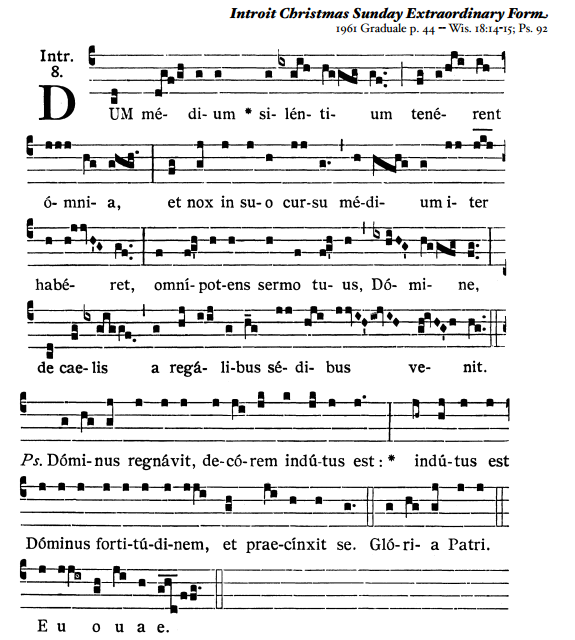
This Sunday's Introit for the Extraordinary Form is Dum Medium: "While a profound silence."  Here's an mp3 of the chant from  ReneGoupil, and below is the chant score from that site, with their English translation below that.  (The Ordinary Form seems to celebrate "Holy Family Sunday" - but I'm not quite sure about that one; the Brazilian Benedictines say it's on December 30, but I'm not clear whether that's a permanent feast day or whether they're referring to this Sunday only.  In any case, Anglicans don't celebrate that feast, so I'm going with the EF this time.)


While a profound silence enveloped all things, and night was in the midst of her course, your all-powerful Word, O Lord, leaped down from your royal throne.   The Lord reigns, he is enrobed with majesty; the Lord is clothed with strength, he has girded himself.

The first part of the introit comes from a beautiful and obscure text I'd never seen until a couple of years ago:  Wisdom 18:14-15.
14 For when peaceful stillness encompassed everything / and the night in its swift course was half spent,

15 Your all-powerful word from heaven’s royal throne / leapt into the doomed land,

Wisdom 18 recounts, once again, the salvation history of the people of Israel - and this section refers to the last of the 10 plagues when the Israelites were captives in Egypt.  Of course, this is a parallel to what's happening in the New Testament and in the Great Church Year- with a twist.   In Exodus, the people are freed from slavery when Pharoah, after the deaths of the Egyptian first-born, finally releases the Israelites from their bondage; here, the Holy Family is escaping into Egypt because Herod has ordered the death of all boys under the age of 2 years in Bethlehem.   (The Feast of the Holy Innocents was this past Wednesday.)

Psalm 92/93 provides the "He has girded himself with strength" portion of the Introit.
1 The LORD is King;
he has put on splendid apparel; *
the LORD has put on his apparel
and girded himself with strength.
2 He has made the whole world so sure *
that it cannot be moved;
3 Ever since the world began, your throne has been established; *
you are from everlasting.
4 The waters have lifted up, O LORD,
the waters have lifted up their voice; *
the waters have lifted up their pounding waves.
5 Mightier than the sound of many waters,
mightier than the breakers of the sea, *
mightier is the LORD who dwells on high.
6 Your testimonies are very sure, *
and holiness adorns your house, O LORD,
for ever and for evermore.

I'm not sure what sort of thing this is; it starts out using this text and then goes someplace else.  It's beautiful, though, so here it is - sung by "Ensemble Gilles Binchois, Dominique Vellard, dir. Le Chant des Cathédrales - Ecole de Notre Dame de Paris" :


And, wow!  The various lectionaries for this Sunday are really all over the place.  The RCL has three different readings for Years A, B, and C; the first is indeed the flight into Egypt - but the others are the Purification (i.e., Simeon and Anna in the temple), and Jesus' adventures as a boy in the temple.   The 1928 and 1662 BCPs both had Matthew's story of Jesus' birth; the 1979 BCP has the Prologue of John on this Sunday for every year (I like this last choice, myself),

Just for the sake of coherence with the chant proper, here's RCL-A: the flight into Egypt from Matthew 2:13-23:
2:13 Now after they had left, an angel of the Lord appeared to Joseph in a dream and said, "Get up, take the child and his mother, and flee to Egypt, and remain there until I tell you; for Herod is about to search for the child, to destroy him."

2:14 Then Joseph got up, took the child and his mother by night, and went to Egypt,

2:15 and remained there until the death of Herod. This was to fulfill what had been spoken by the Lord through the prophet, "Out of Egypt I have called my son."

2:16 When Herod saw that he had been tricked by the wise men, he was infuriated, and he sent and killed all the children in and around Bethlehem who were two years old or under, according to the time that he had learned from the wise men.

2:17 Then was fulfilled what had been spoken through the prophet Jeremiah:

2:18 "A voice was heard in Ramah, wailing and loud lamentation, Rachel weeping for her children; she refused to be consoled, because they are no more."

2:19 When Herod died, an angel of the Lord suddenly appeared in a dream to Joseph in Egypt and said,

2:20 "Get up, take the child and his mother, and go to the land of Israel, for those who were seeking the child's life are dead."

2:21 Then Joseph got up, took the child and his mother, and went to the land of Israel.

2:22 But when he heard that Archelaus was ruling over Judea in place of his father Herod, he was afraid to go there. And after being warned in a dream, he went away to the district of Galilee.

2:23 There he made his home in a town called Nazareth, so that what had been spoken through the prophets might be fulfilled, "He will be called a Nazorean."
Here's the Collect  (which sure seems to parallel the Prologue of John!):
Almighty God, you have poured upon us the new light of your incarnate Word: Grant that this light, enkindled in our hearts, may shine forth in our lives; through Jesus Christ our Lord, who lives and reigns with you, in the unity of the Holy Spirit, one God, now and for ever. Amen.
I don't have Hatchett's commentary on this, but here's a bit about the collect from Trinity Episcopal in Concord, MA:
The familiar theme in this Collect of “the new light that shines forth” was initially part of the Gregorian Sacramentary and later included in the Sarum Rite. It was eventually included in our 1928 BCP revision for the Second Sunday after Christmas. The late Massey Shepherd, who wrote the Commentary on the 1928 Prayer Book, felt that the Collect was more associated with the translation by the Rev. Arwell M.Y. Bayley that was included in his book, “A Century of Collects,” published in 1913. The Petition Clause in the original Latin could be translated as, “Grant that the light which through faith shines in the heart, may shine forth in our works,” thus picking up the relationship between faith and works. The juxtaposition of darkness and light has been with us from the beginning of creation as described in Genesis. The “new light” of Christ is particularly found in this Sunday’s reading from The Gospel of John, as well as our hymns, and our sermons, encouraging and inspiring us to go forth into the world to love and serve God.

Here's the flight into Egypt four ways.  In order:   Giotto (late C13/early C14); Joachim Beuckelaer (2nd half of C16); George Hitchcock (1892); and Henry Ossawa Tanner (1923).


Thursday, October 18, 2012

From the lectionary for today:

Ecclesiasticus 38:1-4,6-10,12-14

Honor physicians for their services,
for the Lord created them;
for their gift of healing comes from the Most High,
and they are rewarded by the king.
The skill of physicians makes them distinguished,
and in the presence of the great they are admired.
The Lord created medicines out of the earth,
and the sensible will not despise them.
And he gave skill to human beings
that he might be glorified in his marvelous works.
By them the physician heals and takes away pain;
the pharmacist makes a mixture from them.
God's works will never be finished;
and from him health spreads over all the earth.
My child, when you are ill, do not delay,
but pray to the Lord, and he will heal you.
Give up your faults and direct your hands rightly,
and cleanse your heart from all sin.
Then give the physician his place, for the Lord created him;
do not let him leave you, for you need him.
There may come a time when recovery lies in the hands of physicians,
for they too pray to the Lord
that he grant them success in diagnosis
and in healing, for the sake of preserving life.

Saturday, December 3, 2011

Vigilate (Byrd)

Vigilate - The King's Singers - YouTube


The text is from this year's Gospel reading for Advent 1, Mark 13: 35-37. A beautiful rendition.

Vigilate,
nescitis enim quando dominus domus veniat,
sero, an media nocte, an gallicantu, an mane.
Vigilate ergo,
ne cum venerit repente, inveniat vos dormientes.
Quod autem dico vobis,
omnibus dico: vigilate.


Watch ye therefore
(for you know not when the lord of the house cometh,
at even, or at midnight, or at the cock crowing, or in the morning):
Watch therefore,
lest coming on a sudden, he find you sleeping.
And what I say to you,
I say to all: Watch.

Friday, May 20, 2011

The text for this Introit comes from Psalm 98, verses 1-2; here's an mp3 from JoguesChant, and their translation:
Sing to the Lord a new song, alleluia; for the Lord has accomplished wondrous deeds, alleluia; he has revealed his justice in the sight of the Gentiles, alleluia, alleluia. His right hand and his holy arm have given him victory.

Here's the Liber Usualis chant score:


The Gospel reading for today is from John 14:1-14:

Jesus said, "Do not let your hearts be troubled. Believe in God, believe also in me. In my Father's house there are many dwelling places. If it were not so, would I have told you that I go to prepare a place for you? And if I go and prepare a place for you, I will come again and will take you to myself, so that where I am, there you may be also. And you know the way to the place where I am going." Thomas said to him, "Lord, we do not know where you are going. How can we know the way?" Jesus said to him, "I am the way, and the truth, and the life. No one comes to the Father except through me. If you know me, you will know my Father also. From now on you do know him and have seen him."

Philip said to him, "Lord, show us the Father, and we will be satisfied." Jesus said to him, "Have I been with you all this time, Philip, and you still do not know me? Whoever has seen me has seen the Father. How can you say, `Show us the Father'? Do you not believe that I am in the Father and the Father is in me? The words that I say to you I do not speak on my own; but the Father who dwells in me does his works. Believe me that I am in the Father and the Father is in me; but if you do not, then believe me because of the works themselves. Very truly, I tell you, the one who believes in me will also do the works that I do and, in fact, will do greater works than these, because I am going to the Father. I will do whatever you ask in my name, so that the Father may be glorified in the Son. If in my name you ask me for anything, I will do it."

Stephen Gerth, the rector of St. Mary the Virgin in Times Sq., was just writing about the extended readings from John during the Sundays after Easter in the new RCL Lectionary. While he has criticisms of other aspects of the new Lectionary, he praises it for this and for several other things:
I think it matters that for 1500 years no ordinary Sunday congregation in the West ever heard the accounts of Jesus and the Samaritan Woman at the Well (John 4:5-42), the Healing of the Man Born Blind (John 9:1-38), or the Raising of Lazarus (John 11:1-44). Even now, they are appointed for use only once every three years. And let me give recognition to this good thing in the new lectionary: there is no longer permission to shorten these lessons. I certainly appreciate the real pastoral need for Sunday services to be a manageable length. But there are some things that can’t be shortened. (Interestingly, the permission to shorten the gospels for the Sunday of the Passion was retained, but the permission to shorten the passion on Good Friday is also gone.)

I’m thinking about all of this because I realized a couple of weeks ago that the lectionary of the 1979 Prayer Book (and the new lectionary) has us reading on the Fifth, Sixth and Seventh Sundays of Easter, in every year, from John’s account of the supper before the Passover – the longest passage in any of the gospels. In the old Prayer Book, we had a passage from this part of John on Pentecost and a moving passage (John 16:16-22) on a Sunday after Easter Day about the joy that will be with his disciples after their sorrow. Now, many more riches of this account will be read and preached every year.

This is the Collect for this day:
Almighty God, whom truly to know is everlasting life: Grant us so perfectly to know your Son Jesus Christ to be the way, the truth, and the life, that we may steadfastly follow his steps in the way that leads to eternal life; through Jesus Christ your Son our Lord, who lives and reigns with you, in the unity of the Holy Spirit, one God, for ever and ever. Amen.

Hatchett's Commentary says, about this collect, that:
This is a revision of a collect formerly appointed for the feast day of Saint Philip and Saint James. It was composed for the 1549 Book and the result clause added in 1662. It has a particular allusion to the Gospel for Year A but is appropriate for readings of the other years as well. The prayer is that we may know Christ who is truth and follow Him who is the way that we may be led to Him who is the source of eternal life.

I'm sorry to say that I can't resist posting this beautiful Hassler Cantate Domino, even though the text comes from that other Psalm:


And as long as I'm going there, why not post the Monteverdi version, too, sung by those amazing BYU singers?  (This one does include bits of Psalm 98.)


As always, I can't resist Arvo Part, either:


And at that point, how can I leave out the Taize chant?


To go along with the Gospel reading - part of the discourse at the Last Supper from John - here's a fresco by Domenico Ghirlandaio, (400 x 880 cm) at Ognissanti (All Saints), Florence (where, BTW, Sandro Botticelli is buried):


Saturday, December 25, 2010

Händel: For unto us a child is born


This one's directly out of the lectionary this morning, which I was privileged to read:
Isaiah 9:2-7

The people who walked in darkness
have seen a great light;
those who lived in a land of deep darkness--
on them light has shined.
You have multiplied the nation,
you have increased its joy;
they rejoice before you
as with joy at the harvest,
as people exult when dividing plunder.
For the yoke of their burden,
and the bar across their shoulders,
the rod of their oppressor,
you have broken as on the day of Midian.
For all the boots of the tramping warriors
and all the garments rolled in blood
shall be burned as fuel for the fire.
For a child has been born for us,
a son given to us;
authority rests upon his shoulders;
and he is named
Wonderful Counselor, Mighty God,
Everlasting Father, Prince of Peace.
His authority shall grow continually,
and there shall be endless peace
for the throne of David and his kingdom.
He will establish and uphold it
with justice and with righteousness
from this time onward and forevermore.
The zeal of the LORD of hosts will do this.