RSS
Facebook
Twitter

Showing posts with label parables. Show all posts

Thursday, May 16, 2013

A great post from catholicity and covenant today.  He's referring to the Church of Ireland here, but TEC has the same Daily Office reading today.  Sometimes Augustine's allegorical readings get on my nerves - but this one is fantastic!  
Today the CofI daily office lectionary NT reading for MP was the parable of the Good Samaritan.  It is appropriate, therefore, to revisit Augustine's Christological reading of the Good Samaritan, reminding us that the parable - rather than being a moralistic addendum - coheres with and flows from the Church's proclamation of the Cross and Resurrection:

A certain man went down from Jerusalem to Jericho; Adam himself is meant; Jerusalem is the heavenly city of peace, from whose blessedness Adam fell; Jericho means the moon, and signifies our mortality, because it is born, waxes, wanes, an dies. Thieves are the devil and his angels. Who stripped him, namely; of his immortality; and beat him, by persuading him to sin; and left him half-dead, because in so far as man can understand and know God, he lives, but in so far as he is wasted and oppressed by sin, he is dead; he is therefore called half-dead. The priest and the Levite who saw him and passed by, signify the priesthood and ministry of the Old Testament which could profit nothing for salvation. Samaritan means Guardian, and therefore the Lord Himself is signified by this name. The binding of the wounds is the restraint of sin. Oil is the comfort of good hope; wine the exhortation to work with fervent spirit. The beast is the flesh in which He deigned to come to us. The being set upon the beast is belief in the incarnation of Christ. The inn is the Church, where travelers returning to their heavenly country are refreshed after pilgrimage. The morrow is after the resurrection of the Lord. The two pence are either the two precepts of love, or the promise of this life and of that which is to come.

Sunday, March 10, 2013

"For Those in the Distant Country"

Here's a really lovely piece from the blog "Interrupting the Silence"; it's a sermon on today's Gospel reading, the parable of the Prodigal Son (Luke 15:11-32).

Detail of Rembrandt’s Return of the Prodigal Son (source)
When I was in the first grade I gathered my stuff and took off for the distant country. I ran away from home. Fortunately, it was a quick trip and I was back in time for supper. In the years since then my trips to the distant country haven’t been nearly as short or uneventful. There have been casualties and losses along the way. People were hurt. Sometimes it was me, sometimes it was others. The distant country always disappointed. It didn’t give me the life I was looking for. It didn’t make me the person I wanted to be. It left me feeling lonely, empty, and lost.

There are a thousand different routes to the distant country: sorrow and loss, sin and guilt, failure and regret, the sheer difficulty of life, to name just a few. More often than not our journey to the distant country is an attempt to run away from home, ourselves, and our lives. The distant country convinces us that the life we want and the person we want to become cannot be found within ourselves. It denies that the kingdom of God is within and creates the illusion that if we can just get to a new place, a new time, a new circumstance everything will be better.

Most of us, I suspect, will at some point in our lives buy in to that illusion. We will gather our stuff and travel to the distant country. The life we want and the person we want to become, however, are found not in the distant country but through repentance. The distant country, as the younger son experienced, offers nothing but starvation and death. That’s why last week Jesus was so intense and direct in his call for us to repent. He seems to know that it’s not a matter of whether we will go to the distant country. Chances are we will. The real question is whether we will repent.

Repentance, the journey home, requires an honest appraisal of our life. We must look at who we are and who we are not, what we have done and what we have left undone, as well as the circumstances that we allow to deny us the fullness of life. Repentance is about more than right behavior and being good. Yes, sometimes we do bad things that we just need to stop doing but often we need to repent and turn away from the failures, guilt, or regrets that bind us to the past, the sorrows and losses that keep us from being fully alive, or the fears that control our lives and keep our world small.

Repentance is the choice to no longer run away from ourselves or our lives. Yet, how can we ever go home knowing what we know about ourselves, having squandered the life given us, and having spent time in the pig pens of the distant country? Surely, that was the younger son’s question when he finally “came to himself.” It was also Bob’s question.

Bob was probably in his late 70s. He had been quiet and attentive throughout the evening as I taught about the parable of the prodigal son (Luke 15:11-32). When I finished speaking Bob was the first one out of his chair. I could tell, as he made his way to the front of the classroom, that he was upset. “What about the bath,” he demanded. “You didn’t say anything about the bath.” I told him I had no idea what he was talking about. That only upset him more. “You know where that kid had been!” “Yes,” I said, “in the pig pen.” “And you know what he would have smelled like and what was on him.” “Pig poop,” I said kiddingly. Bob did not think that was funny. Then he went on to explain. “The son was dirty and smelly. The father would never hug him, kiss him, or put a robe on him until the son first had a bath. Why didn’t you talk about the bath?”

I told him that a bath was not part of the story, that we can never get clean enough to go home. Instead, we go home to become clean. The father receives the son as he is. He hugs him, kisses him, robes him – all without a bath. The son is immersed and washed in the Father’s love.

Bob just could not believe that, so together we read the story again. When we got to the end of the story his eyes filled with tears and he said, “All my life I thought this story said the son had to take a bath before he could go home.” I said to him, “And all your life you’ve been trying to get clean enough to go home.” He simply nodded in silence, tears running down his face.

For all the years he spent in the distant country Bob never did get clean enough to go home. Instead, “he came to himself.” He started gathering the fragments of his life, the clean and the unclean, the acceptable and the unacceptable, things done and things left undone, all that he was and all that he had. He recognized that the unclean and unacceptable parts of his life were real, but they did not have to be his final reality. In the past those parts of his life kept him from going home and exiled him to the pig pens. Now those pieces of his life would become the way home. They would become places of healing, new life, wholeness, forgiveness, love, and grace.

I don’t know what took Bob to that distant country or what he so desperately tried to wash away but I know that his story is my story and your story. We too have been to the distant country. We too have lived with the pigs. We too have washed but cannot get clean. In coming to himself Bob would ultimately have to trust the Father’s love more than he trusted the pig stink. So must you and I. After all, the Father does.
+
This sermon is for the Fourth Sunday in Lent, Year C. It is based on the Parable of the Prodigal Son, Luke 15:1-3, 11-32.

Saturday, June 16, 2012

Here's an mp3 of the introit from JoguesChant, and this is how they translate the Latin:
Hearken, O Lord, unto my voice which has called out to you; deign to be my help, forsake me not, do not despise me, O God my Saviour. The Lord is my light and my salvation; whom shall I fear?

Here's the score:


Interestingly, the Benedictines of Brazil note that the text is taken from Psalm 27, verses 7-9 and then 1 - exactly as was the Introit for the Seventh Sunday of Easter, just a few weeks ago.  This one is slightly different, though; the Benedictines call the Easter 7 Introit Exaudi, Domine... tibi dixit, and they call this one Exaudi, Domine....adiutor, because the texts differ in their middle sections - but they are very much alike.

The whole thing is mysterious, to me! I'm trying to do some quick figuring, wondering why this happened - but I've come up with nothing so far. Easter 7 is the Sunday following the Ascension, and this one is the 3rd Sunday after Pentecost - and so?   Well, maybe something will come to me.

The traditional Introit for today was Respice in me, taken from Psalm 25, verses 16, 18, and then 1-2.  Here's the mp3 for that one, from ReneGoupil, and there chant score and translation below:


Look upon me and have mercy on me, O Lord; for I am abandoned and destitute; consider my abjection and my labour, and forgive me all my sins, my dear God. Unto you, O Lord, have I lifted up my soul; O my God, I trust in you; let me not be put to shame.

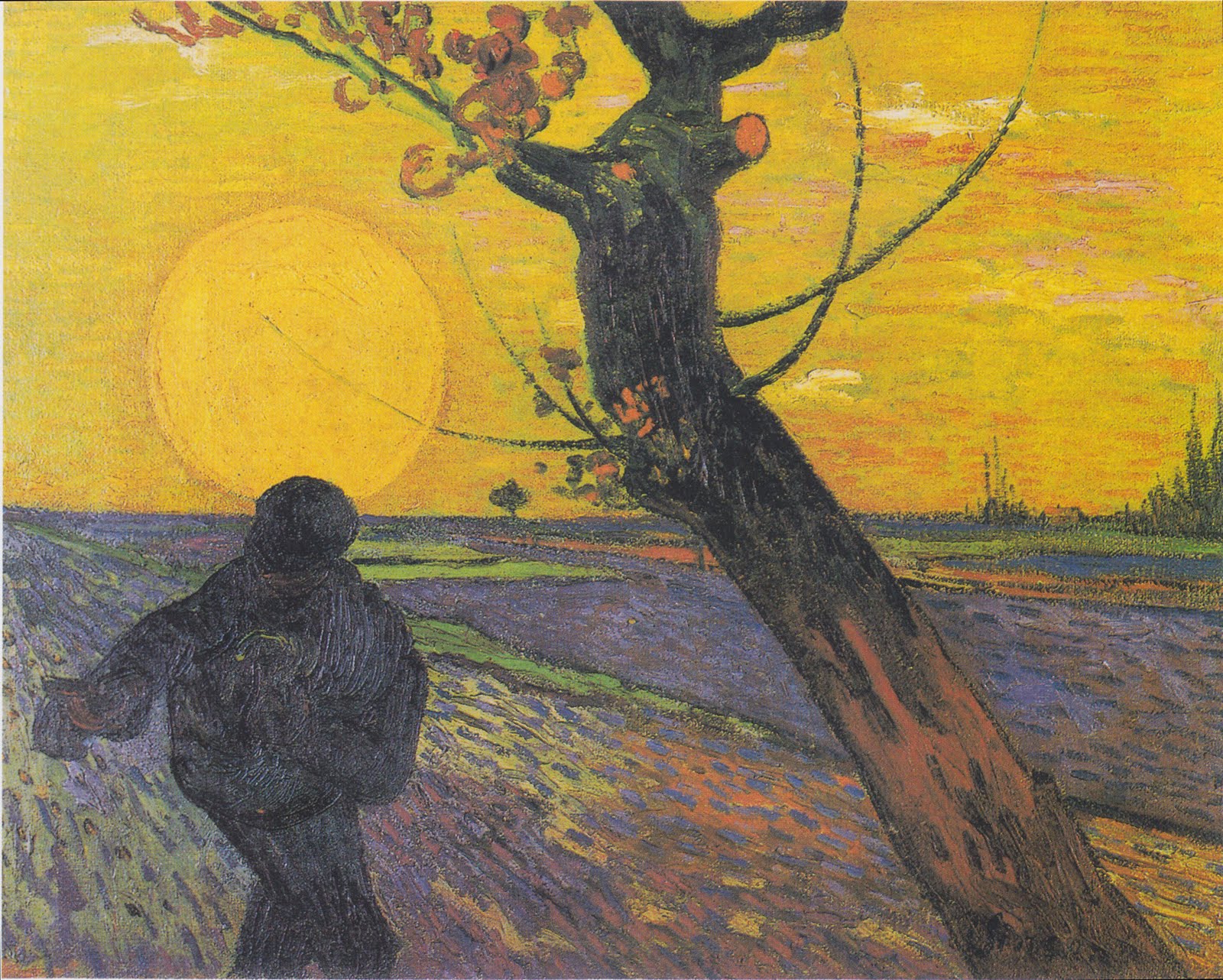
The RCL Gospel reading is Mark 4:26-34 - the parables of the scattered seed and the mustard seed:
Jesus said, "The kingdom of God is as if someone would scatter seed on the ground, and would sleep and rise night and day, and the seed would sprout and grow, he does not know how. The earth produces of itself, first the stalk, then the head, then the full grain in the head. But when the grain is ripe, at once he goes in with his sickle, because the harvest has come."

He also said, "With what can we compare the kingdom of God, or what parable will we use for it? It is like a mustard seed, which, when sown upon the ground, is the smallest of all the seeds on earth; yet when it is sown it grows up and becomes the greatest of all shrubs, and puts forth large branches, so that the birds of the air can make nests in its shade."

With many such parables he spoke the word to them, as they were able to hear it; he did not speak to them except in parables, but he explained everything in private to his disciples.

 Robert Farrar Capon writes, in "Kingdom, Grace, Judgment: Paradox, Outrage, and Vindication in the Parables of Jesus," about the parable of the growing seed:

First and foremost, [the parable] ties the imagery [of seed] expressly, within the parable itself, to the kingdom: "The kingdom of God," Jesus says, "is as if a man should cast seed upon the ground." Note the strength, even the extravagance, of the comparison: the kingdom is presented as the very thing sown. The kingdom is not the result of the sowing of something quite different from itself (in which it would be contained only virtually, as a plant is contained in a seed); rather, the kingdom as such is present, in all its power, right from the start. Moreover, by the very force of the imagery of sowing, the seed is clearly to be understood as having been sownin this world, squarely in the midst of every human and even every earthly condition.  This emphasis on the kingdom as a worldly, not just an otherworldly piece of business was already clear in the Sower; but Jesus' repetition of it here as well as later makes me want to underscore it.

....

The kingdom Jesus proclaims is at hand, planted here, at work in this world.  The Word sown is none other than God himself incarnate.  By his death and resurrection at Jerusalem in A.D. 29, he reconciles everything, everywhere, to himself - whether they be things on earth or things in heaven.  And at the end, when he makes all things new, he makes not just a new heaven but a new earth - a glorified re-creation of nothing less than his old stamping ground.  The Bible's last chapters proclaim a heaven and earth more inextricably intertwined than ever.  Whatever else the "New Jerusalem" may signify, it says plainly that the final "heaven" will be as earthy as the eschatological earth will be heavenly - and that that's the way it is going to be forever.

The (Episcopal Church) collect for today is this one:
Keep, O Lord, your household the Church in your steadfast faith and love, that through your grace we may proclaim your truth with boldness, and minister your justice with compassion; for the sake of our Savior Jesus Christ, who lives and reigns with you and the Holy Spirit, one God, now and for ever. Amen.
 Hatchett's Commentary says this:
This collect is new, but the preamble includes quotations from the collects for the fifth Sunday after the Epiphany, the second Sunday after Trinity, and the twenty-second Sunday after Trinity in earlier Prayer Books.  The prayer was drafted by the Rev. Dr. Massey H. Shepherd, Jr.  It portrays the church's misssion to the world - a ministry of proclamation of the gospel and of social concern and action.  In order that we may fulfill this mission we pray that the church might be kept in God's steadfast faith and love.