RSS
Facebook
Twitter

Friday, March 11, 2011


Text taken from Psalm 102, Verse 1 (the Coverdale Psalter), and composed around 1681:
Hear my prayer, O LORD, and let my crying come unto thee.

From a UC Riverside Purcell concert bulletin:
Purcell's full anthem, Hear My Prayer, O Lord, was most likely composed for the Chapel Royal and set for SSAATTBB and continuo. The work is one of nearly 70 anthems and services that Purcell composed from 1679 until his early death in 1695. Hear My Prayer, O Lord is the opening fragment of a never completed work. The thirty-four-measure fragment survives in a single MS (manuscript) in the Fitzwilliam Museum, Cambridge, England. The fragment is in the composer's own hand and contains supplementary ruled pages in preparation for additional music. Purcell sets but two lines of the Psalm text:

Hear my prayer, O Lord And let my crying come unto Thee.

However, Purcell's complex harmonic language exquisitely expresses the anguish of the text. Each line of text is given its own musical content, subject and counter subject, that permeates the anthem's polyphony and creates extraordinary dissonances that makes this one of the most admired Anglican anthems.

I must say I really, really do like Purcell.

The Great Litany

This is the Episcopal Church's (USA) version of The Great Litany, frequently sung on the First Sunday in Lent. This video comes to us courtesy of Trinity Episcopal Church in Fredonia, NY and their YouTube Channel.  Many thanks to them


I put up another version of this a few years ago, with the complete text included. I'll include it again at the bottom of this post.  Meantime, I'll just quote from the background info there:
Litanies are a very old form of prayer in worship:
The word litany comes from the Latin litania, from the Greek λιτή (litê), meaning "prayer" or "supplication"....The frequent repetition of the Kyrie was probably the original form of the Litany, and was in use in Asia and in Rome at a very early date. The Council of Vaison in 529 passed the decree: "Let that beautiful custom of all the provinces of the East and of Italy be kept up, viz., that of singing with great effect and compunction the 'Kyrie Eleison' at Mass, Matins, and Vespers, because so sweet and pleasing a chant, even though continued day and night without interruption, could never produce disgust or weariness".


The Litany was the first rite developed in English, as well:
An intercessory prayer including various petitions that are said or sung by the leader, with fixed responses by the congregation. It was used as early as the fifth century in Rome. It was led by a deacon, with the collects led by a bishop or priest. The Litany was the first English language rite prepared by Archbishop Thomas Cranmer. It was first published in 1544. Cranmer modified an earlier litany form by consolidating certain groups of petitions into single prayers with response. The Litany's use in church processions was ordered by Henry VIII when England was at war with Scotland and France. It was printed as an appendix to the eucharist in the 1549 BCP. The Litany was used in each of the three ordination rites of the 1550 ordinal, with a special petition and concluding collect. The 1552 BCP called for use of the Litany after the fixed collects of Morning Prayer on Sundays, Wednesdays, and Fridays. The 1928 BCP allowed the Litany to be used after the fixed collects of Morning or Evening Prayer, or before the Eucharist, or separately. The 1928 BCP included a short Litany for Ordinations as an alternative to the Litany. The 1979 BCP titled the Litany "The Great Litany" (p. 148), distinguishing it from other litanies in the Prayer Book.


Another source dates litanies "from before the fourth century."

I know I will be seeing things a bit differently this year when singing "From lightning and tempest; from earthquake, fire, and flood; from plague, pestilence, and famine, Good Lord, deliver us." Please keep the people of Japan close to your hearts and in your daily prayers. God be with them.

There are many more videos of the Litany as sung in the East. Here's one, sung by the "St.Daniel Monastery Feast Male Chorus":


I prefer this one, though; although short (I think it's cut off), it's sung in English "by the men and women's chant groups at St. Nektarios Greek Orthodox Church in Charlotte, NC." I like hearing all the voices, myself:


I believe a Litany is sung every Sunday, in fact, in many Orthodox traditions; I'll take a look around and come back and confirm this or not.  (EDIT:  Yes, according to OrthodoxWiki:  "Every liturgical service of the Orthodox Church, as well as virtually all sacraments and special services, start with the Great Litany, sometimes after the reading of psalms. The petitions of this litany address the basic and general needs of every community and its members.")


As promised, The Great Litany, from the 1979 Book of Common Prayer, in full, below.

The Great Litany

To be said or sung, kneeling, standing, or in procession; before the Eucharist or after the Collects of Morning or Evening Prayer; or separately; especially in Lent and on Rogation days.

O God the Father, Creator of heaven and earth,
Have mercy upon us.

O God the Son, Redeemer of the world,
Have mercy upon us.

O God the Holy Spirit, Sanctifier of the faithful,
Have mercy upon us.

O holy, blessed, and glorious Trinity, one God,
Have mercy upon us.

Remember not, Lord Christ, our offenses, nor the offenses of our forefathers; neither reward us according to our sins. Spare us, good Lord, spare thy people, whom thou hast redeemed with thy most precious blood, and by thy mercy preserve us, for ever.
Spare us, good Lord.

From all evil and wickedness; from sin; from the crafts and assaults of the devil; and from everlasting damnation,
Good Lord, deliver us.

From all blindness of heart; from pride, vainglory, and hypocrisy; from envy, hatred, and malice; and from all want of charity,
Good Lord, deliver us.

From all inordinate and sinful affections; and from allthedeceits of the world, the flesh, and the devil,

Good Lord, deliver us.

From all false doctrine, heresy, and schism; from hardness of heart, and contempt of thy Word and commandment,
Good Lord, deliver us.


From lightning and tempest; from earthquake, fire, and flood; from plague, pestilence, and famine,

Good Lord, deliver us.

From all oppression, conspiracy, and rebellion; from violence, battle, and murder; and from dying suddenly and unprepared,

Good Lord, deliver us.

By the mystery of thy holy Incarnation; by thy holy Nativity and submission to the Law; by thy Baptism, Fasting, and Temptation,

Good Lord, deliver us.

By thine Agony and Bloody Sweat; by thy Cross and Passion; by thy precious Death and Burial; by thy glorious Resurrection and Ascension; and by the Coming of the Holy Ghost,

Good Lord, deliver us.

In all time of our tribulation; in all time of our prosperity; in the hour of death, and in the day of judgment,

Good Lord, deliver us.

We sinners do beseech the to hear us, O Lord God; and that it may please thee to rule and govern thy holy Church Universal in the right way,

We beesech thee to hear us, good Lord.

That it may please thee to illumine all bishops, priests, and deacons, with true knowledge and understanding of thyWord; and that both by their preaching and living, they mayset it forth, and show it accordingly,

We beseech thee to hear us, good Lord.

That it may please thee to bless and keep all thy people,

We beseech thee to hear us, good Lord.

That it may please thee to send forth laborers into thy harvest, and to draw all mankind into thy kingdom,

We beseech thee to hear us, good Lord.

That it may please thee to give to all people increase of grace to hear and receive thy Word, and to bring forth the fruits of the Spirit,

We beseech thee to hear us, good Lord.

That it may please thee to bring into the way of truth all such as have erred, and are deceived,

We beseech thee to hear us, good Lord.

That it may please thee to give us a heart to love and fear thee, and diligently to live after thy commandments,

We beseech thee to hear us, good Lord.

That it may please thee so to rule the hearts of thy servants, the President of the United States (or of this nation), and all others in authority, that they may do justice, and love mercy, and walk in the ways of truth,

We beseech thee to hear us, good Lord.

That it may please thee to make wars to cease in all the world; to give to all nations unity, peace, and concord; and to bestow freedom upon all peoples,

We beseech thee to hear us, good Lord.

That it may please thee to show thy pity upon all prisoners and captives, the homeless and the hungry, and all who are desolate and oppressed,

We beseech thee to hear us, good Lord.

That it may please thee to give and preserve to our use the bountiful fruits of the earth, so that in due time all may enjoy them,

We beseech thee to hear us, good Lord.

That it may please thee to inspire us, in our several callings, to do the work which thou givest us to do with singleness of heart as thy servants, and for the common good,

We beseech thee to hear us, good Lord.

That it may please thee to preserve all who are in danger by reason of their labor or their travel,

We beseech thee to hear us, good Lord.

That it may please thee to preserve, and provide for, all women in childbirth, young children and orphans, the widowed, and all whose homes are broken or torn by strife,

We beseech thee to hear us, good Lord.

That it may please thee to visit the lonely; to strengthen all who suffer in mind, body, and spirit; and to comfort with thy presence those who are failing and infirm,

We beseech thee to hear us, good Lord.

That it may please thee to support, help, and comfort all who are in danger, necessity, and tribulation,

We beseech thee to hear us, good Lord.

That it may please thee to have mercy upon all mankind,

We beseech thee to hear us, good Lord.

That it may please thee to give us true repentance; toforgive us all our sins, negligences, and ignorances; and to endue us with the grace of thy Holy Spirit to amend our lives according to thy holy Word,

We beseech thee to hear us, good Lord.

That it may please thee to forgive our enemies,persecutors, and slanderers, and to turn their hearts,

We beseech thee to hear us, good Lord.

That it may please thee to strengthen such as do stand; to comfort and help the weak-hearted; to raise up those who fall; and finally to beat down Satan under our feet,

We beseech thee to hear us, good Lord.

That it may please thee to grant to all the faithful departed eternal life and peace,

We beseech thee to hear us, good Lord.

That it may please thee to grant that, in the fellowship of [__________ and] all the saints, we may attain to thy heavenly kingdom,

We beseech thee to hear us, good Lord.

Son of God, we beseech thee to hear us.

Son of God, we beseech thee to hear us.

O Lamb of God, that takest away the sins of the world,

Have mercy upon us.

O Lamb of God, that takest away the sins of the world,

Have mercy upon us.

O Lamb of God, that takest away the sins of the world,

Grant us thy peace.

O Christ, hear us.

O Christ, hear us.


Lord, have mercy upon us.
Kyrie eleison.
Christ, have mercy upon us.orChriste eleison.
Lord, have mercy upon us.
Kyrie eleison.


When the Litany is sung or said immediately before the Eucharist, the Litany concludes here, and the Eucharist begins with the Salutation and the Collect of the Day.

On all other occasions, the Officiant and People say together

Our Father, who art in heaven, hallowed be thy Name, thy kingdom come, thy will be done, on earth as it is in heaven. Give us this day our daily bread. And forgive us our trespasses, as we forgive those who trespass against us. And lead us not into temptation, but deliver us from evil. Amen.

V. O Lord, let thy mercy be showed upon us;

R. As we do put our trust in thee.

The Officiant concludes with the following or some other Collect

Let us pray.

Almighty God, who hast promised to hear the petitions of those who ask in thy Son's Name: We beseech thee mercifully to incline thine ear to us who have now made our prayers and supplications unto thee; and grant that those things which we have asked faithfully according to thy will, may be obtained effectually, to the relief of our necessity, and to the setting forth of thy glory; through Jesus Christ our Lord.
Amen.

The Officiant may add other Prayers, and end the Litany, saying

The grace of our Lord Jesus Christ, and the love of God, and the fellowship of the Holy Ghost, be with us all evermore.
Amen.


The Supplication

For use in the Litany in place of the Versicle and Collect which follows the Lord's Prayer; or at the end or Morning or Evening Prayer; or as a separate devotion; especially in times of war, or of national anxiety, or of disaster.

O Lord, arise, help us;

And deliver us for thy Name's sake.

O God, we have heard with our ears, and our fathers have declared unto us, the noble works that thou didst in their days, and in the old time before them.

O Lord, arise, help us; and deliver us for thy Name's sake.

Glory be to the Father, and to the Son, and to the Holy Ghost; as it was in the beginning, is now, and ever shall be, world without end. Amen.

O Lord, arise, help us; and deliver us for thy Name's sake.

V. From our enemies defend us, O Christ;
R. Graciously behold our afflictions.

V. With pity behold the sorrows of our hearts;
R. Mercifully forgive the sins of thy people.


V. Favorably with mercy hear our prayers;
R. O Son of David, have mercy upon us.

V. Both now and ever vouchsafe to hear us, O Christ;
R. Graciously hear us, O Christ; graciously hear us, O Lord Christ.

The Officiant concludes

Let us pray.

We humbly beseech thee, O Father, mercifully to look upon our infirmities; and, for the glory of your Name, turn from us all those evils that we most justly have deserved; and grant that in all our troubles we may put our whole trust and confidence in thy mercy, and evermore serve thee in holiness and pureness of living, to thy honor and glory; through our only Mediator and Advocate, Jesus Christ our Lord. Amen.


Tuesday, March 8, 2011

Ash Wednesday: Miserere Mei Deus

A lovely version of Allegri's very famous Miserere Mei Deus below, sung by "The Sixteen."  (Great name!)    It's thought that the piece was written sometime during the 1630s.


Here's Psalm 51 in its entirety, in Latin first (from CPDL) and then in English, from the Coverdale (1662) Psalter:
Miserére mei, Deus: secúndum magnam misericórdiam tuam.
Et secúndum multitúdinem miseratiónum tuárum: dele iniquitátem meam.
Ámplius lava me ab iniquitáte mea: et a peccáto meo munda me.
Quóniam iniquitátem meam ego cognósco: et peccátum meum contra me est semper.
Tibi soli peccávi, et malum coram te feci: ut justificéris in sermónibus tuis, et vincas cum judicáris.
Ecce enim in iniquitátibus concéptus sum: et in peccátis concépit me mater mea.
Ecce enim veritátem dilexísti: incérta et occúlta sapiéntiæ tuæ manifestásti mihi.
Aspérges me hyssópo, et mundábor: lavábis me, et super nivem dealbábor.
Audítui meo dabis gáudium et lætítiam: et exsultábunt ossa humiliáta.
Avérte fáciem tuam a peccátis meis: et omnes iniquitátes meas dele.
Cor mundum crea in me, Deus: et spíritum rectum ínnova in viscéribus meis.
Ne projícias me a fácie tua: et spíritum sanctum tuum ne áuferas a me.
Redde mihi lætítiam salutáris tui: et spíritu principáli confírma me.
Docébo iníquos vias tuas: et ímpii ad te converténtur.
Líbera me de sangúinibus, Deus, Deus salútis meæ: et exsultábit lingua mea justítiam tuam.
Dómine, lábia mea apéries: et os meum annuntiábit laudem tuam.
Quóniam si voluísses sacrifícium, dedíssem utique: holocáustis non delectáberis.
Sacrifícium Deo spíritus contribulátus: cor contrítum et humiliátum, Deus, non despícies.
Benígne fac, Dómine, in bona voluntáte tua Sion: ut ædificéntur muri Jerúsalem.
Tunc acceptábis sacrifícium justítiæ, oblatiónes et holocáusta: tunc impónent super altáre tuum vítulos.


Have mercy upon me, O God, after thy great goodness *
according to the multitude of thy mercies do away mine offences.
Wash me throughly from my wickedness *
and cleanse me from my sin.
For I acknowledge my faults *
and my sin is ever before me.
Against thee only have I sinned, and done this evil in thy sight *
that thou mightest be justified in thy saying, and clear when thou art judged.
Behold, I was shapen in wickedness *
and in sin hath my mother conceived me.
But lo, thou requirest truth in the inward parts *
and shalt make me to understand wisdom secretly.
Thou shalt purge me with hyssop, and I shall be clean *
thou shalt wash me, and I shall be whiter than snow.
Thou shalt make me hear of joy and gladness *
that the bones which thou hast broken may rejoice.
Turn thy face from my sins *
and put out all my misdeeds.
Make me a clean heart, O God *
and renew a right spirit within me.
Cast me not away from thy presence *
and take not thy holy Spirit from me.
O give me the comfort of thy help again *
and stablish me with thy free Spirit.
Then shall I teach thy ways unto the wicked *
and sinners shall be converted unto thee.
Deliver me from blood-guiltiness, O God, thou that art the God of my health *
and my tongue shall sing of thy righteousness.
Thou shalt open my lips, O Lord *
and my mouth shall shew thy praise.
For thou desirest no sacrifice, else would I give it thee *
but thou delightest not in burnt-offerings.
The sacrifice of God is a troubled spirit *
a broken and contrite heart, O God, shalt thou not despise.
O be favourable and gracious unto Sion *
build thou the walls of Jerusalem.
Then shalt thou be pleased with the sacrifice of righteousness, with the burnt-offerings and oblations *
then shall they offer young bullocks upon thine altar.

What's interesting to me about this piece is that it uses the Tonus Peregrinus for the plainchant melody!  I'm not aware of another sung alternatim with the plainchant/polyphony structure that uses the TP.  Something else to keep in mind is that Allegri wrote this piece for use during Holy Week - and specifically, I believe, for services of Tenebrae on Wednesday, Thursday, and Friday of that week.  (Tenebrae ends with Psalm 51 and its plea for forgiveness after the reading of the Lamentations.)

Here's part of Wikipedia's entry about the piece:
The Miserere is written for two choirs, one of five and one of four voices, and is an example of Renaissance polyphony surviving to the present day. One of the choirs sings a simple version of the original Miserere chant; the other, spatially separated, sings an ornamented "commentary" on this.

The Tenebrae service where the Miserere would be sung normally began at around 3am. During the ritual, candles would be extinguished one by one, save for the last candle which remained alight and was then hidden. Allegri composed his setting of the Miserere for the final act within the first lesson of the Tenebrae service.

It was the last of twelve falsobordone Miserere settings composed and chanted at the service since 1514 and is the most popular: at some point, it became forbidden to transcribe the music and it was allowed to be performed only at those particular services, thus adding to the mystery surrounding it. Writing it down or performing it elsewhere was punishable by excommunication.[1] The setting that escaped from the Vatican is actually a conflation of verses set by Gregorio Allegri around 1638 and Tommaso Bai (also spelled "Baj"; 1650–1718) in 1714.

Three authorized copies of the work were distributed prior to 1770 – to the Holy Roman Emperor, Leopold I, to the King of Portugal, and to Padre (Giovanni Battista) Martini.[1] However, none of them succeeded in capturing the beauty of the Miserere as performed annually in the Sistine Chapel.[citation needed] According to the popular story (backed up by family letters), the fourteen-year-old Mozart was visiting Rome, when he first heard the piece during the Wednesday service. Later that day, he wrote it down entirely from memory, returning to the Chapel that Friday to make minor corrections. Some time during his travels, he met the British historian Dr Charles Burney, who obtained the piece from him and took it to London, where it was published in 1771. Once the piece was published, the ban was lifted; Mozart was summoned to Rome by the Pope, only instead of excommunicating the boy, the Pope showered praises on him for his feat of musical genius. The work was also transcribed by Felix Mendelssohn in 1831 and Franz Liszt, and various other 18th and 19th century sources survive. Since the lifting of the ban, Allegri's Miserere has become one of the most popular a cappella choral works now performed.[citation needed]

The original ornamentation that made the work famous were Renaissance techniques that preceded the composition itself, and it was these techniques that were closely guarded by the Vatican. Few written sources (not even Burney's) showed the ornamentation, and it was this that created the legend of the work's mystery. However, the Roman priest Pietro Alfieri published an edition in 1840 with the intent of preserving the performance practice of the Sistine choir in the Allegri and Bai compositions, including ornamentation.


There's also a long article about this piece at "Ancient Groove Music," a site I've just discovered. 

The traditional Gradual for Ash Wednesday is also Miserere Mei Deus - this one from Psalm 57:1-4 below. Here's the mp3 from the Brazilian Benedictines, and the chant score:


1 Be merciful unto me, O God, be merciful unto me, for my soul trusteth in thee *
and under the shadow of thy wings shall be my refuge, until this tyranny be over-past.
2 I will call unto the most high God *
even unto the God that shall perform the cause which I have in hand.
3 He shall send from heaven *
and save me from the reproof of him that would eat me up.
4 God shall send forth his mercy and truth *
my soul is among lions.
5 And I lie even among the children of men, that are set on fire *
whose teeth are spears and arrows, and their tongue a sharp sword.
6 Set up thyself, O God, above the heavens *
and thy glory above all the earth.
7 They have laid a net for my feet, and pressed down my soul *
they have digged a pit before me, and are fallen into the midst of it themselves.
8 My heart is fixed, O God, my heart is fixed *
I will sing, and give praise.
9 Awake up, my glory; awake, lute and harp *
I myself will awake right early.
10 I will give thanks unto thee, O Lord, among the people *
and I will sing unto thee among the nations.
11 For the greatness of thy mercy reacheth unto the heavens *
and thy truth unto the clouds.
12 Set up thyself, O God, above the heavens *
and thy glory above all the earth.


The Ash Wednesday Introit: Misereris omnium

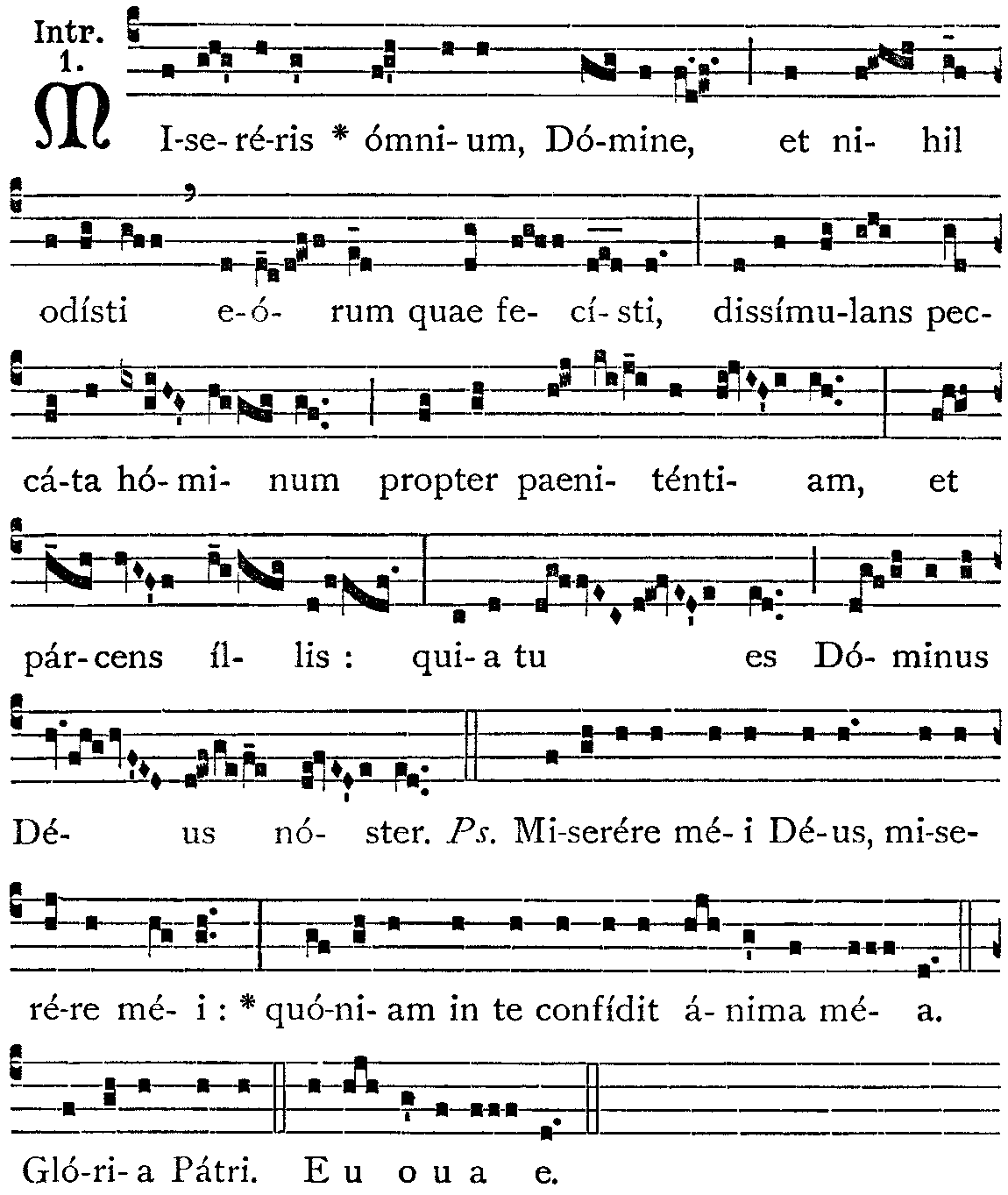
Misereris omnium is the traditional Introit for Ash Wednesday; here's an mp3 of this beautiful piece from JoguesChant.

Here's the chant score, from the Brazilian Benedictines:

The text is from Wisdom 11:24-25,27, and from Psalm 57.

JoguesChant offers this translation:
Your mercy extends to all things, O Lord, and you despise none of the things you have made. You overlook the sins of men for the sake of repentance. You grant them your pardon, because you are the Lord our God. Be merciful to me, O God, be merciful to me, for my soul confides in you.

Here's a video labeled "Feria IV Cinerum 1 - Introitus - Traditional Latin Mass" (i.e., the "Extraordinary Form"); it's labeled "Miserere Mei," but I think that's just an error:


The Collect for the day echoes the portion of Wisdom in this Introit:
Almighty and everlasting God, you hate nothing you have made and forgive the sins of all who are penitent: Create and make in us new and contrite hearts, that we, worthily lamenting our sins and acknowledging our wretchedness, may obtain of you, the God of all mercy, perfect remission and forgiveness; through Jesus Christ our Lord, who lives and reigns with you and the Holy Spirit, one God, for ever and ever. Amen.

Hatchett's Commentary has this about the collect:
The Sarum collect for Ash Wednesday can be traced to the Gelasian sacramentary where it is the inital collect for the fall ember days (no. 1037). In the Gregorian sacramentary it is used on the Wednesday before the first Sunday in Lent (no. 154). It might be translated:

Grant, we beseech, Lord, to your faithful people, that they may undertake the sacred solemnities of the fasts with fitting piety, and that they see them through with undisturbed devotion.

Cranmer's new collect for the 1549 Book places the emphasis on penitence rather than upon the fast. His preamble is similar to that of the form for the blessing of the ashes and to the introit appointed for that day in the Sarum missal. The petition is obviously inspired by Psalm 51 which has traditionally been used on this day. We pray for "remission and forgiveness." The word "remission" normally refers to debst, and "forgiveness" to offenses.

The rubric following the collect was inserted in the 1892 revision to insure that the proper of Ash Wednesday rather than that of the preceeding Sunday would be used on the follow THursday, Friday, and Saturday. Such a rubric is also found in the Scottish Book of 1637. From 1662 until the 1928 revision the Ash Wednesday collect was to be repeated throughout Lent daily, a custom analogous to the use of memorials after the collect of the day late in the medieval period. The 1928 Book qualified this by adding "until Palm Sunday."

The rubric referred to above is this:
"This Collect, with the corresponding Psalm and Lessons, also serves for
the weekdays which follow, except as otherwise appointed.
"

Saturday, March 5, 2011

Here's the beautiful Introit for this Sunday, via mp3, Respice In Me ("Look upon me"), from JoguesChant. Here's the score, from the same source:


The text comes from Psalms 25:16, 18, and 1-2:
Look upon me and have mercy on me, O Lord; for I am abandoned and destitute; consider my abjection and my labour, and forgive me all my sins, my dear God. Unto you, O Lord, have I lifted up my soul; O my God, I trust in you; let me not be put to shame.
The readings are the ones used every year on the Last Sunday After the Epiphany; the Gospel for this day - Quinquagesima - is always the story of the Transfiguration:

Matthew 17:1-9

Six days after Peter had acknowledged Jesus as the Christ, the Son of the Living God, Jesus took with him Peter and James and his brother John and led them up a high mountain, by themselves. And he was transfigured before them, and his face shone like the sun, and his clothes became dazzling white. Suddenly there appeared to them Moses and Elijah, talking with him. Then Peter said to Jesus, "Lord, it is good for us to be here; if you wish, I will make three dwellings here, one for you, one for Moses, and one for Elijah." While he was still speaking, suddenly a bright cloud overshadowed them, and from the cloud a voice said, "This is my Son, the Beloved; with him I am well pleased; listen to him!" When the disciples heard this, they fell to the ground and were overcome by fear. But Jesus came and touched them, saying, "Get up and do not be afraid." And when they looked up, they saw no one except Jesus himself alone.

As they were coming down the mountain, Jesus ordered them, "Tell no one about the vision until after the Son of Man has been raised from the dead."

The collect for today is also used every year for the Last Sunday After the Epiphany (the Sunday before Ash Wednesday), and also refers to the Transfiguration:
O God, who before the passion of your only ­begotten Son revealed his glory upon the holy mountain: Grant to us that we, beholding by faith the light of his countenance, may be strengthened to bear our cross, and be changed into his likeness from glory to glory; through Jesus Christ our Lord, who lives and reigns with you and the Holy Spirit, one God, for ever and ever. Amen.

Hatchett's Commentary says this about this collect:

The Epiphany season may have as few as four or as many as nine Sundays depending upon the date of Easter (see the table on pp. 884-885 of the Prayer Book). The rubric makes clear that, regardless of the number of Sundays after the Epiphany, this proper is used on the Sunday before Ash Wednesday.

The English revision of 1928 first included this modern collect for the feast of the Transfiguration, the subject of the Gospel lesson in all three years for this Sunday in the eucharistic lectionary. It is particularly appropriate on this Sunday, when we recall our Lord's having set His face to go to Jerusalem, for us to pray that we "beholding by faith the light of his countenance, may be strengthened to bear our cross, and be changed into his likeness from glory to glory."

In the EF propers, the Introit for today is Esto Mihi; the English translation at Renegroupil.org is this:

Be thou unto me a God, a protector, and a place of refuge, to save me: for thou art my strength, and my refuge; and for thy name’s sake thou wilt be my leader, and wilt nourish me. In thee, O Lord, have I hoped, let me never be confounded: deliver me in thy justice.
It seems obvious (to me, at least!) that this is a pre-Lent prayer; the prayer to God for a place of "strength and refuge" - and nourishment, a reference to the Lenten fast - is preparation for the 40 days ahead.  Here's the mp3 of this Introit.

Wishing you a blessed Lent. Below is Carl Spitzweg's "Ash Wednesday (the end of Carnival)."


Saturday, February 26, 2011

The Introit for Sexagesima Sunday - the second Sunday before Lent (used only in the Extraordinary Form today) - is Exsurge Quare.  The text comes from Psalm 44:23-26, and is quite dramatic, in fact:


Pre-Lent -  Sexagesima: Introit from Corpus Christi Watershed on Vimeo.
Exsúrge, quare obdórmis, Dómine? exsúrge, et ne repéllas in finem: quare fáciem tuam avértis, oblivísceris tribulatiónem nostram? adhaésit in terra venter noster: exsúrge, Dómine, ádjuva nos, et líbera nos. Vs. (Ps. 43: 2) Deus, áuribus nostris audívimus: patres nostri annuntiavérunt nobis. Vs. Glória Patri, et Fílio, et Spirítui Sancto. Sicut erat in princípio, et nunc, et semper, et in saécula sæculórum. Amen. Exsúrge, quare obdórmis, Dómine? exsúrge, et ne repéllas in finem: quare fáciem tuam avértis, oblivísceris tribulatiónem nostram? adhaésit in terra venter noster: exsúrge, Dómine, ádjuva nos, et líbera nos.

Arise, why sleepest Thou, O Lord? arise, and cast us not off to the end. Why turnest Thou Thy face away, and forgettest our trouble? our belly hath cleaved to the earth: arise, O Lord, help us and deliver us. Vs. (Ps. 43: 2) We have heard, O God, with our ears: our fathers have declared to us. Vs. Glory be to the Father, and to the Son, and to the Holy Spirit. As it was in the beginning, is now, and ever shall be, world without end. Amen. Arise, why sleepest Thou, O Lord? arise, and cast us not off to the end. Why turnest Thou Thy face away, and forgettest our trouble? our belly hath cleaved to the earth: arise, O Lord, help us and deliver us.

Here's another video of this, here by The Benedictine nuns of Notre-Dame de l'Annonciation, Le Barroux.


Here's the chant score:


About Sexagesima, from the Catholic Encyclopedia of 1913:
(Latin sexagesima, sixtieth) is the eighth Sunday before Easter and the second before Lent. The Ordo Romanus, Alcuin, and others count the Sexagesima from this day to Wednesday after Easter. The name was already known to the Fourth Council of Orléans in 541. For the Greeks and Slavs it is Dominica Carnisprivii, because on it they began, at least to some extent, to abstain from meat. The Synaxarium calls it Dominica secundi et muneribus non corrupti adventus Domini. To the Latins it is also known as "Exsurge" from the beginning of the Introit. The statio was at Saint Paul's outside the walls of Rome, and hence the oratio calls upon the doctor of the Gentiles. The Epistle is from Paul, 2 Corinthians 11 and 12, describing his suffering and labours for the Church. The Gospel (Luke 8) relates the falling of the seed on good and on bad ground, while the Lessons of the first Nocturn continue the history of man's iniquity, and speak of Noah and of the Deluge. (See SEPTUAGESIMA.) 

Thursday, February 24, 2011

Chichester Choral Evensong

Here's a full service of Evensong from Chichester Cathedral, in 5 videos.
This is a live recording from Choral Evensong in Chichester Cathedral during our tour of England in which we sang at Ely Cathedral and nor Chichester Cathedral. The choirs are made up of the choristers and schola members of Trinity Church in Boston, Massachusetts under the direction of Richard Webster.

The Preces and Responses are by Richard Webster. The Psalm setting is Anglican chant. The Magnificat and Nunc Dimittis in G by Stanford and is sung by the choristers. The anthem is "Attend to the Music Divine" by Richard Webster.


At the end of each video is a link to the next; just click through.