


Thursday, October 24, 2013
This is a 52-minute version of a shorter video that's been around for a number of years now, I believe. Clear Creek is a Benedictine Monastery in Oklahoma; the video addresses the topics of the order in general, and of Clear Creek in particular. There are short segments about the Mass and the Offices, as well.
Wednesday, October 23, 2013
In honor of today's Feast of St. James of Jerusalem (AKA, "The Brother of Our Lord"), here's Exultet Caelum Laudibus - a Lauds and 2nd Evensong hymn for Apostles & Evangelists - sung by La Capella Reial De Catalunya. Here's a little something about them:
In English, the first line of this hymn is given as "Let the round world with songs rejoice!" Quite pretty, really; here are the words from CPDL:
(FYI, here's what the Sarum chant version (mp3) of the hymn sounds like; the audio file comes from the website of the Lutheran Liturgical Prayer Brotherhood.)
La Capella Reial de Catalunya was created in Barcelona in 1987 by its conductor Jordi Savall as a group of soloist singers whose aim is to make the repertoire of Catalan historical music and, by extension, that of Spanish and other music widely known throughout the world. La Capella Reial de Catalunya often performs with Le Concert des Nations, a period instrument group also founded and conducted by Savall.I do not know anything more about this piece, but will return to post anything I find in the future; it's very pretty, though, and worth listening to I think.
In English, the first line of this hymn is given as "Let the round world with songs rejoice!" Quite pretty, really; here are the words from CPDL:
1. Exultet coelum laudibus
resultet terra gaudiis
apostolorum gloriam
sacra canunt solemnia.
2. Vos saecli justi judices
et vera mundi lumina
votis precamur cordium
audite preces supplicum.
3. Qui caelum verbo clauditis
serasque ejus solvitis
nos a peccatis omnibus
solvite jussu, quaesumus.
4. Quorum praecepto subditor
salus et languor omnium:
sanate aegros moribus
nos reddentes virtutibus.
5. Ut cum judex advenerit
Christus in fine saeculi
nos sempiterni gaudii
faciat esse compotes.
6. Deo Patri sit gloria
ejusque soli Filio,
cum Spiritu Paracleto,
et nunc et in perpetuum.
Additional verse
Summa sit ipsi gloria,
qui dat nos evangelicis
per vos doctrinis instrui
et prosequi caelestia.
1. Let the round world with songs rejoice;
Let Heaven return the joyful voice;
All mindful of th’Apostles’ fame,
Let Heav’n and earth their praise proclaim.
2. Ye servants who once bore the light
Of Gospel truth o’er heathen night,
Still may your work that light impart,
To glad our eyes and cheer our heart.
3. O God, by whom to them was giv’n
The key that shuts and opens Heav’n,
Our chains unbind, our loss repair,
And grant us grace to enter there.
4. For at Thy will they preached the Word
Which cured disease, which health conferred:
O may that healing power once more
Our souls to grace and health restore.
5.That when Thy Son again shall come,
And speak the world’s unerring doom,
He may with them pronounce us blest,
And place us in Thy endless rest.
6. To Thee, O Father; Son, to Thee;
To Thee, blest Spirit, glory be!
So was it ay for ages past,
So shall through endless ages last.
tr. Richard Mant (1776-1848)
Additional verse
The highest glory be to him,
who gives us the Gospel.
May we be taught by you
and follow you to heaven.
(FYI, here's what the Sarum chant version (mp3) of the hymn sounds like; the audio file comes from the website of the Lutheran Liturgical Prayer Brotherhood.)
Monday, October 21, 2013
This is the second of three posts about the Compline hymns; see Part I here and Part III here.
The following are the hymns listed for Compline, in Hymn melodies for the whole year, from the Sarum service-books:
Follow along with the office here, at Breviary Offices, from Lauds to Compline Inclusive (Society of St. Margaret, Boston, 1885). I'll link-in via iFrame at the bottom of the post too.
We'll start this time with Christe, qui Lux es et Dies, the hymn sung "On the First Sunday in Lent & daily until Passion Sunday," as above. Here is the chant score for melody #12:

Here's an mp3 of melody #12, sung by the St. David's (Austin, TX) Compline Choir. TPL (which calls the hymn "Christe, qui spelndor et dies") notes that this is:
Here are the Latin words, as given at CPDL, followed by an English translation (via "William John Copeland and others, 1906") from Oremus Hymnal. The English words are different than what's on the mp3 (whose English words I believe come from the 1982 Hymnal, from Hymns #40 and 41).
Cultor Dei, memento is sung to Melody #13 "On Passion Sunday & daily until Wednesday in Holy-Week inclusive":

I have found no recording of melody #13, but I do like this melody (that's a midi file) used for this hymn, from HymnTime.com; it's another of those tuneful German hymn chorales, Nun Lasst Uns Geh’n - and would certainly make a good substitute. Here's a page scan of the score for the tune on that midi file (PDF), again from HymnTime:

The words to this hymn are very beautiful - the first verse is a reference to baptism - and it's no surprise that they come from Prudentius.
Here's a note at Hymnary.org about Cultor dei, memento:
This comes from Prudentius' longer poem Hymnus Ante Somnum ("Hymn before sleeping"); the poem's first line is Ades Pater Supreme. Here's a short Hymnary.org note about that longer poem:
And this longer quote is taken from the introduction to the (out-of-print, it seems) book Hymns of Prudentius: The Cathemerinon; or, The Daily Round by Aurelius Prudentius Clemens:
The Hymnus Ante Somnum from which Cultor Dei, memento is taken comes from The Cathemerinon; you can find that online in full, with English translation by R. Martin Pope, at Gutenberg.org. (subtitled there "Hymns for the Christian's Day"). Or, you can download the book in various e-formats here.
On Low Sunday & daily until Ascension Day, Jesu, Salvator seculi, Verbum is sung at Compline to Melody #14:

Melody #14 is the same tune used for Te Lucis Ante Terminum above. Here's the mp3 of that hymn sung to melody #14, again from the St. David's (Austin, TX) Compline Choir, recorded during an actual service of Compline.
The Hymner has the words for this one in English:
Here's an interesting alternatim of this hymn; I believe this is Thomas Tallis' composition:
Sing Jesu, nostra Redempcio to Melody #34 "On Ascension Day & daily until Whitsun Day":

Giovanni Viannini has posted this as an Inno Gregoriano per la solennità dell'Ascensione I e II Vespri; it's Melody #34, for sure:
The Hymner has an English translation (not a good one, alas!) for this one, too:
CPDL has the Latin words, along with a non-metrical English translation here; it's quite a beautiful hymn, actually:
Tomas Luis de Victoria had something (beautiful!) to say about this hymn as well:
Here's still another English translation found in an 1837 book by John Chandler, Hymns of the Primitive Church, at Google Books that has the Latin words.
The last two hymns are Sequences, and I'll make a separate post about them.
Here's a peek-in to the SSM Breviary entry for Compline:
The following are the hymns listed for Compline, in Hymn melodies for the whole year, from the Sarum service-books:
Daily throughout the year, except on Double Feasts & from the 1st Sunday in Lent until Trinity Sunday inclusive :-Te lucis ante terminum
(1) On Sundays & when the Choir has Rulers ... ... 14
(2) On Ferias & Simple Feasts of the lowest class ...11
On Double Feasts during Advent & daily from Xmas Eve to the 8ve of Epiphany, & on all Double Feasts from thence until the 1st Sunday in Lent, on the Vigil of Pentecost, on the Thursday, Friday, & Saturday in the 8ve of the same, & on all Double Feasts from Trinity Sunday until Advent, except on the Feast of the Holy Name :Salvator mundi Domine ... ... 8[At Christmas-tide (York): Corde natus ex Parentis ... 73]
On the First Sunday in Lent & daily until Passion Sunday :Christe, qui Lux es et Dies ... ... 12
On Passion Sunday & daily until Wednesday in Holy-Week inclusive:Cultor Dei, memento ... ... 13
From Maundy Thursday to Low Sunday no Hymns are sung.
On Low Sunday & daily until Ascension Day :Jesu, Salvator seculi, Verbum ... 14
On Ascension Day & daily until Whitsun Day :Jesu, nostra Redempcio ... ... 34
On Whitsun Day, (but not on the Vigil, see above) & on the three days following, & on the Feast of the Holy Name :Alma chorus Domini ... Sequence p. (xxiij)
[On Monday & Wednesday in Whitsun Week (York):Laudes Deo devotas ... Sequence p. (x)]
Follow along with the office here, at Breviary Offices, from Lauds to Compline Inclusive (Society of St. Margaret, Boston, 1885). I'll link-in via iFrame at the bottom of the post too.
We'll start this time with Christe, qui Lux es et Dies, the hymn sung "On the First Sunday in Lent & daily until Passion Sunday," as above. Here is the chant score for melody #12:

Here's an mp3 of melody #12, sung by the St. David's (Austin, TX) Compline Choir. TPL (which calls the hymn "Christe, qui spelndor et dies") notes that this is:
Another old and venerable hymn for the close of day at Compline. This hymn has 8th century origins and is sometimes attributed to the Venerable Bede.
Here are the Latin words, as given at CPDL, followed by an English translation (via "William John Copeland and others, 1906") from Oremus Hymnal. The English words are different than what's on the mp3 (whose English words I believe come from the 1982 Hymnal, from Hymns #40 and 41).
Christe qui lux es et dies,
Noctis tenebras detegis,
Lucisque lumen crederis,
Lumen beatum praedicans.
Precamur Sancte Domine,
Defende nos in hac nocte,
Sit nobis in te requies,
Quietam noctem tribue.
Ne gravis somnus irruat,
Nec hostis nos surripiat,
Nec caro illi consentiens,
Nos tibi reos statuat.
Oculi somnum capiant,
Cor ad te semper vigilet,
Dextera tua protegat
Famulos qui te diligunt.
Defensor noster aspice,
Insidiantes reprime,
Guberna tuos famulos,
Quos sanguine mercatus es.
Memento nostri Domine
In gravi isto corpore,
Qui es defensor animae,
Adesto nobis Domine.
Deo Patri sit gloria,
Eiusque soli Filio,
Cum Spiritu Paraclito,
Et nunc et in perpetuum. Amen.
O Christ, who art the Light and Day,
thou drivest darksome night away!
we know thee as the Light of light
illuminating mortal sight.
All holy Lord, we pray to thee,
keep us tonight from danger free;
grant us, dear Lord, in thee to rest,
so be our sleep in quiet blessed
And while the eyes soft slumber take,
still be the heart to thee awake,
be thy right hand upheld above
thy servants resting in thy love.
Yea, our Defender, be thou nigh,
to bid the powers of darkness fly;
keep us from sin, and guide for good
thy servants purchased by thy blood.
Remember us, dear Lord, we pray,
while in this mortal flesh we stay:
'tis thou who dost the soul defend
be present with us to the end.
Blest Three in One and One in Three,
almighty God, we pray to thee,
that thou wouldst now vouchsafe to bless
our fast with fruits of righteousness.
Cultor Dei, memento is sung to Melody #13 "On Passion Sunday & daily until Wednesday in Holy-Week inclusive":

I have found no recording of melody #13, but I do like this melody (that's a midi file) used for this hymn, from HymnTime.com; it's another of those tuneful German hymn chorales, Nun Lasst Uns Geh’n - and would certainly make a good substitute. Here's a page scan of the score for the tune on that midi file (PDF), again from HymnTime:

The words to this hymn are very beautiful - the first verse is a reference to baptism - and it's no surprise that they come from Prudentius.
Servant of God, remember
The stream thy soul bedewing,
The grace that came upon thee
Anointing and renewing.
When kindly slumber calls thee,
Upon thy bed reclining,
Trace thou the cross of Jesus,
Thy heart and forehead signing.
The cross dissolves the darkness,
And drives away temptation;
It calms the wavering spirit
By quiet consecration.
Begone, begone, the terrors
Of vague and formless dreaming;
Begone, thou fell deceiver,
With all thy boasted scheming.
Begone, thou crooked serpent,
Who, twisting and pursuing,
By fraud and lie preparest
The simple soul’s undoing.
Tremble, for Christ is near us,
Depart, for here He dwelleth,
And this, the sign thou knowest,
Thy strong battalions quelleth.
Then while the weary body
Its rest in sleep is nearing,
The heart will muse in silence
On Christ and His appearing.
To God, eternal Father,
To Christ, our king, be glory,
And to the Holy Spirit,
In never ending story.
Here's a note at Hymnary.org about Cultor dei, memento:
Cultor Dei memento—Servant of God, remember. Prudentius. This portion of the hymn, given in Daniel , i., No. 110; Card. Newman's Hymnal Eccl. 1838 and 1865; Wackernagel and others, is composed of lines 125-152, with the addition of a doxology. It was used in the Sarum Breviary "At Compline on Passion Sunday, and Daily up to Maundy Thursday." Also in the Mozarabic Breviary; the Mozarabic Hymnarium ; and in an 11th century manuscript in the British Museum (Harl. 2961, f. 238). The translation in common use is:—"Servant of God! remember," by W. J. Blew. First printed with music on a broadsheet, and then in The Church Hymn and Tune Book, 1852; 2nd ed. 1855. It is from the Sarum text, and in 7 stanzas of 4 lines. In 1870 it was included in Mr. Rice's Hymns, No. 105.
-- John Julian, Dictionary of Hymnology (1907)
Ades Pater supreme. This is in a manuscript of the 6th century, in the Bibl. Nat. Paris (Lat, 8084, f. 18). Another translation of the cento Ades Pater is "Father, Most High, be with us." In the 1885 edition of Hymns Ancient & Modern, by the Compilers.And here's a bit about Prudentius himself (with much more at the link):
--John Julian, Dictionary of Hymnology, Appendix, Part II (1907)
Marcus Aurelius Clemens Prudentius, "The Christian Pindar" was born in northern Spain, a magistrate whose religious convictions came late in life. His subsequent sacred poems were literary and personal, not, like those of St. Ambrose, designed for singing. Selections from them soon entered the Mozarabic rite, however, and have since remained exquisite treasures of the Western churches. His Cathemerinon liber, Peristephanon, and Psychomachia were among the most widely read books of the Middle Ages. A concordance to his works was published by the Medieval Academy of America in 1932. There is a considerable literature on his works.
--The Hymnal 1940 Companion
And this longer quote is taken from the introduction to the (out-of-print, it seems) book Hymns of Prudentius: The Cathemerinon; or, The Daily Round by Aurelius Prudentius Clemens:
"Fetch me a pen, lad. I mean to sing of the noble deeds of Jesus Christ, the theme of my heavenly Muse."
Born in Spain in the fourth century, Aurelius Prudentius Clemens held a position of considerable authority in the Roman imperial administration. He was thirteen when Julian, the last pagan emperor, came to the throne and attempted to suppress Christianity and restore paganism. And he watched, two years later, when Julian was succeeded by the co-emperors, Valentinian and Valens, both Christians whose courts included such men as Jerome, Ausonius, and Martin of Tours.
His lasting influence comes, however, from his work as a poet: a pioneer in the creation of a Christian literature, Prudentius is generally regarded as the greatest of the Christian Latin poets, and his legacy informed the work of future poets, among them George Herbert and John Donne. Prudentius wrote two collections of hymns: the Cathemerinon Liber and the Peristephanon. The former, a collection of twelve songs in English "The Daily Round" is translated here by David Slavitt. Essentially literary in nature, the hymns replaced mythology of the classical mode with stories from the Scriptures and enjoyed immense popularity and success for centuries in the liturgy of the church.
"Prudentius's Latin is decorative and his poetic stance is enormously appealing. I have tried to do the voice and suggest to others something of what I admire in it. If I read these poems as objets d'art, I have no objection to my Christian friends reading them another way, as devotions. Indeed, I cannot for the life of me guess which of us will be getting more out of them. The particular belief is perhaps not so much the crucial issue as the yearning for belieffor the faithful feel, in the momentary flaggings of their faith, a fervent longing most agnostics have experienced, whether they admit it or not."
The Hymnus Ante Somnum from which Cultor Dei, memento is taken comes from The Cathemerinon; you can find that online in full, with English translation by R. Martin Pope, at Gutenberg.org. (subtitled there "Hymns for the Christian's Day"). Or, you can download the book in various e-formats here.
On Low Sunday & daily until Ascension Day, Jesu, Salvator seculi, Verbum is sung at Compline to Melody #14:

Melody #14 is the same tune used for Te Lucis Ante Terminum above. Here's the mp3 of that hymn sung to melody #14, again from the St. David's (Austin, TX) Compline Choir, recorded during an actual service of Compline.
The Hymner has the words for this one in English:
JEsu, who brought'st redemption nigh,
Word of the Father, God most high:
O Light of Light, to man unknown,
And watchful Guardian of thine own.
Thy hand Creation made and guides;
Thy wisdom time from time divides:
By this world's cares and toils opprest,
O give our weary bodies rest.
That, while in frames of sin and pain
A little longer we remain,
Our flesh may here in such wise sleep,
That watch with Christ our souls may keep.
O free us, while we dwell below,
From insults of our ghostly foe,
That he may ne'er victorious be
O'er them that are redeem'd by thee.
We pray thee, King with glory deck'd,
In this our Paschal joy, protect
From all that death would fain effect,
Thy ransom'd flock, thine own elect.
To thee who, dead, again dost live,
All glory, Lord, thy people give:
All glory, as is ever meet,
To Father and to Paraclete. Amen.
Here's an interesting alternatim of this hymn; I believe this is Thomas Tallis' composition:
Sing Jesu, nostra Redempcio to Melody #34 "On Ascension Day & daily until Whitsun Day":

Giovanni Viannini has posted this as an Inno Gregoriano per la solennità dell'Ascensione I e II Vespri; it's Melody #34, for sure:
The Hymner has an English translation (not a good one, alas!) for this one, too:
JEsu, Redemption all divine,
Whom here we love, for whom we pine,
God, working out creation's plan,
And, in the latter time, made Man:
What love of thine was that, which led
To take our woes upon thy head,
And pangs and cruel death to bear,
To ransom us from death's despair!
To thee hell's gate gave ready way,
Demanding there his captive prey:
And now, in pomp and victor s pride,
Thou sittest at the Father's side.
Let very mercy force thee still
To spare us, conquering all our ill;
And, granting that we ask, on high
With thine own face to satisfy.
Be thou our Joy and thou our Guard;
Who art to be our great Reward:
Our glory and our boast in thee
For ever and for ever be.
All glory, Lord, to thee we pay,
Ascending o'er the stars to-day:
All glory, as is ever meet,
To Father and to Paraclete. Amen.
CPDL has the Latin words, along with a non-metrical English translation here; it's quite a beautiful hymn, actually:
Jesu, nostra redemptio,
Amor et desiderium,
Deus creator omnium,
Homo in fine temporum.
Quae te vicit clementia,
Ut ferres nostra crimina,
Crudelem mortem patiens
Ut nos a morte tolleres!
Inferni claustra penetrans,
Tuos captivos redimens,
Victor triumpho nobili
Ad dextram Dei residens
Ipsa te cogat pietas
Ut mala nostra superes
Parcendo et voti compotes
Nos tuo vultu saties.
Tu esto nostrum gaudium,
Qui es futurus praemium,
Sit nostra in te gloria,
In sempiterna saecula.
Jesus, our redemption,
love and desire,
God, Creator of all things,
becomes man in the fullness of time.
What mercy made thee
bear our crimes,
to suffer a cruel death
that we might be saved from death!
Descending into Hell’s prison,
freeing thy captives,
Thy noble triumph won,
dwelling at the Father’s right hand.
Let pity compel thee
to overcome our evils,
granting pardon,
fulfil and satisfy us with thy face.
Be our joy,
who will be our future prize;
let all our glory be in Thee
forever, throughout all ages.
Tomas Luis de Victoria had something (beautiful!) to say about this hymn as well:
Here's still another English translation found in an 1837 book by John Chandler, Hymns of the Primitive Church, at Google Books that has the Latin words.
O Christ, our Hope, our heart’s Desire,And this is another chant version (mp3) of Jesu, nostra redemptio - but it's not Melody #34. Again this comes from the St. David's Choir, and seems to be an entirely different translation from any of those we've seen here. The version sung here is taken from #38 (for Compline) in the 1982 Hymnal. The note there says that the words are "Latin, 10th cent.; ver Hymnal 1982. St. 5, Anne K. LeCroy (b. 1930)." The tune, BTW, is also used for #238 for Martyrs, and there is a metrical version at #233 for Apostles, as well. This page at Google books notes that Jesu nostra redemptio is "an Ascension hymn of the 9th or 10th Century."
Redemption’s only Spring!
Creator of the world art Thou,
Its Savior and its King.
How vast the mercy and the love
Which laid our sins on Thee,
And led Thee to a cruel death,
To set Thy people free.
But now the bands of death are burst,
The ransom has been paid,
And Thou art on Thy Father’s throne,
In glorious robes arrayed.
O may Thy mighty love prevail
Our sinful souls to spare;
O may we come before Thy throne,
And find acceptance there!
O Christ, be Thou our lasting Joy,
Our ever great Reward!
Our only glory may be it be
To glory in the Lord.
All praise to Thee, ascended Lord;
All glory ever be
To Father, Son, and Holy Ghost,
Through all eternity.
The last two hymns are Sequences, and I'll make a separate post about them.
Here's a peek-in to the SSM Breviary entry for Compline:
Friday, October 18, 2013
This is the first of three posts about the Compline hymns;see Part II here and Part III here.
The following are the hymns listed for Compline, in Hymn melodies for the whole year, from the Sarum service-books:
There are so many hymns and tunes here that I plan to break this post into sections; here I'll deal only with the first four melodies listed. Follow along with the office here, at Breviary Offices, from Lauds to Compline Inclusive (Society of St. Margaret, Boston, 1885). I'll link-in via iFrame at the bottom of the post too.
Now, let's work our way through all these hymns and melodies, starting with Te lucis ante terminum, the hymn sung "On Sundays & when the Choir has Rulers" (melody #14) and "On Ferias & Simple Feasts of the lowest class" (melody #11) . And, no: I have absolutely no idea what "when the Choir has Rulers"means; that's definitely what it says. I'm totally stumped.
Nevertheless, here's hymn melody #14:
Here's an mp3 of this hymn sung to melody #14, sung by the St. David's (Austin, TX) Compline Choir, during an actual service of Compline. TPL notes that Te lucis ante terminum is:
Here's a fantastic Tallis alternatim composition based on melody #14:
Here's melody #11, the ferial tune:
 Here's Te lucis ante terminum sung to melody #11, again sung by St. David's Compline Choir; this time, though, it's the "Ferial Tone, à 5," a composition by Thomas Tallis that includes the plainsong tune, and sung in Latin. The doxology is slightly different on the audio file.
The next hymn is Salvator mundi Domine, sung on a variety of occasions (see list above) to melody #8:

Melody #8 is the famous Pentecost hymn tune for Veni, Creator Spiritus. CPDL has the words in Latin, at a link to a John Sheppard composition, and notes that:
The hymn at York for Christmastide is an ancient, wonderful and famous one: Corde natus ex Parentis (Of the Father's Heart Begotten). The melody prescribed, though, isn't the well-known tune called Divinum mysterium, but melody #73, this one:

Again, I have no recording this melody tune above; will try to remedy that. Here, though, are the Latin words - there are a lot of them! -along with J.M. Neale's English translation:
And just because I love the (11th C., I believe) melody Divinum mysterium, I'll include this video from "Concordia Theological Seminary Fort Wayne Kantorei. Recorded in Kramer Chapel on the campus of CTS, Ft. Wayne." I would certainly recommend its use during Christmastide as an alternative! They are using a different set of words here, though.
Here's more about the hymn from the Wikipedia page linked above:
Here's something about Compline; as noted, much of the content comes from the Catholic Encyclopedia of 1917:
Don't forget, either, to subscribe to the podcasts of the Compline Choir of St. Mark's Cathedral in Seattle; they are well worth a listen each week.
More Compline links here.
The following are the hymns listed for Compline, in Hymn melodies for the whole year, from the Sarum service-books:
Daily throughout the year, except on Double Feasts & from the 1st Sunday in Lent until Trinity Sunday inclusive :-Te lucis ante terminum
(1) On Sundays & when the Choir has Rulers ... ... 14
(2) On Ferias & Simple Feasts of the lowest class ...11
On Double Feasts during Advent & daily from Xmas Eve to the 8ve of Epiphany, & on all Double Feasts from thence until the 1st Sunday in Lent, on the Vigil of Pentecost, on the Thursday, Friday, & Saturday in the 8ve of the same, & on all Double Feasts from Trinity Sunday until Advent, except on the Feast of the Holy Name :Salvator mundi Domine ... ... 8[At Christmas-tide (York): Corde natus ex Parentis ... 73]
On the First Sunday in Lent & daily until Passion Sunday :Christe, qui Lux es et Dies ... ... 12
On Passion Sunday & daily until Wednesday in Holy-Week inclusive:Cultor Dei, memento ... ... 13
From Maundy Thursday to Low Sunday no Hymns are sung.
On Low Sunday & daily until Ascension Day :Jesu, Salvator seculi, Verbum ... 14
On Ascension Day & daily until Whitsun Day :Jesu, nostra Redempcio ... ... 34
On Whitsun Day, (but not on the Vigil, see above) & on the three days following, & on the Feast of the Holy Name :Alma chorus Domini ... Sequence p. (xxiij)
[On Monday & Wednesday in Whitsun Week (York):Laudes Deo devotas ... Sequence p. (x)]
There are so many hymns and tunes here that I plan to break this post into sections; here I'll deal only with the first four melodies listed. Follow along with the office here, at Breviary Offices, from Lauds to Compline Inclusive (Society of St. Margaret, Boston, 1885). I'll link-in via iFrame at the bottom of the post too.
Now, let's work our way through all these hymns and melodies, starting with Te lucis ante terminum, the hymn sung "On Sundays & when the Choir has Rulers" (melody #14) and "On Ferias & Simple Feasts of the lowest class" (melody #11) . And, no: I have absolutely no idea what "when the Choir has Rulers"means; that's definitely what it says. I'm totally stumped.
Nevertheless, here's hymn melody #14:
Here's an mp3 of this hymn sung to melody #14, sung by the St. David's (Austin, TX) Compline Choir, during an actual service of Compline. TPL notes that Te lucis ante terminum is:
An old and venerable Ambrosian hymn from the 7th century for the close of day at Compline. This version is the one found in the Monastic Breviary and the Roman Breviary. The current version in the Liturgy of the Hours, which is given below, drops the second verse and replaces it with two other verses.The words below are from CPDL; the English translation (a version of J.M. Neale's translation) is slightly different from what's on the audio file, as you'll note.
TE lucis ante terminum,
rerum Creator, poscimus
ut pro tua clementia
sis praesul et custodia.
Procul recedant somnia
et noctium phantasmata;
hostemque nostrum comprime,
ne polluantur corpora.
Praesta, Pater piissime,
Patrique compar Unice,
cum Spiritu Paraclito
regnans per omne saeculum.
Amen.
To thee before the close of day,
Creator of the world, we pray
That, with thy wonted favor, thou
Wouldst be our guard and keeper now.
From all ill dreams defend our sight,
From fears and terrors of the night;
Withhold from us our ghostly foe,
That spot of sin we may not know.
O Father, that we ask be done,
Through Jesus Christ, thine only Son,
Who, with the Holy Ghost and thee,
Doth live and reign eternally. Amen.
Here's a fantastic Tallis alternatim composition based on melody #14:
Here's melody #11, the ferial tune:
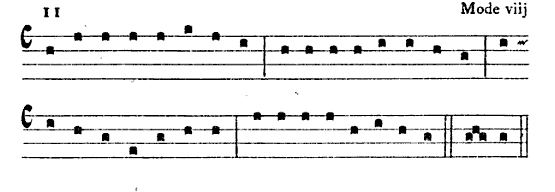
The next hymn is Salvator mundi Domine, sung on a variety of occasions (see list above) to melody #8:

Melody #8 is the famous Pentecost hymn tune for Veni, Creator Spiritus. CPDL has the words in Latin, at a link to a John Sheppard composition, and notes that:
This Compline Hymn setting for the Vigil of Christmas in the Sarum Rite makes use of the Sarum Plainchant also associated with Veni Creator Spiritus. Sheppard sets the second and fourth verses, the odd verses being sung as plainchant.I would dearly love to have a recording of the Sheppard composition, but alas! Here, though, via mp3 from the LLPB, is what melody #8 sounds like; just substitute the Salvator mundi Domine text. The English words below are from the SSM Breviary:
Salvator mundi Domine,
Qui nos salvasti hodie,
In hac nocte nos protege,
Et salva omni tempore.
Adesto nunc propitius,
Et parce supplicantibus;
Tu dele nostra crimina,
Tu tenebras illumina.
Ne mentem somnus opprimat,
Ne hostis nos surrepiat,
Nec ullis caro, petimus,
Commaculetur sordibus.
Te, reformator sensuum,
Votis precamur cordium,
Ut puri castis mentibus
Surgamus a cubilibus.
Deo Patri sit gloria,
Eiusque soli Filio,
Cum Spiritu Paraclito
Et nunc et in perpetuum.
Amen.
SAVIOUR of man, and Lord alone,
"Who through this day hast saved Thine own,
Protect us through the coming night,
And ever save us by Thy might.
Be with us, Lord, in mercy nigh,
And spare Thy servants when they cry;
Blot out our every past offence,
And lighten Thou our darkened sense.
0 let not sleep oppress the soul,
Nor Satan with his spirits foul;
Our flesh keep chaste, that it may be
An holy temple unto Thee.
To Thee, Who makest souls anew,
With heartfelt vows we humbly sue;
That pure in heart, and free from stain,
We from our beds may rise again.
All laud to God the Father be;
All praise, Eternal Son, to Thee;
All glory, as is ever meet,
To God the blessed Paraclete. Amen.
The hymn at York for Christmastide is an ancient, wonderful and famous one: Corde natus ex Parentis (Of the Father's Heart Begotten). The melody prescribed, though, isn't the well-known tune called Divinum mysterium, but melody #73, this one:

Again, I have no recording this melody tune above; will try to remedy that. Here, though, are the Latin words - there are a lot of them! -along with J.M. Neale's English translation:
Corde natus ex parentis
Ante mundi exordium
A et O cognominatus,
ipse fons et clausula
Omnium quae sunt, fuerunt,
quaeque post futura sunt.
Saeculorum saeculis.
Ipse iussit et creata,
dixit ipse et facta sunt,
Terra, caelum, fossa ponti,
trina rerum machina,
Quaeque in his vigent sub alto
solis et lunae globo.
Saeculorum saeculis.
Corporis formam caduci,
membra morti obnoxia
Induit, ne gens periret
primoplasti ex germine,
Merserat quem lex profundo
noxialis tartaro.
Saeculorum saeculis.
O beatus ortus ille,
virgo cum puerpera
Edidit nostram salutem,
feta Sancto Spiritu,
Et puer redemptor orbis
os sacratum protulit.
Saeculorum saeculis.
Psallat altitudo caeli,
psallite omnes angeli,
Quidquid est virtutis usquam
psallat in laudem Dei,
Nulla linguarum silescat,
vox et omnis consonet.
Saeculorum saeculis.
Ecce, quem vates vetustis
concinebant saeculis,
Quem prophetarum fideles
paginae spoponderant,
Emicat promissus olim;
cuncta conlaudent eum.
Saeculorum saeculis.
Macte iudex mortuorum,
macte rex viventium,
Dexter in Parentis arce
qui cluis virtutibus,
Omnium venturus inde
iustus ultor criminum.
Saeculorum saeculis.
Te senes et te iuventus,
parvulorum te chorus,
Turba matrum, virginumque,
simplices puellulae,
Voce concordes pudicis
perstrepant concentibus.
Saeculorum saeculis.
Tibi, Christe, sit cum Patre
hagioque Pneumate
Hymnus, decus, laus perennis,
gratiarum actio,
Honor, virtus, victoria,
regnum aeternaliter.
Saeculorum saeculis.
Of the Father’s love begotten,
Ere the worlds began to be,
He is Alpha and Omega,
He the source, the ending He,
Of the things that are, that have been,
And that future years shall see,
Evermore and evermore!
At His Word the worlds were framèd;
He commanded; it was done:
Heaven and earth and depths of ocean
In their threefold order one;
All that grows beneath the shining
Of the moon and burning sun,
Evermore and evermore!
He is found in human fashion,
Death and sorrow here to know,
That the race of Adam’s children
Doomed by law to endless woe,
May not henceforth die and perish
In the dreadful gulf below,
Evermore and evermore!
O that birth forever blessèd,
When the virgin, full of grace,
By the Holy Ghost conceiving,
Bare the Saviour of our race;
And the Babe, the world’s Redeemer,
First revealed His sacred face,
evermore and evermore!
O ye heights of heaven adore Him;
Angel hosts, His praises sing;
Powers, dominions, bow before Him,
and extol our God and King!
Let no tongue on earth be silent,
Every voice in concert sing,
Evermore and evermore!
This is He Whom seers in old time
Chanted of with one accord;
Whom the voices of the prophets
Promised in their faithful word;
Now He shines, the long expected,
Let creation praise its Lord,
Evermore and evermore!
Righteous judge of souls departed,
Righteous King of them that live,
On the Father’s throne exalted
None in might with Thee may strive;
Who at last in vengeance coming
Sinners from Thy face shalt drive,
Evermore and evermore!
Thee let old men, thee let young men,
Thee let boys in chorus sing;
Matrons, virgins, little maidens,
With glad voices answering:
Let their guileless songs re-echo,
And the heart its music bring,
Evermore and evermore!
Christ, to Thee with God the Father,
And, O Holy Ghost, to Thee,
Hymn and chant with high thanksgiving,
And unwearied praises be:
Honour, glory, and dominion,
And eternal victory,
Evermore and evermore!
And just because I love the (11th C., I believe) melody Divinum mysterium, I'll include this video from "Concordia Theological Seminary Fort Wayne Kantorei. Recorded in Kramer Chapel on the campus of CTS, Ft. Wayne." I would certainly recommend its use during Christmastide as an alternative! They are using a different set of words here, though.
Here's more about the hymn from the Wikipedia page linked above:
Of the Father's Heart Begotten alternatively known as Of the Father's Love Begotten is a Christmas carol based on the Latin poem Corde natus by the Roman poet Aurelius Prudentius, from his Liber Cathemerinon (hymn no. IX) beginning "Da puer plectrum," which includes the Latin stanzas listed below.[1]Here's a peek-in to the SSM Breviary entry for Compline:
The ancient poem was translated and paired with a medieval plainchant melody Divinum mysterium. Divinum mysterium was a "Sanctus trope" - an ancient plainchant melody which over the years had been musically embellished.[2] An early version of this chant appears in manuscript form as early as the 10th century, although without the melodic additions, and "trope" versions with various melodic differences appear in Italian, German, Gallacian, Bohemian and Spanish manuscripts dating from the 13th to 16th centuries.[2]
Divinum mysterium first appears in print in 1582 in the Finnish song book Piae Cantiones, a collection of seventy-four sacred and secular church and school songs of medieval Europe compiled by Jaakko Suomalainen and published by Theodoric Petri.[3] In this collection, Divinum mysterium was classified as "De Eucharistia" reflecting its original use for the Mass.[4]
The text of the Divinum mysterium was substituted for Prudentius's poem when it was published by Thomas Helmore in 1851. In making this fusion, the original meter of the chant was disturbed, changing the original triple meter rhythm into a duple meter and therefore altering stresses and note lengths. A later version by Charles Winfred Douglas corrected this using an "equalist" method of transcription, although the hymn is now found in both versions as well as a more dance-like interpretation of the original melody.[2
Here's something about Compline; as noted, much of the content comes from the Catholic Encyclopedia of 1917:
Compline (/ˈkɒmplɪn/ kom-plin; also Complin, Night Prayer, Prayers at the End of the Day) is the final church service (or Office) of the day in the Christian tradition of canonical hours. The English word Compline is derived from the Latin completorium, as Compline is the completion of the working day. The word was first used in this sense about the beginning of the 6th century by St. Benedict in his Rule (Regula Benedicti; hereafter, RB), in Chapters16, 17, 18, and 42, and he even uses the verb complere to signify Compline: "Omnes ergo in unum positi compleant" ("All having assembled in one place, let them say Compline"); "et exuentes a completorio" ("and, after going out from Compline...") (RB, Chap. 42).
Catholic, Eastern Orthodox, Anglican, Lutheran, and certain other Christian denominations with liturgical traditions prescribe Compline services. Compline tends to be a contemplative Office that emphasizes spiritual peace. In manymonasteries it is the custom to begin the "Great Silence" after Compline, during which the whole community, including guests, observes silence throughout the night until the morning service the next day.Historical development
The origin of Compline has given rise to considerable discussion among liturgists. In the past, general opinion (including Bäumer and Batiffol) ascribed the origin of this Hour to St. Benedict, in the beginning of the 6th century. But Jules Pargoire and, later still, A. Vandepitte oppose this opinion and seek a more ancient origin for this Hour.
- This section incorporates information from the Catholic Encyclopedia of 1917. References to psalms follow the numbering system of the Septuagint, as said in the Latin of the Vulgate.
A text in Callinicus (between 447 and 450), first introduced in Father Pargoire's argument, informs us that betweenVespers and the Night Office there was celebrated in the East a canonical Hour called in this text prothypnia, because it preceded the first sleep, being nothing other than what the Greeks today call apodeipnon, on account of the meal it follows (see Compline in Byzantine usage, below). However, in the thirty-seventh question of his Great Asketikon (Long Rules), St. Basil the Great, also, speaks of an intermediate Hour between Vespers and the nightly Office. Father Pargoire therefore disputes the assertion that St. Benedict was the originator of Compline, being rather disposed to trace its source to St. Basil.
In the article mentioned above, Father Vandepitte confirms these conclusions; nevertheless he states, in the clearest terms, that it was not in Cæsarea in 375, but in his retreat in Pontus (358-362), that Basil established Compline, which Hour did not exist prior to his time, that is, until shortly after the middle of the 4th century. Dom Plaine also traced the source of Compline back to the 4th century, finding mention of it in a passage in Eusebius and in another in St. Ambrose, and also in John Cassian. These passages have been critically examined, and Fathers Pargoire and Vandepitte have proved that before St. Basil's time the custom of reciting Compline was unknown.
At any rate, even if these texts do not express all that Dom Plaine says they do, at least they bear witness to the private custom of saying a prayer before retiring to rest. If this was not the canonical Hour of Compline, it was certainly a preliminary step towards it.
The same writers reject the opinion of Paulin Ladeuze and Dom Besse, both of whom believe that Compline had a place in the Rule of St. Pachomius, which would mean that it originated still earlier in the 4th century.
It might be possible to reconcile these different sentiments by stating that, if it be an established fact that St. Basil instituted and organized the Hour of Compline for the East, as St. Benedict did for the West, there existed as early as the days of St. Cyprian and Clement of Alexandria the custom of reciting a prayer before sleep, in which practice we find the most remote origin of our Compline.Compline in the Roman Rite
Prior to Vatican II
It is generally thought that the Benedictine form of Compline is the earliest western order, although some scholars, such as Dom Plaine, have maintained that the Hour of Compline as found in the Roman Breviary at his time, antedated the Benedictine Office. These debates apart, Benedict's arrangement probably invested the Hour of Compline with the liturgical character and arrangement which were preserved in the Benedictine Order, and largely adopted by the Roman Church. The original form of the Benedictine Office, lacking even an antiphon for the psalms, is much simpler than its Roman counterpart, resembling more closely the Minor Hours of the day.
Saint Benedict first gave the Office the basic structure by which it has come to be celebrated in the West: threepsalms (4, 90, and 133) as noted above said without antiphons, the hymn, the lesson, the versicle Kyrie eleison, thebenediction, and the dismissal (RB, Chaps. 17 and 18).
The Roman Office of Compline came to be richer and more complex. To the simple Benedictine psalmody—modified, there is a fourth psalm, "In te Domine speravi" (Psalm 30)— and perhaps at a fairly late date it added the solemn introduction of a benediction with a reading (based perhaps on the spiritual reading which, in the Rule of St. Benedict, precedes Compline; RB, Chap. 42), and the confession and absolution of faults. This is absent from parallel forms, such as that of Sarum.
The distinctive character and greater solemnity of the Roman form of Compline comes from the response, In manus tuas, Domine ("Into Thy hands, O Lord ..."), with the evangelical canticle, Nunc Dimittis, and its anthem, which is particularly characteristic.[1]
The Hour of Compline, such as it appeared in the Roman Breviary prior to the Second Vatican Council, may be divided into several parts, viz. the beginning or introduction, the psalmody, with its usual accompaniment ofantiphons, the hymn, the capitulum, the response, the evangelical canticle, the prayer, and the benediction.
By way of liturgical variety, the service of initium noctis may also be studied in the Celtic Liturgy, such as it is read in the Antiphonary of Bangor, its plan being set forth by Warren and by Bishop (see Bibliography, below).Current usage
In the breviary of 1974 Roman Catholic Liturgy of the Hours, Compline is divided as follows: introduction, an optionalexamination of conscience or penitential rite, a hymn, psalmody with accompanying antiphons, scriptural reading, the responsory, the Canticle of Simeon, concluding prayer, and benediction. The final antiphon to the Blessed Virgin Mary (Salve Regina, etc.) is an essential part of the Office.[2] Summorum Pontificum does allow Compline to be recited according to the older form.Compline in Byzantine usage
Compline (Greek: Apodeipnon; Slavonic: Povecheriye; literally, "after-supper" prayer) in the Eastern Orthodox andGreek-Catholic Churches takes two distinct forms: Small Compline and Great Compline. The two versions are quite different in length.
At Compline (whether Small or Great), a Canon to the Theotokos in the Tone of the Week will normally be read (these Canons will be found in the Octoechos). Services to saints in the Menaion that, for one reason or another, cannot be celebrated on the day assigned to them, may be chanted on the nearest convenient day at Compline. In such cases, the Canon for the Saint would be read together with the Canon to the Theotokos, followed by theStichera to the saint from Vespers. There are also particular days (such as certain Forefeasts, Afterfeasts, and days during the Pentecostarion) that have special Canons for Compline composed for them.
The Office always ends with a mutual asking of forgiveness. In some traditions, most notably among the Russians, Evening Prayers (i.e., Prayers Before Sleep) will be read near the end of Compline. It is an ancient custom, practiced on the Holy Mountain and in other monasteries, for everyone present at the end of Compline to venerate the Relics and Icons in the church, and receive the priest's blessing.Small Compline
Small Compline is served on most nights of the year (i.e., those nights on which Great Compline is not served). On the eves of Sundays and feasts with All-Night Vigil, Compline may be either read privately or suppressed altogether. Among the Greeks, who do not normally hold an All-Night Vigil on Saturday evenings, Compline is said as normal.
The service is composed of three Psalms (50, 69, 142), the Small Doxology, the Nicene Creed, the Canon followed by Axion Estin,[3] the Trisagion, Troparia for the day, Kyrie eleison (40 times), the Prayer of the Hours, the Supplicatory Prayer of Paul the Monk, and the Prayer to Jesus Christ of Antiochus the Monk.[4] Then the mutual forgiveness and final blessing by the Priest. After this, there is a Litany and the veneration of Icons and Relics.Great Compline
Great Compline is a penitential office which is served on the following occasions:Unlike Small Compline, Great Compline has portions of the service which are chanted by the Choir [8] and during Lent the Prayer of St. Ephraim is said with prostrations. During the First Week of Great Lent, the Great Canon ofSaint Andrew of Crete is divided into four portions and read on Monday through Thursday nights.
- Tuesday and Thursday nights of Cheesefare Week (the week before Great Lent)
- Monday through Thursday nights of Great Lent [5]
- Friday nights of Great Lent [6]
- Monday and Tuesday of Holy Week
- Monday through Friday during the lesser Lenten seasons: Nativity Fast, Apostles' Fast and Dormition Fast [7]
- The Eves of certain Great Feasts, as a part of the All-Night Vigil:
Due to the penitential nature of Great Compline, it is not uncommon for the priest to hear Confession during the service.
Great Compline is composed of three sections, each beginning with the call to prayer, "O come, let us worship...":
First PartSecond Part
- Psalms[9] 4, 6, and 12; Glory..., etc.; Psalms 24, 30, 90; then the hymn "God is With Us" and troparia, the Creed, the hymn "O Most holy Lady Theotokos", the Trisagion and Troparia of the Day, Kyrie eleison (40 times), "More honorable than the cherubim..." and the Prayer of St. Basil the Great.
Third Part
- Psalms 50, 101, and the Prayer of Manasses; the Trisagion, and Troparia of Repentance,[10] Kyrie eleison (40 times), "More honorable than the cherubim..." and the Prayer of St. Mardarius.
- Psalms 69, 142, and the Small Doxology;[11] then the Canon followed by Axion Estin, the Trisagion, the hymn "O Lord of Hosts, be with us...", Kyrie eleison (40 times), the Prayer of the Hours, "More honorable than the cherubim....", the Prayer of St. Ephraim, Trisagion, the Supplicatory Prayer of Paul the Monk, and the Prayer to Jesus Christ of Antiochus the Monk.[4] Then the mutual forgiveness. Instead of the normal final blessing by the Priest, all prostrate themselves while the priest reads a special prayer intercessory prayer. Then the Litany and the veneration of Icons and Relics.
Anglican usage
In the Anglican tradition, Compline was originally merged with Vespers to form Evening Prayer in the Book of Common Prayer. ECUSA's Book of Offices of 1914, the Church of England's proposed Prayer Book of 1928, and the Anglican Church of Canada's Prayer Book of 1959 restored a form of Compline to Anglican worship. Several contemporary liturgical texts, including the American 1979 Book of Common Prayer, the Anglican Church of Canada's Book of Alternative Services, and the Church of England's Common Worship, provide modern forms of the service. The Common Worship service consists of the opening sentences, the confession of sins, the psalms and other Bible lessons, the canticle of Simeon, and prayers, including a benediction. There are authorised alternatives for the days of the week and the seasons of the Christian year. As a public service of worship, likeMorning Prayer and Evening Prayer, Compline may be led by a layperson.Lutheran usage
Among Lutherans, Compline has re-emerged as an alternative to Vespers. The Office of Compline is included in the various Lutheran books of worship and prayer books [along with Matins/Morning Prayer and Vespers/Evening Prayer]. Quite similar to Anglican use, in some Lutheran Churches Compline may be conducted by a layperson.
Don't forget, either, to subscribe to the podcasts of the Compline Choir of St. Mark's Cathedral in Seattle; they are well worth a listen each week.
More Compline links here.
Wednesday, October 16, 2013
This is the beautiful Kyrie (Altissime) from Mass IV, sung by the Benedictine monks of St. Martin Beuron.
According to the Liber Usualis (1961), Mass IV (Cunctípotens génitor Deus) is "For Feasts of the II Class." This is a Kyrie Cantus ad libitum, an option to be used, according to a note in the L.U., "in order to add greater solemnity."
Cunctípotens génitor Deus is "Omnipotent Creator God" in English. This nine-fold Kyrie - in common with other nine-fold Kyries - has also been used in a medieval trope. Here's a definition of "trope," from the Episcopal Church website; it includes something about Cunctípotens génitor Deus, too:
This site has the words to - and quite a bit more about - Cunctípotens génitor Deus. As you can see, the words to each of the nine stanzas can be fitted to the chant, in lieu of the usual Kyrie text:
A beautiful Trinitarian text! That same site also offers this:
Here's something from Wikipedia about tropes, with the text for another troped Kyrie:
The troped material for the kyrie in the video has been dropped out, leaving just the original form of the chant, Kyrie eleison, Christe eleison, Kyrie eleison.
Some of the masses are actually named according to the tropes on their Kyries, as far as I can tell. (I am in the middle of some investigation into tropes, and will confirm this when I'm sure of it!)
There's more about tropes here, at New Advent.
According to the Liber Usualis (1961), Mass IV (Cunctípotens génitor Deus) is "For Feasts of the II Class." This is a Kyrie Cantus ad libitum, an option to be used, according to a note in the L.U., "in order to add greater solemnity."
Cunctípotens génitor Deus is "Omnipotent Creator God" in English. This nine-fold Kyrie - in common with other nine-fold Kyries - has also been used in a medieval trope. Here's a definition of "trope," from the Episcopal Church website; it includes something about Cunctípotens génitor Deus, too:
A textual insertion into the authorized liturgical texts. Tropes varied from a few words to lengthy sentences. Used with traditional plainchant, the extra words were matched to the notes of a long melisma (a series of notes assigned to one syllable of the text). For example, the setting for the Kyrie eleison at S 356 in The Hymnal 1982 Accompaniment Edition, Vol. 1, once included the trope cunctipotens Genitor Deus inserted after the word Kyrie. The practice of including tropes was popular in the ninth to thirteenth centuries.
This site has the words to - and quite a bit more about - Cunctípotens génitor Deus. As you can see, the words to each of the nine stanzas can be fitted to the chant, in lieu of the usual Kyrie text:
Cunctipotens genitor Deus omnicreator eleison
Salvificet pietas tua nos bone rector eleison
Fons et origo bone pie luxque perhennis eleison
Christe dei splendor virtus patrisque sophia eleison
Plasmatis humanis factor lapsis reparator eleison
Ne tua dampnatur Jhesu factura benigne eleison
Amborum sacrum spiramen nexus amorque eleison
Procedens fomes vite fons purificans vis eleison
Indultor culpe venie largitor optime offensas dele sacro nos munere reple eleison
Spirte alme eleison
All-powerful Father, God, Creator of all things, have mercy
May thy compassion save us, good ruler, have mercy
Font and origin of goodness, Holy one, light everlasting, have mercy
Christ, the splendor of God, strength and wisdom of the Father, have mercy
Creator of humankind, healer of those who fall, have mercy
Lest thy creation be damned, kind Jesus, have mercy
The holy breath, the fusion and the love of both, have mercy
Advancing flame, source of life, purifying power, have mercy
Forgiver of sin, bestower of pardon, erase our offenses, replenish us, give us holy grace, have mercy
Most gracious Spirit, have mercy
A beautiful Trinitarian text! That same site also offers this:
Generally Kyries of the early medieval period contained long untexted portions. To compensate for this, Notker writes that he fitted Latin poetry to the untexted portions as a mnemotic device. Consequently, the Kyrie began to exist in two equally valid formats: the original Greek text and in a Latin prosula. In this case, prosula refers to the words added to the pre-existing chant. Such additions, known also as tropes were added to many chants, in both the Mass and the Office, that contained long melismatic passages. In the Mass this showed itself most clearly in the Kyrie and the Alleluia. Adding words, however, could become problematic, as tradition held that the words and music of the chants were given to the original composers by God himself. These added texts, nevertheless, served three purposes: to provide a memory aid for long melismas; to enhance and elaborate the liturgy; and (in a backhanded way) to create new liturgical texts. Tropes and Sequences (another form of medieval liturgical poetry) were severly restricted in the reforms of the 16th century Council of Trent: four Sequences were allowed to remain and all tropes were eliminated.
It is believed that a man named Tuotilo was responsible for writing this added text to Kyrie IV. Like Notker, Tuotilo was a monk at the monastery of St. Gall. Also like Notker, Tuotilo was a student of Iso annd Marcellus, unlike Notker, Tuotilo was also a sculptor and painter. Scholars believe that Notker and Tuotilo shared the work of composing prosulas; Notker was primarily responsible for adding text to the Alleluias and Tuotilo added text to other parts of the Mass. Ekkehard IV, who wrote a small biography of these early monks described Tuotilo's melodies as "strange and easily recognisable." Of Tuotilo himself, he wrote:"Tutilo was widely different. [from Notker] He was strong and supple in arm and limb, such a man as Fabius tells us to choose for an athlete; ready of speech, clear of voice, a delicate carver and painter; musical, with especial skill on the harp and the flute; for the Abbot gave him a cell wherein he taught the harp to the sons of noble families around. He was a crafty messenger, to run far or near; skilled in building and all the kindred arts; he had a natural gift of ready and forcible expression whether in German or in Latin, in earnest or in jest; so that the emperor Charles [the Fat] once said, "Devil take the fellow who made so gifted a man into a monk!" But with all this he had higher gifts: in choir he was mighty, and in secret prayer he had the gift of tears; a most excellent composer of poetry and melodies, yet chaste, as became the disciple of our Master Marcellus, who shut his eyes against women."
Here's something from Wikipedia about tropes, with the text for another troped Kyrie:
Tropes were a particular feature of the music and texts of the Sarum Use (the use of Salisbury, the standard liturgical use of England until the Reformation), although they occurred widely in the Latin church. Deus creator omnium, was widely used in the Sarum Use and is in the form of a troped Kyrie.
- Deus creator omnium tu theos ymon nostri pie eleyson.
- Tibi laudes coniubilantes regum rex Christe oramus te eleyson.
- Laus virtus pax et imperium cui est semper sine fine eleyson.
- Christe rex unice Patris almi nate coeterne eleyson.
- Qui perditum hominem salvasti de morte reddens vite eleyson.
- Ne pereant pascue oves tue Jesu pastor bone eleyson.
- Consolator Spiritus supplices ymas te exoramus eleyson.
- Virtus nostra Domine atque salus nostra in eternum eleyson.
- Summe Deus et une vite dona nobis tribue misertus nostrique tu digneris eleyson.
The standard Latin-rite ninefold Kyrie is the backbone of this trope. Although the supplicatory format ('eleyson'/'have mercy') has been retained, the Kyrie in this troped format adopts a distinctly Trinitarian cast with a tercet address to the Holy Spirit which is not present in the standard Kyrie. Deus creator omnium is thus a fine example of the literary and doctrinal sophistication of some of the tropes used in the Latin rite and its derived uses in the mediæval period.
- O God, creator of all things, most benevolent God: have mercy upon us.
- To you, Christ, King of Kings, we pray and rejoice together: have mercy.
- Praise, strength, peace and power are given to him always and without end: have mercy.
- Christ, king coeternal and only-begotten of the father: have mercy.
- Who saved lost man from death and restored him to life: have mercy.
- Jesus, good shepherd, let not your sheep perish: have mercy.
- Holy Spirit, the Comforter, we implore you to pray for us: have mercy.
- Lord God our strength and salvation in eternity: have mercy.
- Great and ever-living God, you have had pity on us. Grant your gifts to those whom you deem worthy: have mercy.
The troped material for the kyrie in the video has been dropped out, leaving just the original form of the chant, Kyrie eleison, Christe eleison, Kyrie eleison.
Some of the masses are actually named according to the tropes on their Kyries, as far as I can tell. (I am in the middle of some investigation into tropes, and will confirm this when I'm sure of it!)
There's more about tropes here, at New Advent.
Tuesday, October 15, 2013
This is one of my favorite Psalms! And this is a quite nice chant; here's the Coverdale Psalter version:
1 The Lord is King, and hath put on glorious apparel *
the Lord hath put on his apparel, and girded himself with strength.
2 He hath made the round world so sure *
that it cannot be moved.
3 Ever since the world began hath thy seat been prepared *
thou art from everlasting.
4 The floods are risen, O Lord, the floods have lift up their voice *
the floods lift up their waves.
5 The waves of the sea are mighty, and rage horribly *
but yet the Lord, who dwelleth on high, is mightier.
6 Thy testimonies, O Lord, are very sure *
holiness becometh thine house for ever.
Here's Wikipedia on Psalm 93:
Psalm 93 (Greek numbering: Psalm 92) is the 93rd psalm in the biblical Book of Psalms. One of the Royal Psalms, Psalm 93-99, praising God as the King of His people.Uses - Judaism
- Is the psalm of the day for the Shir Shel Yom on Friday.[1]
- Is recited during Kabbalat Shabbat.[2]
- Is recited during Pesukei Dezimra on Shabbat, Yom Tov, and Hoshana Rabbah.[3]
- Verse 1 is part of Mishnah Tamid 7:4.[4] It is found in the Mussaf Amidah on Rosh Hashanah.[5]
And here's something about Garrett:
George Mursell Garrett (8 June 1834 – 8 April 1897[1]) was an English organist and composer.
Garrett was born in Winchester where his father was master of the choristers at Winchester Cathedral. He later served as assistant to Samuel Sebastian Wesley at Winchester. Garrett was appointed the Director of Music at St. John's College, Cambridge in 1857 and held the position for forty years.[2]
Garrett wrote music for the Anglican Church in the form of service settings and anthems. He is perhaps best represented today by his Anglican chant setting of Psalm 126.
He is buried in the Mill Road cemetery, Cambridge.
Subscribe to:
Posts (Atom)


