RSS
Facebook
Twitter

Saturday, June 2, 2012

The Trinity

Via Into the Expectation:

“Suddenly the Trinity filled my heart full of the greatest joy, and I understood that it will be so in heaven without end to all who will come there. For the Trinity is God, God is the Trinity. The Trinity is our maker, the Trinity is our protector, the Trinity is our everlasting lover, the Trinity is our endless joy and our bliss, by our Lord Jesus Christ and in our Lord Jesus Christ. . . for where Jesus appears the Trinity is understood.”

–Julian of Norwich (1342-1423)


(Andrei Rublev's "Angels at Mamre (Holy Trinity)" Icon, from around 1410.)

Thursday, May 31, 2012

"Whitsunday"

Whitsunday.


     Listen sweet Dove unto my song,
And spread thy golden wings in me;
Hatching my tender heart so long,
Till it get wing, and flie away with thee.

Where is that fire which once descended
On thy Apostles? thou didst then
Keep open house, richly attended,
Feasting all comers by twelve chosen men.

Such glorious gifts thou didst bestow,
That th’ earth did like a heav’n appeare;
The starres were coming down to know
If they might mend their wages, and serve here.

The sunne, which once did shine alone,
Hung down his head, and wisht for night,
When he beheld twelve sunnes for one
Going about the world, and giving light.

But since those pipes of gold, which brought
That cordiall water to our ground,
Were cut and martyr’d by the fault
Of those, who did themselves through their side wound,

Thou shutt’st the doore, and keep’st within;
Scarce a good joy creeps through the chink:
And if the braves of conqu’ring sinne
Did not excite thee, we should wholly sink.

Lord, though we change, thou art the same;
The same sweet God of love and light:
Restore this day, for thy great name,
Unto his ancient and miraculous right. 


- George Herbert (from The Temple (1633))

Wednesday, May 30, 2012

That's tomorrow, May 31; here the offertory is sung by the Cantarte Regensburg:


Here are the Latin and English words, from CPDL:
Beata es, Virgo María, quae omnium portasti Creatorem: genuisti qui te fecit, et in aeternum permanes virgo, Alleluia.

Blessed art thou, O Virgin Mary, who didst bear the Creator of all things: thou didst bring forth Him Who made thee, and remainest forever a virgin. Alleluia.

Here's the full chant score:


The story of the Visitation comes from Luke 1:39-56 - and contains some of the most wonderful writing in the Gospels, including the words for the Magnificat:
In those days Mary set out and went with haste to a Judean town in the hill country, where she entered the house of Zechariah and greeted Elizabeth. When Elizabeth heard Mary’s greeting, the child leapt in her womb. And Elizabeth was filled with the Holy Spirit and exclaimed with a loud cry, ‘Blessed are you among women, and blessed is the fruit of your womb. And why has this happened to me, that the mother of my Lord comes to me? For as soon as I heard the sound of your greeting, the child in my womb leapt for joy. And blessed is she who believed that there would be a fulfilment of what was spoken to her by the Lord.’

And Mary* said,
‘My soul magnifies the Lord,
and my spirit rejoices in God my Saviour,
for he has looked with favour on the lowliness of his servant.
Surely, from now on all generations will call me blessed;
for the Mighty One has done great things for me,
and holy is his name.
His mercy is for those who fear him
from generation to generation.
He has shown strength with his arm;
he has scattered the proud in the thoughts of their hearts.
He has brought down the powerful from their thrones,
and lifted up the lowly;
he has filled the hungry with good things,
and sent the rich away empty.
He has helped his servant Israel,
in remembrance of his mercy,
according to the promise he made to our ancestors,
to Abraham and to his descendants for ever.’

And Mary remained with her for about three months and then returned to her home.
Interestingly, Oremus Bible footnotes this, at the point of the asterisk above, with: "Other ancient authorities read Elizabeth"!  That's totally fascinating, to me.  Of course, the Magnificat was originally cribbed, anyway, from the song of Hannah from 1 Samuel 2:1-10:

Hannah prayed and said,
‘My heart exults in the Lord;
my strength is exalted in my God.
My mouth derides my enemies,
because I rejoice in my victory.

‘There is no Holy One like the Lord,
no one besides you;
there is no Rock like our God.
Talk no more so very proudly,
let not arrogance come from your mouth;
for the Lord is a God of knowledge,
and by him actions are weighed.
The bows of the mighty are broken,
but the feeble gird on strength.
Those who were full have hired themselves out for bread,
but those who were hungry are fat with spoil.
The barren has borne seven,
but she who has many children is forlorn.
The Lord kills and brings to life;
he brings down to Sheol and raises up.
The Lord makes poor and makes rich;
he brings low, he also exalts.
He raises up the poor from the dust;
he lifts the needy from the ash heap,
to make them sit with princes
and inherit a seat of honour.
For the pillars of the earth are the Lord’s,
and on them he has set the world.

‘He will guard the feet of his faithful ones,
but the wicked shall be cut off in darkness;
for not by might does one prevail.
The Lord! His adversaries shall be shattered;
the Most High will thunder in heaven.
The Lord will judge the ends of the earth;
he will give strength to his king,
and exalt the power of his anointed.’

Here's Tomás Luis de Victoria's beautiful polyphonic setting:


Wikipedia says this image is "The Embrace of Elizabeth and the Virgin Mary," from St. George Church, Kurbinovo, Macedonia, and dates from 1191:


Discendi, amor santo

Here's the full text, in Italian, of Bianco da Siena's XXXVth poem in his Laudi Spirituali; the Laudi were written in the 14th or 15th century, and then published as a book in 1851.  It's not known when da Siena was born, or when, exactly, these Laudi were written; it is known that he died in or around 1434.  The Anglo-Irish clergyman, Richard Frederick Littledale, translated this poem for "Come Down, O Love Divine" in the 19th century.
1. Discendi, amor santo,
Visita la mie mente
Del tuo amore ardente,
Si che di te m’infiammi tutto quanto.

2. Vienne, consolatore,
Nel mio cuor veramente:
Del tuo ardente amore
Ardel veracemente:
Del tuo amor cocente
Si forte sie ferito:
Vada come smarrito
Dentro e di fuore ardendo tutto quanto.

3. Arda sì fortemente
Che tutto mi consume,
Si che veracemente
Lassi mondan costumi:
Li splendienti lumi
Lucenti, illuminanti
Mi stien sempre davanti,
Per li quali mi vesta il vero manto.

4. E ‘l manto chi’ i’ mi vesta
Sie la carità santa:
Sott’ una bigia vesta
Umilità si canta,
La qual mai non si vanta
Per se nullo ben fare,
Non si sa inalzare,
Ma nel profondo scende con gran pianto.

5. Nel fondo più profondo
Discende nel suo cuore:
Di ciascun uom del mondo
Sè  ved’ esser minore:
Non si cura d’ onore,
Ma le vergogne brama:
Di se vendetta chiama,
0dia se stesso sempre in ogni canto.

6. Se dagli altri è inalzato
Nel cuor sempre discende,
Del ben che ‘gli ha, ingrato
Sè esser sempre intende.
Chi tale stato prende
Già ma’ non può perire:
Vita si gli è ‘l morire,
Morendo vive e vivend’ è poi santo.

7. In queste duo colonne
Si ferman gli amaderi,
Perchè sôn le madonnne
Sopra l’ altre migliori:
Chi ben c’è ferm’, ardori
Sì grandi sente al cuore,
Che grida per amore,
Che sostener nol può, si è tamanto.

8. Sì grande è quel disio
Ch’ allor l’ anima sente,
Che dir nol sapre’ io,
A ciò non son potente:
Nulla  umana mente
Entender nol potria,
Se nol gustasse  pria
Per la vertù dello Spirito Santo.
               Deo gratias. Amen.


You can always try Google Translate on this; when I did, I got information about the Holy Spirit's "love of baking" - and something about the Secretary of State!   I'm going, eventually, to try to translate the entire Lauda myself; meantime here's the shorter - but very beautiful - Littledale version used for the hymn "Come Down, O Love Divine".
Come down, O love divine, seek Thou this soul of mine,
And visit it with Thine own ardor glowing.
O Comforter, draw near, within my heart appear,
And kindle it, Thy holy flame bestowing.

O let it freely burn, till earthly passions turn
To dust and ashes in its heat consuming;
And let Thy glorious light shine ever on my sight,
And clothe me round, the while my path illuming.

Let holy charity mine outward vesture be,
And lowliness become mine inner clothing;
True lowliness of heart, which takes the humbler part,
And o’er its own shortcomings weeps with loathing.

And so the yearning strong, with which the soul will long,
Shall far out pass the power of human telling;
For none can guess its grace, till he become the place
Wherein the Holy Spirit makes His dwelling.

Da Siena (whose given name, apparently, was Bianco dall' Anciolin) was a member of the Jesuati, a mystical religious order - a lay order, as far as I can tell - founded by Giovanni Colombini in the 14th Century.  Here's Wikipedia on that movement:

The Jesuati (Jesuates) were a religious order founded by Giovanni Colombini of Siena in 1360. The order was initially called Clerici apostolici Sancti Hieronymi (Apostolic Clerics of Saint Jerome)[1] because of a special veneration for St. Jerome and the apostolic life the founders led[2].
Colombini had been a prosperous merchant and a senator in his native
city, but, coming under ecstatic religious influences, abandoned secular
affairs and his wife and daughter (after making provision for them),
and with a friend of like temperament, Francesco Miani, gave himself to a life of apostolic poverty, penitential discipline, hospital service and public preaching.

The name Jesuati was given to Colombini and his disciples from the habit of calling loudly on the name of Jesus
at the beginning and end of their ecstatic sermons. The senate banished
Colombini from Siena for imparting foolish ideas to the young men of
the city, and he continued his mission in Arezzo and other places, only to be honourably recalled home on the outbreak of the bubonic plague. Howard Eves[3] writes that the order was then "dedicated to nursing and burying the victims of the rampant bubonic plague."

He went out to meet Urban V on his return from Avignon to Rome
in 1367, and craved his sanction for the new order and a distinctive
habit. Before this was granted Colombini had to clear the movement of a
suspicion that it was connected with the heretical sect of Fraticelli,
and he died on July 31, 1367, soon after the papal approval had been
given. The guidance of the new order, whose members (all lay brothers)
gave themselves entirely to works of mercy, devolved upon Miani.

Their rule of life, originally a compound of Benedictine and Franciscan elements, was later modified on Augustinian lines, but traces of the early penitential idea persisted, e.g. the wearing of sandals and a daily flagellation. Paul V
in 1606 arranged for a small proportion of clerical members, and later
in the 17th century the Jesuati became so secularized that the members
were known as the Aquavitae Fathers. Eves[3] writes, "certain abuses, apparently involving the manufacture and sale of distilled liquors in a manner not sanctioned by Canon Law, crept in. This, along with a difficulty in maintaining a reasonable membership quota, led to the order's abolishment by Pope Clement IX in 1668."

Mathematician Bonaventura Cavalieri was a member from the age of fifteen until his death.[3]


The female branch of the order, the Jesuati sisters, founded by Caterina Colombini (d. 1387) in Siena, and thence widely dispersed, more consistently maintained the primitive strictness of the society and survived the male branch by 200 years, existing until 1872 in small communities in Italy.
Here's more about Colombini, from the Catholic Encyclopedia:

Founder of the Congregation of Jesuati; b. at Siena, Upper Italy,
about 1300; d. on the way to Acquapendente, 31 July, 1367. There was
nothing in his early life to indicate the presence in his character of
any unusual seeds of holiness. Belonging to an old patrician family, he
devoted himself, like thousands of his class in Italy, to commerce,
swelled his already substantial fortune, and rose to a position of great
prominence and influence among his fellow-citizens, who on several
occasions elected him gonfalonier. Fortunate in his marriage, of
which two children -- Peter and Angela -- were the fruit, his private
life was marred by his avarice, his ambition, and his proneness to
anger. One day, while still suffering under a sense of mortification
after one of his passionate outbursts occasioned by a petty domestic
disappointment, he chanced to take up a biography of St. Mary of Egypt,
whose later life had been as conspicuous for penance as her earlier had
been for sin. The perusal of this narrative brought a new light into his
fife; henceforth ambition and anger gave way to an almost incredible
humility and meekness. The great transformation of his life extended to
his business affairs, and excited in the purely mercenary-minded a
ridicule easy to understand. Heedless, however, of raillery, he did not
rest content with selling cheaper than any other merchant, but persisted
in paying more for his purchases than the sum demanded. With the
consent of his wife he soon abandoned his former patrician associates,
visited hospitals, tended the sick, and made large donations to the
poor. Then casting aside the clothes usual to his station, he assumed
the garments of the most indigent, and, having fallen ill and believing
himself treated with too much delicacy at home, deserted his luxurious
house for the ordinary ward of a poor hospital. His relations urged him
to return, and finally elicited his consent on the condition that
thenceforth he would be given only the coarser forms of nourishment.
Nursed back to health, he insisted on making his house the refuge of the
needy and the suffering, washing their feet with his own hands,
dispensing to them bodily and spiritual comfort, leaving nothing undone
that the spirit of charity could suggest. Among the wonders recorded to
have taken in this abode of Christian mercy was the miraculous
disappearance of a leper, leaving the room permeated with an
indescribable fragrance.

It required eight years to render his wife reconciled to the
extraordinary philanthropy of her husband. His son having meanwhile died
and his daughter taken the veil, Colombini with the approval of his
wife, on whom he first settled a life-annuity, divided his fortune into
three parts: the first went to endow a hospital, the second and third to
two cloisters. Together with his friend Francisco Mini, who had been
associated with him in all charitable labours, Colombini lived
henceforward a life of apostolic poverty, begged for his daily bread,
and esteemed it a favour to be allowed to wait on the sick poor, while
in public and in their dwellings he stimulated the people to penance. He
was soon joined by three of the Piccolomini and by members of other
patrician families, who likewise distributed all their goods among the
poor. Alarmed at these occurrences, many of the Sienese now raised an
outcry, complaining that Colombini was inciting all the most promising
young men of the city to "folly", and succeeded in procuring his
banishment. Accompanied by twenty-five companions, Colombini left his
native city without a protest and visited in succession Arezzo, Città di
Castello, Pisa and many other Tuscan cities, making numerous
conversions, reconciling sundered friends, and effecting the return of
much property to its rightful owners. An epidemic which broke out at
Siena shortly after his departure, was generally regarded as a heavenly
chastisement for his banishment, and there was a universal clamour for
his recall. Regardless alike of derision and insult, he resumed on his
return his former charitable occupations, in his humility rejoicing to
perform the most menial services at houses where he had once been an
honoured guest.
 And this, from New Advent:, from the "Italian Literature" page:

[The fourteenth] century in Italy, as elsewhere, is the golden age of vernacular ascetical and mystical literature, producing a rich harvest of translations from the Scriptures and the Fathers, of spiritual letters, sermons, and religious treatises no less remarkable for their fervour and unction than for their linguistic value. From the earliest years of the Trecento have come down the sermons of the Dominican, B. Giordano da Rivalto (died 1311). The exquisite "Fioretti di San Francesco", now known to be a translation from the Latin, date from about 1328. Prominent among the spiritual writers, who thus set themselves to open the Church's treasury to the unlearned, are the Augustinians,
B. Simone Fidati da Cascia (died 1348) and Giovanni da Salerno (died
1388), whose works have been edited by P. Nicola Mattioli; and the Dominicans, Domenico Cavalca, a copious translator, and Jacopo Passavanti (died 1357), whose "Specchio della Vera Penitenza" is a model of style and language.

The admirable letters of B. Giovanni Colombini (died 1367) and the mystical lyrics of his follower, Bianco dall' Anciolina (El Bianco da Siena), have the glowing fervour, the Divine madness, of the first Franciscans. In a less exalted vein, the epistles of the monk of Vallombrosa, B. Giovanni dalle Celle (died 1396), extend from the forties to the nineties of the century. Supreme above them all, a figure worthy, from the mere literary point of view, to stand by Dante and Petrarca, is St. Catherine of Siena (1347-80), whose "Dialogo" is the greatest mystical work in prose in the Italian language, and whose "Letters" have hardly been surpassed in the annals of Christianity.
Christian mysticism bloomed during the Middle Ages - and was particularly strong during the 13th-16th centuries - all over Europe (and perhaps elsewhere - something I'll look at at some point).  Here's more from Wikimedia about mysticism during this period:

The Early Middle Ages in the West includes the work of Gregory the Great and Bede, as well as developments in Celtic Christianity and Anglo-Saxon Christianity, and comes to fulfillment in the work of Johannes Scotus Eriugena and the Carolingian Renaissance.

The High Middle Ages
saw a flourishing of mystical practice and theorization corresponding
to the flourishing of new monastic orders, with such figures as Guigo II, Hildegard of Bingen, Bernard of Clairvaux, the Victorines, and Bonaventure, all coming from different orders, as well as the first real flowering of popular piety among the laypeople.

The Late Middle Ages saw the growth of groups of mystics centered around geographic regions: the Beguines, such as Mechthild of Magdeburg and Hadewijch (among others); the Rhineland mystics Meister Eckhart, Johannes Tauler and Henry Suso; and the English mystics Richard Rolle, Walter Hilton and Julian of Norwich. This period also saw such individuals as John of Ruysbroeck, Catherine of Siena and Catherine of Genoa, the Devotio Moderna, and such books as the Theologia Germanica, The Cloud of Unknowing and The Imitation of Christ.
More about medieval mysticism - and about Littledale - to come.

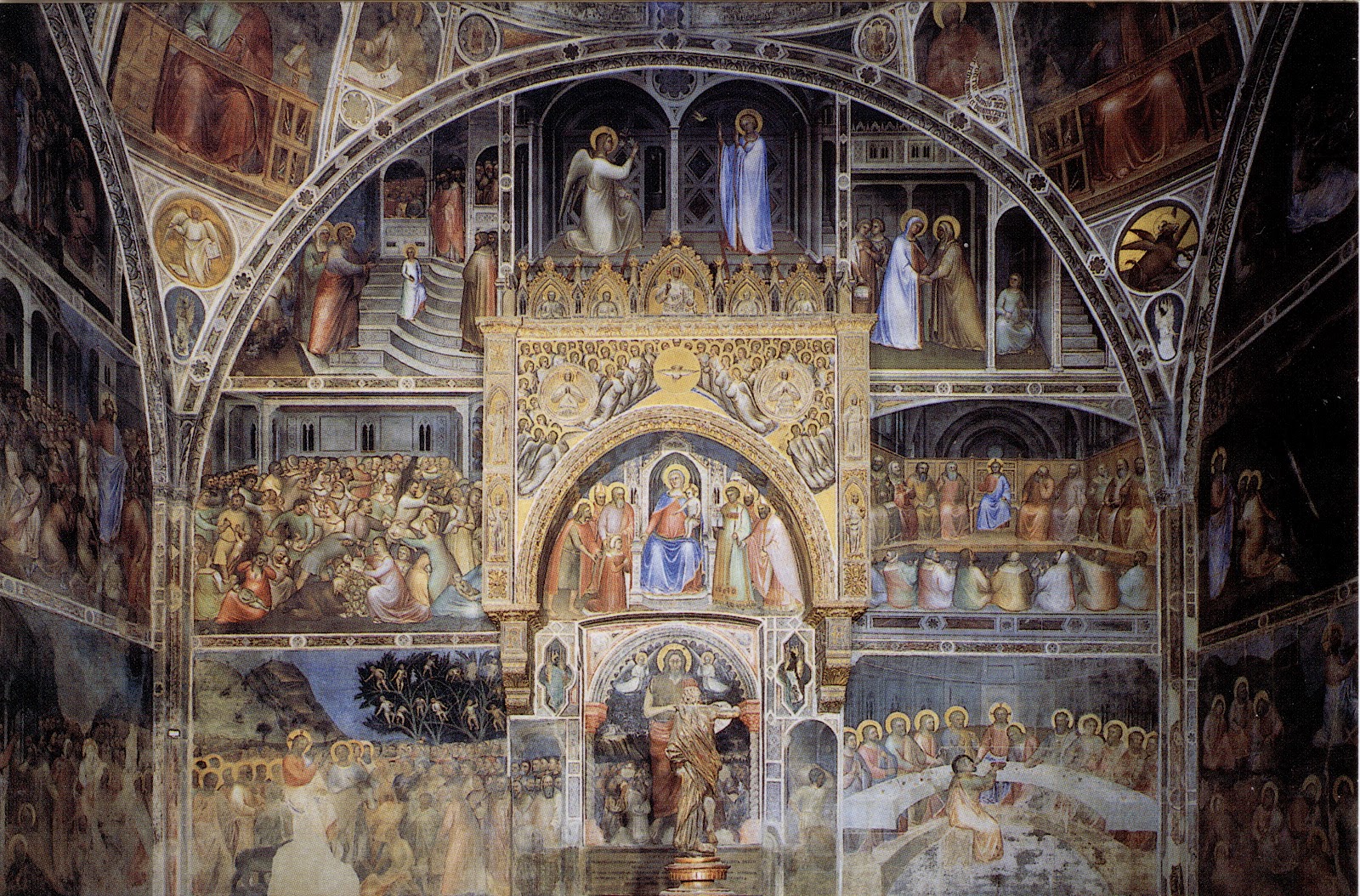
Meanwhile, below is an image of part of a fresco by Giusto de' Menabuoi (a follower of Giotti di Bondone) around the time that Bianco da Siena lived and perhaps wrotehis Laudi Spirituali; it's a detail of Paradiso, from 1376-78, painted on the ceiling of the Baptistry in Padua, Italy.


Here's an image of one of the amazing walls of the same baptistry:


Here's a photo of the Padua Cathedral; the Baptistry's on the right:


A bit later, around 1435 (da Siena died in 1434), Flemish artist Rogier van der Weyden painted "The Descent from the Cross," now hanging in the Prado in Madrid.


And here's "Come Down, O Love Divine" again, sung by the Kings' College Choir:


Sunday, May 27, 2012

"Come Down, O Love Divine"

Listen to the best hymn ever written*, sung by the King's College Choir.

Text via Bianco da Siena (14th C.) and translated by Anglo-Irish clergyman, Richard Frederick Littledale ; music by R.V. Williams (20th C.). And another example of the fantastic music that Pentecost has inspired.  (See more about this beautiful hymn, and the complete Bianco da Siena poem, at Discendi, amor santo.)


Come down, O love divine, seek Thou this soul of mine,
And visit it with Thine own ardor glowing.
O Comforter, draw near, within my heart appear,
And kindle it, Thy holy flame bestowing.

O let it freely burn, till earthly passions turn
To dust and ashes in its heat consuming;
And let Thy glorious light shine ever on my sight,
And clothe me round, the while my path illuming.

Let holy charity mine outward vesture be,
And lowliness become mine inner clothing;
True lowliness of heart, which takes the humbler part,
And o’er its own shortcomings weeps with loathing.

And so the yearning strong, with which the soul will long,
Shall far out pass the power of human telling;
For none can guess its grace, till he become the place
Wherein the Holy Spirit makes His dwelling.

* Well, one of, anyway.

Saturday, May 26, 2012

Loquebantur variis linguis is the Responsory after the second lesson at Matins of the Feast of Pentecost. This video gives, I think, the chant for that Responsory, and then a piece called Paraclitus egrediens; I'm not sure exactly what the second piece is, or what its liturgical function might have been, but it's another of those interesting medieval chants from Hungary.  I really have to look into that at some point!

Anyway, the chant - and very, very pretty it is, too:


Loquebantur variis linguis
apostoli, Alleluia.
Magnalia Dei, Alleluia.
Repleti sunt omnes Spiritu Sancto,
et coeperunt loqui:
Magnalia Dei, Alleluia.
Gloria Patri et Filio,
et Spiritui Sancto.
Alleluia.


The apostles were speaking
in different tongues, Alleluia,
of the great works of God, Alleluia.
They were all filled with the Holy Spirit,
and they began to speak of
the great works of God, Alleluia.
Glory be to the Father and to the Son,
and to the Holy Spirit.
Alleluia.

The blurb at the YouTube page says this, in Hungarian:

Schola Hungarica vezényel:
Dobszay László
Szendrei Janka

Részlet a Schola Hungarica Magyar Gregoriánum 2. Advent - Karácsony - Pünkösd c. hanglemezéről
Kép: Pünkösd (Bambergi Apokalipszis, XI. század)

Google Translate does pretty well with that, as far as I can tell:

Schola Hungarica conducted by:
Laszlo Dobszay
Janka Szendrei

Excerpt from the Schola Hungarica, the Hungarian second Gregoriánum Advent - Christmas - Pentecost c. sound drive

Picture: Pentecost (Bamberg Apocalypse, XI century.)

Here's the second lesson in its entirely from Breviary.net:

Lesson ii
Sed ecce, si unusquísque vestrum requirátur an díligat Deum : tota fidúcia et secúra mente respóndet, Díligo.  In ipso autem lectiónis exórdio audístis quid Véritas dicit : Si quis díligit me, sermónem meum servábit.  Probátio ergo dilectiónis, exhibítio est óperis.  Hinc in epístola sua idem Joánnes dicit : Qui dicit : Díligo Deum, et mandáta ejus non custódit, mendax est.  Vere étenim Deum dilígimus et mandáta ejus custodímus, si nos a nostris voluptátibus coarctámus.  Nam qui adhuc per illícita desidéria díffluit, profécto Deum non amat : quia ei in sua voluntáte contradícit.
But, behold now, if I shall ask any one of you whether he loveth God, he will answer will all boldness and quietness of spirit : I do love him.  But at the very beginning of this day's Lesson from the Gospel, ye have heard what the Truth saith : If a man love me, he will keep my word.  The test, then, of love, is whether it is shewed by works.  Hence the same John hath said in his Epistle : If a man say, I love God, and keepeth not his commandments, he is a liar.  Then do we indeed love God, and keep his commandments, if we deny ourselves the gratification of our appetites.  Whosoever still wandereth after unlawful desires, such an one plainly loveth not God, for he saith, Nay, to that which God willeth.
V.  Tu autem, Dómine, miserére nobis.
R.  Deo grátias.
V.  But thou, O Lord, have mercy upon us.
R.  Thanks be to God.
R.  Repléti sunt omnes Spíritu Sancto : et cœpérunt loqui, prout Spíritus Sanctus dabat éloqui illis : * Et convénit multitúdo dicéntium, allelúja.
V.  Loquebántur váriis linguis Apóstoli magnália Dei.
R.  Et convénit multitúdo dicéntium, allelúja.
V.  Glória Patri, et Fílio, et Spirítui Sancto.
R.  Et convénit multitúdo dicéntium, allelúja.
R.  They were all filled with the Holy Ghost, and began to speak as the Spirit gave them utterance : * And the multitude came together, singing Alleluia.
V.  The Apostles did speak in other tongues the wonderful works of God.
R.  And the multitude came together, singing Alleluia.
V.  Glory be to the Father, and to the Son, and to the Holy Ghost.
R.  And the multitude came together, singing Alleluia.

I'm not sure where the lesson itself comes from, but Lesson 1 is from Gregory the Great's 30th Gospel Homily, so perhaps Lesson 2 continues that reading.  I don't have the book, and it doesn't seem to be online anywhere.

Now, as for Paraclitus egrediens:  there's something in this Google Book (Music as Concept and Practice in the Late Middle Ages) about it, and a reference to Czech medieval music; perhaps Jakub will come along and let us know more.  And that book does look interesting; I'm going to have a look myself in any case.

Here's Thomas Tallis' version, sung by the Tallis Singers:


A shorter version of this text is also used as an antiphon at Lauds and at First and Second Vespers of Pentecost, and also as the Alleluia on the Feast of St. Mark.  Very beautiful, all around.

It's interesting to me that Mary figures so prominently in much of the art for Pentecost; anybody know where that tradition comes from?  It's not Biblical, at any rate - but I'm glad of it. [EDIT: Well, it is Biblical, as Grotheer Shull notes in comments: 'The description of Pentecost in Acts itself begins: "When the Day of Pentecost had fully come, they were all with one accord[a] in one place. 2 And suddenly there came a sound from heaven, as of a rushing mighty wind..." That doesn't identifiy who they "all" are, but in the previous chapter of Acts it talks about them getting together to meet in the upper room, and lists "Mary, mother of Jesus" among the people meeting for prayer, which would make it rather likely she was there later when they were assembled again.' Thanks, Grotheer!]

And of course, I can't put up a post for Pentecost without posting a video of the Sequence - probably my favorite of all Gregorian hymns (and Pentecost has some really great ones!):


Holy Spirit, Lord of light,
From the clear celestial height
Thy pure beaming radiance give.

Come, thou Father of the poor,
Come with treasures which endure;
Come, thou light of all that live!

Thou, of all consolers best,
Thou, the soul's delightful guest,
Dost refreshing peace bestow.

Thou in toil art comfort sweet,
Pleasant coolness in the heat;
Solace in the midst of woe.

Light immortal, light divine,
Visit thou these hearts of thine,
And our inmost being fill.

If thou take thy grace away,
Nothing pure in man will stay;
All his good is turned to ill.

Heal our wounds, our strength renew;
On our dryness pour thy dew,
Wash the stains of guilt away.

Bend the stubborn heart and will,
Melt the frozen, warm the chill,
Guide the steps that go astray.

Thou, on us who evermore
Thee confess and thee adore,
With thy sevenfold gifts descend.

Give us comfort when we die,
Give us life with thee on high,
Give us joys that never end.

Amen.

Another Pentecost treat: some lovely Georgian chant.


From the YouTube page:
Troparion of Pentecost, sung by the choir of the convent of Sameba-Jikheti. It can be found on their CD "Chant melodies."

"Blessed art Thou, O Christ our God, Who hast revealed the fishermen as most wise by sending down upon them the Holy Spirit - through them Thou didst draw the world into Thy net. O Lover of Man, glory to Thee!"
I just love Orthodox hymnody! The texts are always splendid. Here's a PDF of the same text (although not, I think, the same music), from the Antiochian Orthodox Christian Archdiocese of North American.

According to OrthodoxWiki:
A Troparion (also tropar; plural troparia) is a type of hymn in Byzantine music, in the Orthodox Church and other Eastern Christian churches. It is a short hymn of one stanza, or one of a series of stanzas; this may carry the further connotation of a hymn interpolated between psalm verses.

The term most often refers to the apolytikion (or "dismissal hymn"), the thematic hymn which closes Vespers. (In Greek churches, the apolytikion troparion is known simply as the apolytikion; in most other churches, it is known simply as the troparion.) This troparion serves as a thematic hymn and is repeated at every service of the day.

Troparia are also found as the stanzas of canons. Such troparia are modeled on the irmoi of the ode.

Troparia are also sometimes used as refrains for chanted psalm verses, though stichera more often serve this function.
Another kind of hymn is the Kontakion:
A Kontakion (also kondakion, kondak, and kontak; plural kontakia, kondakia) is a type of thematic hymn in the Orthodox Church and other Eastern Christian churches. Originally, the kontakion was an extended homily in verse consisting of one or two proemia (preliminary stanzas) followed by several strophes called oikoi (also ikoi; singular oikos, ikos), usually between 18 and 24. The kontakia were so long that the text was rolled up on a pole for use in the services -- the genesis of the name kontakion, which means "from the pole" in Greek. It is typical of the form that each of the proemia and strophes end with the same refrain. Acrostics are also a hallmark of this hymnographic form.

In current practice, the kontakion has been greatly abbreviated. Only the (first) proemium and first strophe are sung or read after the sixth ode of the canon at orthros. The proemium alone is sung at the Divine Liturgy, following the troparia, and most other services of the daily cycle. The kontakion is not sung at vespers.

According to tradition, Saint Roman the Melodist wrote the first kontakion, the Kontakion for the Birth of Our Lord, by divine inspiration. Legend aside, Roman established the kontakion in the form it retained for centuries, and he is the most famous composer of kontakia.