RSS
Facebook
Twitter

Saturday, May 12, 2012

Easter Day: Pascha Nostrum

Pascha Nostrum ("Our Passover") is the Alleluia for Easter Day. Here's a beautiful version chanted by the Benedictine monks of the Abbey of Notre-Dame de Fontgombault (France):


Pascha Nostrum
is also the Communion Hymn for Easter Day. Here it is sung by the Gloriæ Dei Cantores Schola:


The text for both comes from 1 Corinthians 5, v. 7-8:
7 Cleanse out the old leaven that you may be a new lump, as you really are unleavened. For Christ, our Passover lamb, has been sacrificed. 8 Let us therefore celebrate the festival, not with the old leaven, the leaven of malice and evil, but with the unleavened bread of sincerity and truth.

Here's William Byrd's polyphonic version of the Communio text:


Here's another version of the shorter Alleluia text, by Léonin (1150 - 1201?); this was recorded by the Early Music Consort of London in 1975 (it says).


 Don't quite know what this "Medieval Chant of the Cathedral of Benevento" (sung by Ensemble Organum)  is. Beautiful, though!

Friday, May 11, 2012

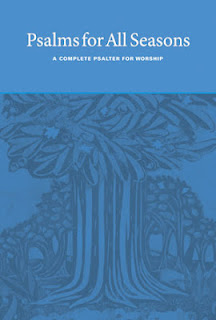
From Faith and Theology: "Psalms for all seasons: a contemporary psalter" (my bolding below, because I love the discussion of the Psalms and "emotional range"):

At the opening worship service of the Romans conference, it was a joy to use the wonderful new psalter, Psalms for All Seasons: A Complete Psalter for Worship (Brazos Press 2012). It has multiple versions of each of the 150 psalms (sometimes as many as ten versions of a single psalm), with musical styles ranging from chant and classical hymnody to African American spirituals and contemporary urban music. There are also spoken word and responsorial settings for each psalm. In our service, there was a psalm reading with part of a Wesleyan hymn for the response – it was very well done, and I've been singing it in my head all week. The book also includes brief theological-practical notes on how each psalm can be used in Christian worship.

I sometimes worry that our hymnbooks – where you have a more or less arbitrary selection of songs, arranged by various doctrinal and liturgical themes – create the impression that worship is a matter of human choice. You choose your Sunday hymns as you might choose a dessert from the menu at a restaurant; and you choose them on the basis of thematic relevance (this week, let's sing about love; this week, let's sing about forgiveness), so that entire dimensions of human experience might never once enter into the singing of a congregation.

But with psalmody as an overarching structure, the congregation is invited to share in experiences that might seem quite remote from their own everyday concerns. That is why we find some of the psalms so offensive: we simply cannot conceive of such experiences, even though they are – manifestly – genuine human possibilities. Instead of criticising such psalms, we need to learn how to sing them.

Our own private griefs are, often enough, quite paltry: but we are invited to join in the gigantic earth-shaking laments of the psalms. Our own criteria for happiness are selfish and small: but we are allowed to share in the magnificent heaven-rending joys of the psalmist. Our own love for God is so feeble that we might even forget all about God for days at a time: but our hearts are torn wide open as we join our voices to the enormous lovesick longing of the psalmist's praise. We are safe, affluent, protected, untroubled by enemies or oppression: but we learn to join our voices to the psalmist's indignant cries for the catastrophic appearance of justice on the earth.

If your congregation sings only Hillsong choruses, then their emotional repertoire will be limited to about two different feelings (God-you-make-me-happy, and God-I'm-infatuated-with-you) – considerably less even than the emotional range of a normal adult person. It is why entire congregations sometimes seem strangely adolescent, or even infantile: they lack a proper emotional range, as well as a suitable adult vocabulary. But in the psalter one finds the entire range of human emotion and experience – a range that is vastly wider than the emotional capacity of any single human life.

Just to stick with Hillsong as an example: for a congregation to go from singing Hillsong to singing the psalter would be like seeing Shakespeare's plays after you've only ever watched sitcoms – it would be a shock to discover that human beings can be so large, and that they come in so many different varieties. Nobody has ever felt the way Hamlet feels, or felt so much: that's exactly what makes Hamlet important.

To enter into the singing of the psalms is to participate in a pattern of worship that transcends any private experience. As though worship were really worship, not just the expression of private thoughts and feelings. As though the voice that really sings in the psalms were a universal voice, the voice of fallen and redeemed humanity gathered together in one lump – which is to say, Christ's voice.

When the church's singing is structured around Israel's psalms, there is a constant reminder that worship is not primarily a matter of personal choice; that the experience of worship is not primarily my own private experience; that the voice in worship is not even primarily my voice, but the voice of Israel, the voice of Christ, the voice of Christ's people gathered across time and space, learning together how to transmute all the varied raw materials of human experience into the praise of God through the alchemy of Jesus Christ.

(This isn't an anti-Hillsong post, BTW; I don't even know what Hillsong is. It's a pro-Psalms post....)

Monday, May 7, 2012

Easter Lauds: Et ecce terræmótus


Et ecce terræmótus  - "And behold there was a great earthquake" - is the second Psalm antiphon at Lauds on Easter Day.  You can look this up at Divinum Officium ; just enter (for instance) 3-31-2013 for Easter's date, and then click "Laudes."  (The Psalm number is according to the Vulgate; this is Psalm 100 for Anglicans):

Ant.    Et ecce terræmótus * factus est magnus : Angelus enim Dómini descéndit de cælo, allelúja.
Ant.    And behold there was a great earthquake, * for the Angel of the Lord descended from heaven, allelúja.
Psalmus 99.  Jubilate
Jubiláte Deo, omnis terra: * servíte Dómino in lætítia.
2  Introíte in conspéctu ejus, * in exsultatióne.
3  Scitóte quóniam Dóminus ipse est Deus: * ipse fecit nos, et non ipsi nos.
4  Pópulus ejus, et oves páscuæ ejus: * introíte portas ejus in confessióne, átria ejus in hymnis: confitémini illi.
5  Laudáte nomen ejus: quóniam suávis est Dóminus, in ætérnum misericórdia ejus, * et usque in generatiónem et generatiónem véritas ejus.
Psalm 99.  Jubilate
O be joyful in the Lord, all ye lands: * serve the Lord with gladness,
2  And come before his presence * with a song..
3  Be ye sure that the Lord he is God; * it is he that hath made us, and not we ourselves.
4  We are his people, and the sheep of his pasture : * O go your way into his gates with thanksgiving, and into his courts with praise; be ye thankful unto him.
5  Give praises unto his Name: for the Lord is gracious, his mercy is everlasting; * and his truth endureth from generation to generation.
Ant.    Et ecce terræmótus factus est magnus : Angelus enim Dómini descéndit de cælo, allelúja.
Ant.    And behold there was a great earthquake, for the Angel of the Lord descended from heaven, allelúja.

The text for the antiphon comes from Matthew 28:2:

1 Now after the Sabbath, toward the dawn of the first day of the week, Mary Magdalene and the other Mary went to see the tomb. 2 And behold, there was a great earthquake, for an angel of the Lord descended from heaven and came and rolled back the stone and sat on it. 3 His appearance was like lightning, and his clothing white as snow. 4 And for fear of him the guards trembled and became like dead men.

5 But the angel said to the women, “Do not be afraid, for I know that you seek Jesus who was crucified. 6 He is not here, for he has risen, as he said. Come, see the place where he lay. 7 Then go quickly and tell his disciples that he has risen from the dead, and behold, he is going before you to Galilee; there you will see him. See, I have told you.”

8 So they departed quickly from the tomb with fear and great joy, and ran to tell his disciples. 9 And behold, Jesus met them and said, “Greetings!” And they came up and took hold of his feet and worshiped him. 10 Then Jesus said to them, “Do not be afraid; go and tell my brothers to go to Galilee, and there they will see me.”

There is, again, no chant score or recording of this antiphon online (I'll wait for Jakub to come by for that!  - or maybe I can find it in some manuscript someplace and transcribe it myself)....

(EDIT: Thanks, Jakub!


)

....but there's a rather famous mass of the same name, by the 14th/15th Century French composer Antoine Brumel.  Missa Et ecce terræmótus - "The Earthquake Mass," that is - is an amazing piece in 12 voices, here sung by the Huelgas Ensemble.


Here's something from Gimell records about Brumel and this mass:

It is hard to think of any other piece of music quite like the 12-part 'Earthquake' Mass by Antoine Brumel (c.1460-c.1520). Both in its employment of twelve voices for almost its entire length and in its musical effects, there is nothing comparable to it in the renaissance period, even if some of those effects may remind the listener of the 40-part motet Spem in alium (1) by Thomas Tallis (c.1505-1585). Brumel's masterpiece did not inaugurate a fashion for massive compositions; but it did quickly establish a formidable reputation for itself, admired throughout central Europe in the 16th century as an experiment which could not easily be repeated. It is tribute enough that the only surviving source was copied in Munich under the direct supervision of the late renaissance composer Orlandus Lassus (1532-1594), who nonetheless never tried to rival its idiom in his own work.

A pupil of Josquin des Prés (c.1440-1521) and one of the leading Franco-Flemish composers around 1500, Brumel was famous throughout the 16th century. In a period which has left a large number of laments in memory of its great composers, Brumel received an exceptional number, more than Obrecht (c.1450-1505), Mouton (c.1459-1522) and Agricola (?1446-1506) put together. Thomas Morley (in A Plain and Easy Introduction to Practical Music, 1597) was probably the last writer to praise Brumel for his skill, the only master he ranked alongside Josquin, making particular reference to his ability in the art of canonic composition. Brumel is important to modern commentators because he was one of the few leading members of the Franco-Flemish school to be genuinely French, which is to say that he was born outside the boundaries of the Burgundian Empire, somewhere near Chartres. He was initially employed in France proper at the Cathedrals of Chartres and Laon and (in 1498) at Notre Dame in Paris where he was responsible for the education of the choirboys. However he seems to have had a restless temperament, which led to his dismissal on at least two occasions, and he soon began the peripatetic life of so many musicians of the renaissance period. There is evidence that he was employed in Geneva, Chambéry and probably Rome; but the high-point of his career was the fifteen years he spent as successor to Josquin and Obrecht at the court of Ferrara (between 1505 and 1520) in the retinue of Alfonso d'Este I.

Brumel's reputation as a writer of canons would not have been greatly increased by the simple example which underlies the Missa Et ecce terrae motus, for all that the presence of the canon plays an important role in understanding the unusual musical style of the whole. Brumel restricted his quotation of the Easter plainsong antiphon at Lauds, Et ecce terrae motus, to its first seven notes (which set the seven syllables of its title to D-D-B-D-E-D-D), working them in three-part canon between the third bass and the first two tenor parts during some of the Mass's 12-part passages. These statements occur in very long notes compared with the surrounding activity and their details may vary slightly from quotation to quotation (for example, which of the three voices begins and what the interval between them may be). By and large, though, the realisation of this canonic scaffolding is not rigorous and many of the sections of the mass are free of canon altogether.

However the influence of these slow-moving notes can be heard throughout the work, whether they are actually there or not, in the solid, slow-changing underlying chords. A casual listener to the Missa Et ecce terrae motus, confused at first by the teeming detail of the rhythmic patterns, may hear only some rather disappointing harmonies. Closer listening will reveal why Brumel chose to write in so many parts: he needed them to decorate his colossal harmonic pillars. In doing so he effectively abandoned polyphony in the sense of independent yet interrelated melodic lines, and resorted to sequences and figurations which were atypical of his time. The effect can even be akin to that of Islamic art: static, non-representational, tirelessly inventive in its use of abstract designs, which are intensified by their repetitive application. This style of writing is so effective that anyone who might be reminded of Tallis's Spem in alium would be unable to conceive of the need for another 28 parts.

The manuscript source for Brumel's 'Earthquake' Mass (Munich Bayerische Staatsbibliothek Mus. MS1) was copied for a performance in about 1570 at the Bavarian court. The names of the 33 court singers are given against the nine lower parts (the boys are not named), amongst whom Lassus sang Tenor II. Unfortunately the last folios, which contain the Agnus Dei, have rotted, leaving holes in the voice-parts. Any editor of the piece is presented with the unusual task of trying to guess where the notes which he can read might fit, as they are placed on the page in individual parts rather than in score; then re-compose what is missing. This was done for Gimell by Francis Knights. A further Agnus Dei, on the Et ecce terrae motus chant and attributed to Brumel, survives in Copenhagen; but it is widely thought not to belong to the 12-part Mass, since it is for six voices, which use different vocal ranges from those in the 12-part setting. In addition its musical style differs in various important respects from that of the larger work, not least in quoting many more than the first seven notes of the chant. For these reasons it has been omitted from this recording. The Mass is scored for three sopranos, one true alto, five wide-ranging tenors and three basses. The tessitura of all these parts (except perhaps that of the sopranos) is unpredictable to the point of eccentricity. Countertenor II, for example, has a range of two octaves and a tone, the widest vocal range I have ever met in renaissance music.

Wednesday, May 2, 2012

Alamire records the Trinity Carol Roll

See the scrolling text in the video for more.


Here's Alamire's website, on which they offer a page of video samples.

HT Sed Angli; they've just posted a couple of Alamire's videos. Here's part of John Taverner's beautiful Dum transisset sabbatum:


Dum transisset Sabbatum Maria Magdalene et Maria Jacobi et Salome emerunt aromata, ut venientes ungerent Jesum, alleluia. Et valde mane una sabbatorum veniunt ad monumentum orto jam sole. Gloria Patri...

And when the Sabbath was past, Mary Magdalene and Mary [the mother of] James, and Salome brought spices, that coming they might anoint Jesus, alleluya. And very early the first of the Sabbath, they came to the monument, the sun being now risen. Glory be to the Father...

I hadn't known of this U.K. group till now; they're great!

Saturday, April 28, 2012

Surrexit pastor bonus

Surrexit pastor bonus is the second Matins Responsory for Easter Monday; see it here in its context at Breviary.net.  Here is the text and translation from that site:

R.  Surréxit pastor bonus, qui ánimam suam pósuit pro óvibus suis, et pro grege suo mori dignátus est : * Allelúja, allelúja, allelúja.

V. Etenim Pascha nostrum immolátus est Christus.

R.  Allelúja, allelúja, allelúja.

V. Glória Patri, et Fílio, et Spirítui
Sancto.


R.  Allelúja, allelúja, allelúja.
R.  The Good Shepherd is risen, who laid down his life for his sheep, and vouchsafed to die for his flock : * Alleluia, alleluia, alleluia.

V. For even Christ our Passover is sacrificed for us.

R.  Alleluia, alleluia, alleluia.

V. Glory be to the Father, and to the Son,
and to the Holy Ghost.

R.  Alleluia, alleluia, alleluia.

Unfortunately, there seems to be no plainchant audio recording of this anywhere online. (EDIT: But there may be soon, thanks to Jakub Pavlik (see comments)! Jakub, who lives, I believe, in the Czech Republic, has already transcribed the responsory from the Antiphonarium Sedunense - a 14th-Century manuscript from Domstift Sitten (that's "the Cathedral Chapter" in Sion ("Sitten"), Switzerland) housed at a Swiss manuscript library - and linked to a PDF of the transcription posted at this Czech Liturgy of the Hours website! Amazing.

Here's an image file I created from his PDF; this Responsory was, evidently, put together a bit differently at Domstift Sitten. Notice the second Versicle, which reads "Surrexit dominus de sepulchro qui pro nobis propendit in ligno," which translates as "The Lord is risen from the grave, who for us was hung from the tree."


Many, many thanks to Jakub, who may soon create an audio file of this! Ah, the interwebs....!)

However, many composers have set this text in polyphony - Victoria, di Lassus, Palestrina, L'Héritier, and Mendelssohn, among others.  Understandable; it's a beautiful text.

Most have set only the first part of the text; here it is, along with a different (and I think better) English translation:

Surrexit pastor bonus,
qui animam suam posuit,
pro ovibus suis et pro grege suo mori
dignatus est. Alleluia.


The good shepherd has risen,
who laid down his life for his sheep,
and deigned to die for his flock. Alleluia.

Here's one recording of di Lassus' version, sung by the Wicker Park [Chicago] Choral Singers:


It would be very worth your while, I think, to click over to this page and listen to L'Héritier's version, sung by the Oxford Camerata; I can't embed it here. Here's what Wikipedia has to say about L'Héritier:
Jean L'Héritier (Lhéritier, Lirithier, Heritier and other spellings also exist) (c. 1480 – after 1551) was a French composer of the Renaissance. He was mainly famous as a composer of motets, and is representative of the generation of composers active in the early to middle 16th century who anticipated the style of Palestrina. He was a native of the diocese of Thérouanne, in the Pas-de-Calais, but little is known about his early years.

According to a note by an Italian contemporary, L'Héritier was a pupil of Josquin des Prez, a relationship which most likely occurred while Josquin was at the French royal court in the years after 1500 (exact years for Josquin's stay there have not been established).
[EDIT:  The video is now embeddable:


]

And here's an interesting bit about this particular piece:

The manuscript containing Surrexit pastor bonus was a working choirbook for the choir of the Julian Chapel in the Vatican, and is a major source for motets by composers of the post-Josquin generation. It is dated 1536 and bears the coat of arms of Pope Paul III (1534-49). It contains seven motets by Lhéritier, one fewer than the best represented composer, Claudin de Sermisy. It also contains motets by Josquin, Festa, Maistre Jan, Jachet of Mantua, Verdelot, Gombert, Willaert, Lupi, Morales and da Silva.

That Lhéritier's music was highly regarded in the sixteenth century is evident from the number and geographical diversity of sources in which his music is found. Much of his work was published by printers in Paris, Lyon, Rome, Ferrara and Venice as well as in Nuremberg, Louvain and Seville. Moreover, his works were being reprinted well into the 1580s, and manuscripts of his works were compiled as far afield as Spain, Germany, Austria, Poland and Bohemia as well as in France, the Netherlands and Italy. Palestrina based two masses on motets by Lhéritier, and it is obvious that Lhéritier was important in developing the style of continuous imitation from Josquin and disseminating this style in Italy.

And wow! How about this terrific take on Mendelssohn's Surrexit pastor bonus, from "Concert de l'Escolania de Montserrat a l'església de Saint-Hilaire de Poitiers - 27 de juny del 2008." Man, these boys can sing!


This sheet-music site offers an interesting anecdote about the Mendelssohn:

Inspiration for the Three Motets op. 39 was a visit to the romanesque church of Trinità dei Monti. On 20 Dec 1830 Mendelssohn wrote to his parents: "The French nuns sing there, and it is wonderfully lovely. ... Now, one should know one more thing: that one is not allowed to see the singers. Therefore I have come to an unusual decision: I will compose something for their voices, which I rememer exactly..."

Another recording of the Mendelssohn - very beautiful, but in my opinion not as exciting - from the Stuttgart Chamber Choir:


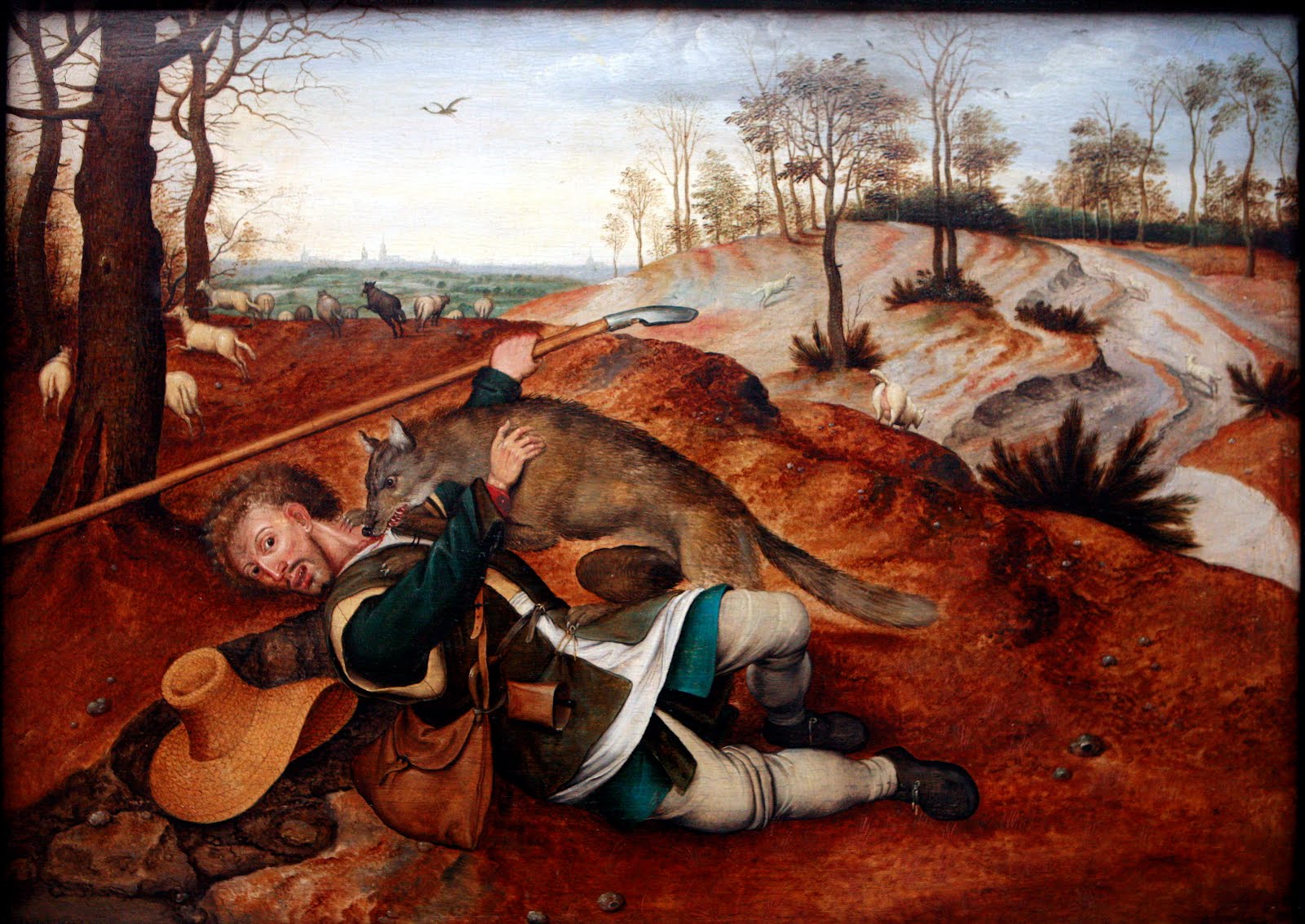
Here's Pieter Brueghel the Younger's "Good Shepherd,"  which hangs in the Musées royaux des Beaux-Arts de Belgique. Brueghel lived from 1565 to 1636.


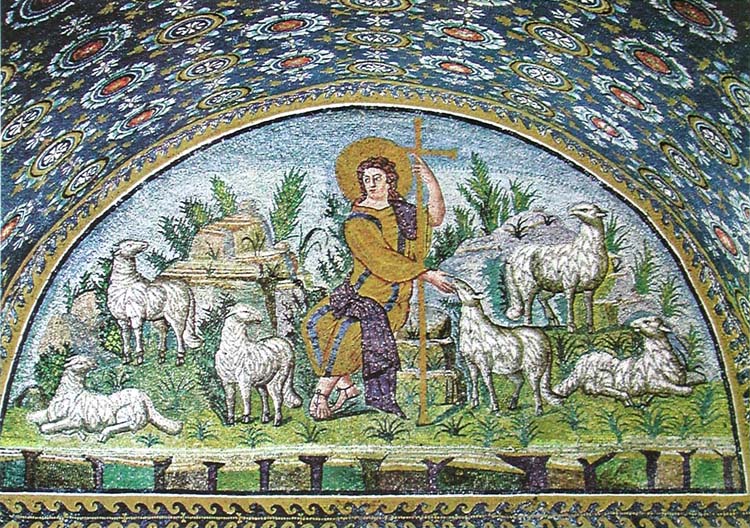
And here's The Good Shepherd mosaic in the Mausoleum of Galla Placidia, Ravenna, from the 1st half of 5th century:

Tuesday, April 24, 2012

Kathleen Ferrier: Ma Bonny Lad


The lyrics, from "The Lied, Art Song, and Choral Texts Archive":

Have ye seen owt o my bonnie lad,
and are ye sure he's vveel, oh?
He's gone ower land
wiv his stick in his hand,
he's gyen to moor the keel, O!
Yes, aa'v seen yor bonny lad,
'twas on the sea aa spied him,
his grave is green, but not wi grass,
and thou'lt never lie aside him.

Says Wikipedia about Ferrier:


Kathleen Mary Ferrier, CBE (22 April 1912 – 8 October 1953) was an English contralto who achieved an international reputation as a stage, concert and recording artist, with a repertoire extending from folksong and popular ballads to the classical works of Bach, Brahms, Mahler and Elgar. Her death from cancer, at the height of her fame, was a shock to the musical world and particularly to the general public, which was kept in ignorance of the nature of her illness until after her death. She was especially known in Britain for her unaccompanied recording of the Northumbrian folk tune "Blow the Wind Southerly", which was played regularly on BBC Radio for many years after her death.

The daughter of a Lancashire village schoolmaster, Ferrier showed early talent as a pianist, and won numerous amateur piano competitions while working as a telephonist with the General Post Office. She did not take up singing seriously until 1937, when after winning a prestigious singing competition at the Carlisle Festival she began to receive offers of professional engagements as a vocalist. Thereafter she took singing lessons, first with J.E. Hutchinson and later with Roy Henderson. After the outbreak of the Second World War Ferrier was recruited by the Council for the Encouragement of [Music and] the Arts (CEMA), and in the following years sang at concerts and recitals throughout England. In 1942 her career was boosted when she met the conductor Malcolm Sargent, who recommended her to the influential Ibbs and Tillett concert management agency. She became a regular performer at leading London and provincial venues, and made numerous BBC radio broadcasts.

More here.  HT All Manner of Thing.


Monday, April 16, 2012

James Alison talks about Girard's reading of Scripture. I've bolded a couple of (what I think are) really important things below:

I guess that many of you shared the sort of excitement I felt when I first read “The woes against the Pharisees” in Things Hidden or any of the chapters in the second half of The Scapegoat. Or when I heard René explain “The woman taken in adultery” even before he had written it up in I saw Satan. It was and is the excitement of experiencing someone handling scripture in a way that none of us had ever seen or heard it handled before. It was not like the massively erudite deliverences of our Scripture professionals, which so often leave us impressed, or depressed, by their knowledge, but no more enflamed by, or loving of, the sacred pages themselves. On the contrary Girard’s readings don’t tell you much about Girard, nor stun you with his erudition. Rather he seems to be reading Scripture from within a logic that is proper to Scripture itself, as though the same spirit which had enabled Scripture to be written was enabling it to be read, so that you, the reader, end up seeing more and more in Scripture than what Girard points out himself, and you find yourself loving and treasuring the Scriptures even more. You get the sense that you are, at last, beginning to understand the text “from the inside”.

It is because of this that I wanted to start with something which seemingly has little to do with any “Girardian themes” in Scripture. And yet which is vital if we are to avoid bibliolatry. That is, to recall the sense, from which I hope we all learn, of someone who simultaneously takes texts extremely seriously, and yet not seriously at all. Girard really looks in a very detailed way at what particular texts say, and then appears to throw them all up in the air so that the textual elements come down any which way, but “any which way” turns out to be extraordinarily powerful, coherent and whole. It is having seen Girard do this, time after time, that I have begun to get a sense of Jesus doing the same thing, time after time in the Gospels. In other words, what Girard does with texts is in itself an education in the art of “doing things with texts” which is what we see Jesus do in the New Testament. When we can glimpse that this is what is going on, so many of the apparently arcane arguments set in an ancient world suddenly become alive and contemporary.

Now there is something consistent which has enabled Girard to read texts in this way. It is not simply an adorable personal quirk of his. And it is something which can consistently help us avoid bibliolatry. It is the realisation that the centre of meaning is not to be found in the texts themselves. The centre of meaning is real, historical, non-textual, or not primarily textual, and the texts themselves are certain sorts of monuments to this real, historical, pre-textual reality. At Hiroshima and Nagasaki, so intense were the explosions that the light from them etched what look like photographs of buildings and protrusions on the walls of other buildings. Each one of those light-etched walls is a monument to the unimaginable, and unsurviveable reality of the explosion, some hints of whose force can be read off from its monuments. And for Girard the centre of meaning, the unimaginable explosion, is a highly agile and dynamic centre in which two apparently opposed things are happening at the same time.

The first of these is entirely offstage and entirely beyond any sort of direct knowledge of ours, only detectable in the traces thrown up against some textual walls (and just conceivably, some cave walls, as at Çatalhöyük). This is the postulate of the founding murder, a dynamic postulate which suggests that, however it happened, over whatever huge length of time it happened, the central building block which has enabled our human cultures to come to be and to survive at all is the all-against-one of collective lynching. All human cultural forms flow from this. Ancient mythical texts do not point to this in a simple affirmative way. On the contrary, they dance round it, mostly hiding it, occasionally glimpsing it, sometimes horrified by what they see, sometimes complacently satisfied with the order which has resulted. The point is not “if you read ancient texts you will see that Girard is right”. Because of course, if you want you can read anything at all into ancient texts. The point is this: if you accept Girard’s postulate, you will find that the ancient texts make much more sense than they have before, in a way which is much more worthy of respect than we are inclined to acknowledge, and that there was and is a certain rationale in what we call the “primitive” mind which, while we cannot go along with it, is not at all stupid, and is a serious part of what has enabled our own ways of being and living together to survive and thus of what has allowed us to exist as we do now.

The second part of this unimaginable explosion is also prior to any text, but it has been reaching into our foreground and into our texts in a strange and unique way through the adventure of the Hebrew people, culminating in the making explicit, public, evident and frontstage of something which had been structuring and running people without their being aware of it up until then. The apparently necessary lie by which we bring into being and maintain order, culture, language, memory, thus finding ourselves established as humans, is shown to be exactly that – a lie. So the offstage structuring reality is gradually over time brought closer and closer to the surface, less and less dishonestly, in the interpretations which we glimpse in the Hebrew Scriptures, until finally that offstage structuring reality is brought centre-stage and made completely visible and obvious in the Passion. Thus the lie is undone, and we find ourselves embarked on the possibility of humanity becoming something much better, more interesting, more responsible than we had imagined, and simultaneously we start to discover how very much more dangerous to each other we can be than we had thought, and how much more precarious is our stability, given that the comfort of “the old lie” only reassures for as long as we don’t know that it’s a lie.

....

....Girard offers us a centre of meaning that is both prior to history, yet historical, liturgical, and contemporary, it means that the whole question of the relation between the texts of the Hebrew Scriptures and those of the Apostolic Witness (or New Testament) comes into a much fresher light. Rather than seeing two juxtaposed histories, of which one is newer and the other older, it makes much more sense to see the Hebrew Scriptures as being a permanently contemporary vision of who we are, and the Apostolic Witness being the permanently actual interpretative key revealing what has really been going on all along as the Word comes into the world. In this sense, what Girard has given us is an extraordinary tool for breaking free of the twin temptations which have beset Christian reading of the Scriptures: – the Marcionite temptation of attributing to some other god all the really unpleasant and violent passages of the Old Testament, and the Fundamentalist temptation of applying the words “God” and “Lord” univocally across both Testaments. Nor is this a Christian temptation alone: the prophets Jeremiah and Ezekiel were wrestling with the same temptations close to six centuries before Christ, as are shown in their differing justifications for moving beyond the child sacrifice apparently enjoined in the book of Exodus.

Here's a fairly simple illustration of "mimetic theory" from another source:

Here’s a new word for you: hominization. It refers to the process of becoming human and is part of the language of cultural anthropology and archaeology. One of the 20th century giants of this world is Rene Girard, a French thinker and devout Roman Catholic who has contributed numerous books and articles to a wide range of disciplines: history, philosophy, literary criticism, critical theory, anthropology, theology, psychology, mythology, sociology, economics and cultural studies. Girard received his Ph.D. in history from Indiana University and has lived and taught for most of his life in America.

What makes him fun is that while he combines a “deconstructionist” and “debunking” analysis of the origins and bases of human culture he uses it to affirm his Catholic faith and Christianity. Most in academia would belong to a secular or atheist bent but Girard is unapologetically Catholic. His thought, while at times complex and demanding is rooted in a simple phenomena called mimesis, the imitation or representation of aspects of the sensible world, especially human actions, in literature and art. Brian MacDonald, whose interview with Girard is here, gives this explanation of Girard’s thought in his introduction:

“Picture two young children playing happily on their porch, a pile of toys beside them. The older child pulls a G.I. Joe from the pile and immediately, his younger brother cries out, “No, my toy,” pushes him out of the way, and grabs it. The older child, who was not very interested in the toy when he picked it up, now conceives a passionate need for it and attempts to wrest it back. Soon a full fight ensues, with the toy forgotten and the two boys busy pummeling each other.

As the fight intensifies, the overweight child next door wanders into their yard and comes up to them, looking for someone to play with. At that point, one of the two rivals looks up and says, “Oh, there’s old fat butt!” “Yeah,” says his brother. “Big fat butt!” The two, having forgotten the toy, now forget their fight and run the child back home. Harmony has been restored between the two brothers, though the neighbor is now indoors crying.”

McDonald continues: “It would not be much of an exaggeration to say that Girard builds his whole theory of human nature and human culture through a close analysis of the dynamics operating in this story. Most human desires are not “original” or spontaneous, he argues, but are created by imitating another whom he calls the “model.” When the model claims an object, that tells another that it is desirable — and that he must have it instead of him. Girard calls this “mimetic” (or imitative) desire. In the subsequent rivalry, the two parties will come to forget the object and will come to desire the conflict for itself. Harmony will only be restored if the conflicting parties can vent their anger on a common enemy or ‘scapegoat.’…Girard shows, throughout the body of his work, how his theory of “mimetic” desire can illuminate and unify an extraordinarily disparate set of human phenomena. It can explain everything from sacrifice to conflict, from mythology to Christianity.

The point here, at least for me, is NOT (necessarily) that Girard's "mimetic theory" is correct (although I have to say it sure looks right, from the last illustration!). The main point is simply that we can dispense with all sorts of problems of communication in post-Christendom if we can show that Christian faith has something to do with the way human beings actually are. We don't have to worry so much about "translations," or "exegesis," or the whole scholarly endeavor in the course of evangelism (although these will still be exceedingly helpful and in fact can be a fun and profitable exercise, even for layfolks like me - so don't go anywhere, scholars).

We can simply point to the facts of the world and of the human condition, and to Revelation as we understand it to speak to these facts. The Nicene Creed sets up the boundaries of this Revelation - but that's all it does (an important thing, no doubt!). This is not important by itself, but only how it affects how we ought to understand Revelation.