RSS
Facebook
Twitter

Tuesday, December 10, 2013

More Jesse Tree: "There is a flower"

Thanks to "A Clerk of Oxford" for pointing this out; here the Cambridge Singers, directed by John Rutter, sing his "There Is a Flower."


The words are taken from John Audelay's absolutely splendid 15th-Century carol; ACoO has added some translation below, in italics, where a word may not be clear.
There is a flower sprung of a tree,
The root thereof is called Jesse,
A flower of price;
There is none such in paradise.

This flower is fair and fresh of hue;
It fades never, but ever is new;
The blessed branch where this flower grew
Was Mary mild who bore Jesu,
A flower of grace!
Against all sorrow it is solace.

The seed thereof was of God's sending,
Which God himself sowed with his hand;
In Bethlehem, in that holy land,
Within her bower he there her found.
This blessed flower
Sprang never but in Mary's bower.

When Gabriel this maiden met,
With "Ave, Maria," he her gret [greeted]
Between them two this flower was set,
And was kept, no man should wit, [know]
Til on a day
In Bethlehem, it began to spread and spray.

When that flower began to spread,
And his blossom to bud,
Rich and poor of every seed, [i.e. kind]
They marvelled how this flower might spread,
Until kings three
That blessed flower came to see.

Angels there came out of their tower
To look upon this fresh flower,
How fair he was in his colour,
And how sweet in his savour,
And to behold
How such a flower might spring amid the cold.

Of lily, of rose on ryse, [branch]
Of primrose, and of fleur-de-lys,
Of all the flowers at my devyse [I can think of],
That flower of Jesse yet bears the prize,
As the best remedy
To ease our sorrows in every part.

I pray you, flowers of this country,
Wherever ye go, wherever ye be,
Hold up the flower of good Jesse,
Above your freshness and your beauty,
As fairest of all,
Which ever was and ever shall be.


ACoO also offers this beautiful image "(Harley 1892, f. 31v, from c.1490-c.1510)," among many others.


See them all here.


"A Daily Jesse Tree Devotion"

In case you're not following Full Homely Divinity's Advent Calendar, here's something else very interesting, also from FHD and its "Rediscovering Advent" page.  It's chock full of Biblical people and readings and themes and symbols, and very worth doing at home each day, I think - even if you don't have an actual Jesse Tree.  I believe these are the same Old Testament readings you find in the Advent Calendar, but for me the enumerations and additions make this even more rich and resonant - even though the readings from Revelation are not included here.
A Daily Jesse Tree Devotion

Leader: There shall come forth a shoot from the stump of Jesse, and a branch shall grow out of his roots. (Isaiah 11:1)

Hang an ornament on the Jesse Tree and sing:
O come, thou Branch of Jesse's stem, From every foe deliver them That trust thy mighty power to save, And give them vict'ry o'er the grave. Refrain:  Rejoice!  Rejoice!  Emmanuel Shall come to thee, O Israel!

Read the Lesson for the day. Someone appointed may then give a brief reflection or explanation of the reading. Since one of the purposes of the Jesse Tree is to teach the history of salvation, it is especially important that children have an opportunity to learn more about the story and the symbol. Some Advent resource books provide questions for reflection.

Leader, or all together: Eternal Father, we thank you for all of the people who have been part of your plan of salvation from the very beginning of the world. As we remember all that you have done to prepare for our salvation, help us to be prepared to receive your Son Jesus Christ when he comes, who lives and reigns with you and the Holy Spirit, both now and for ever. Amen.

The Lord's Prayer may also be said and, if a meal is to follow, the usual grace before meals.

A Table of Suggested Lessons and Symbols for the Jesse Tree
The earliest Sunday on which Advent can begin is November 27th. When it begins later than that, either drop one or more of the starred (*) days, or double up as many days as are necessary. Always add Ruth to the tree on December 9th, and continue on from there to the end of Advent.

DayPersonThemeReadingSymbol
First Sunday of Advent
Jesse TreeIsaiah 11:1-3Tree
Monday
CreationGenesis 1:1-3, 26-31Sun and Moon
TuesdayAdam & EveSinGenesis 3:1-24Apple & Snake
WednesdayNoahThe FloodGenesis 6:11-19; 7:11-12; 8:6-11Ark or Dove & Olive Branch
ThursdayAbrahamThe PromiseGenesis 12:1-7Tent & Camel or Field of Stars
FridayIsaacSacrifice of IsaacGenesis 22:1-14Altar & Ram
*JacobJacob's DreamGenesis 28:10-22Ladder
*JosephGod's ProvidenceGenesis 37:1-28; 45:1-11Joseph's Coat
*MosesGod Calls MosesExodus 3:1-14Burning Bush
*BalaamGod Blesses his PeopleNumbers 22:4-6, 21-35; 24:1-2, 15-17Donkey
*JoshuaThe Fall of JerichoJoshua 2:1, 8-18; 6:1-5, 15-17Ram's Horn Trumpet or City Wall with Scarlet Cord
*GideonVictory against OddsJudges 7:1-21Clay Pitcher
December 9RuthForeign AncestressRuth 1:1-18; 3:1-9; 4:13-17Sheaf of Wheat
December 10JesseRoot of the Family Tree1 Samuel 16:1-13Tree Stump with New Shoot
December 11DavidShepherd King2 Samuel 5:1-12Shepherd's Crook
December 12NathanA Royal House2 Samuel 7:1-17Prophet's Scroll
December 13SolomonWisdom on the Throne1 Kings 3:3-15Crown
December 14ElijahRejecting False Gods1 Kings 18:17-39Altar and Lightning
December 15IsaiahProphet of the AdventIsaiah 6:1-11Advent Rose or Throne
December 16HezekiahA Faithful King1 Kings 18:1-8Broken Idol
December 17JeremiahA New CovenantJeremiah 31:31-34Heart
December 18HaggaiSplendor RenewedHaggai 2:1-9Temple
December 19HabakkukWatchfulnessHabakkuk 2:1-4Watchtower
December 20MicahA Ruler from BethlehemMicah 5:2-4Town of Bethlehem
December 21John the BaptistForerunner of the MessiahLuke 3:1-17Dove Descending to Water
December 22GabrielThe AnnunciationLuke 1:26-38Angel or Lily
December 23JosephTrusting God's PlanMatthew 1:18-24Carpenter's Tools
December 24 (morning)MaryMother of GodLuke 1:46-55Lily or MARIA Monogram
Christmas EveJesus ChristChrist is BornLuke 2:1-20Manger
Christmas DayEmmanuelThe Word Made FleshJohn 1:1-18Chi Rho Monogram

Saturday, December 7, 2013

The Advent 2 Alleluia: Laetatus sum


This text comes from Psalm (121/)122, v. 1:
I was glad when they said to me,
    “Let us go to the house of the Lord!”

Here's the full score:


This Sunday's emphasis in the chant propers is heavily on Zion / Jerusalem; other propers (sung by the Benedictines of Sao Paolo, Brazil) on the day are:
Introitus: Cf. Is. 30, 19.30; Ps. 79 Populus Sion (3m15.8s - 3061 kb) score
Graduale: Ps. 40, 2.3. V. 5 Ex Sion (2m50.7s - 2675 kb) score
Alleluia: Ps. 121, 1 Lætatus sum (2m11.2s - 2057 kb) score
Offertorium: Ps. 84, 7.8 Deus, tu convertens (2m01.6s - 1901 kb) score
Communio: Bar. 5, 5; 4, 36 Ierusalem, surge cum Ps. 147, 12.13 (1m56.7s - 1825 kb) score

As you can see, four of five of the propers concern themselves directly with Zion / Jerusalem; that is really a very insistent theme!  I have been looking through various lectionaries from various periods to try to understand the Zion theme; so far I've had no luck.  This page contains what it says is a "Medieval Lectionary" - and I can find no reason there for the strong emphasis on Zion/Jerusalem.  (The Gospel then was apparently Luke 21:25-36 - "And there shall be signs in the sun, and in the moon, and in the stars; and upon the earth distress of nations, with perplexity; the sea and the waves roaring...." - and the Epistle is the same Romans passage we're reading now, below.)

I do plan to read more about this, though, and will post what I find.   It could simply be that the Introit, Populus Sion, is setting the tone with its text from the very Advent-ish Isaiah:  "People of Sion, behold the Lord shall come to save the nations: and the Lord shall make the glory of His voice to be heard, in the joy of your heart." - and that the rest of the propers follow from this theme.

The current readings for today, including today's collect, by contrast, emphasize Prophets.  We are back to Year A in the Lectionary, and are looking at some of the really wonderful readings of the year - the Isaiah Advent passages in particular, and the Gospel gives us John the Baptist.

Here is that collect:
Merciful God, who sent your messengers the prophets to preach repentance and prepare the way for our salvation: Give us grace to heed their warnings and forsake our sins, that we may greet with joy the coming of Jesus Christ our Redeemer; who lives and reigns with you and the Holy Spirit, one God, now and for ever. Amen.

And the readings:
Isaiah 11:1-10

A shoot shall come out from the stump of Jesse,
and a branch shall grow out of his roots.
The spirit of the LORD shall rest on him,
the spirit of wisdom and understanding,
the spirit of counsel and might,
the spirit of knowledge and the fear of the LORD.
His delight shall be in the fear of the LORD.
He shall not judge by what his eyes see,
or decide by what his ears hear;
but with righteousness he shall judge the poor,
and decide with equity for the meek of the earth;
he shall strike the earth with the rod of his mouth,
and with the breath of his lips he shall kill the wicked.
Righteousness shall be the belt around his waist,
and faithfulness the belt around his loins.
The wolf shall live with the lamb,
the leopard shall lie down with the kid,
the calf and the lion and the fatling together,
and a little child shall lead them.
The cow and the bear shall graze,
their young shall lie down together;
and the lion shall eat straw like the ox.
The nursing child shall play over the hole of the asp,
and the weaned child shall put its hand on the adder's den.
They will not hurt or destroy
on all my holy mountain;
for the earth will be full of the knowledge of the LORD
as the waters cover the sea.
On that day the root of Jesse shall stand as a signal to the peoples; the nations shall inquire of him, and his dwelling shall be glorious.


Psalm 72:1-7, 18-19 Page 685, BCP

Deus, judicium

1
Give the King your justice, O God, *
and your righteousness to the King's Son;
2
That he may rule your people righteously *
and the poor with justice;
3
That the mountains may bring prosperity to the people, *
and the little hills bring righteousness.
4
He shall defend the needy among the people; *
he shall rescue the poor and crush the oppressor.
5
He shall live as long as the sun and moon endure, *
from one generation to another.
6
He shall come down like rain upon the mown field, *
like showers that water the earth.
7
In his time shall the righteous flourish; *
there shall be abundance of peace till the moon shall be no more.
18
Blessed be the Lord GOD, the God of Israel, *
who alone does wondrous deeds!
19
And blessed be his glorious Name for ever! *
and may all the earth be filled with his glory.
Amen. Amen.


Romans 15:4-13

Whatever was written in former days was written for our instruction, so that by steadfastness and by the encouragement of the scriptures we might have hope. May the God of steadfastness and encouragement grant you to live in harmony with one another, in accordance with Christ Jesus, so that together you may with one voice glorify the God and Father of our Lord Jesus Christ.

Welcome one another, therefore, just as Christ has welcomed you, for the glory of God. For I tell you that Christ has become a servant of the circumcised on behalf of the truth of God in order that he might confirm the promises given to the patriarchs, and in order that the Gentiles might glorify God for his mercy. As it is written,

"Therefore I will confess you among the Gentiles,
and sing praises to your name";

and again he says,

"Rejoice, O Gentiles, with his people";

and again,

"Praise the Lord, all you Gentiles,
and let all the peoples praise him";

and again Isaiah says,

"The root of Jesse shall come,
the one who rises to rule the Gentiles;
in him the Gentiles shall hope."

May the God of hope fill you with all joy and peace in believing, so that you may abound in hope by the power of the Holy Spirit.


Matthew 3:1-12

In those days John the Baptist appeared in the wilderness of Judea, proclaiming, "Repent, for the kingdom of heaven has come near." This is the one of whom the prophet Isaiah spoke when he said,

"The voice of one crying out in the wilderness:
`Prepare the way of the Lord,
make his paths straight.'"

Now John wore clothing of camel's hair with a leather belt around his waist, and his food was locusts and wild honey. Then the people of Jerusalem and all Judea were going out to him, and all the region along the Jordan, and they were baptized by him in the river Jordan, confessing their sins.

But when he saw many Pharisees and Sadducees coming for baptism, he said to them, "You brood of vipers! Who warned you to flee from the wrath to come? Bear fruit worthy of repentance. Do not presume to say to yourselves, `We have Abraham as our ancestor'; for I tell you, God is able from these stones to raise up children to Abraham. Even now the ax is lying at the root of the trees; every tree therefore that does not bear good fruit is cut down and thrown into the fire.

"I baptize you with water for repentance, but one who is more powerful than I is coming after me; I am not worthy to carry his sandals. He will baptize you with the Holy Spirit and fire. His winnowing fork is in his hand, and he will clear his threshing floor and will gather his wheat into the granary; but the chaff he will burn with unquenchable fire."

It is very interesting to note, in any case, that the Advent propers are identical in every respect in the ordinary and extraordinary forms; that is, these chant propers have been used continuously since at least the middle of the 16th Century - and I would suspect longer than that.


Other Advent 2 propers on Chantblog are discussed at these links:

Here's Michaelangleo's Isaiah, from the Sistene Chapel:


And this is a Russian icon of Isaiah, from the Iconostasis of Transfiguration church, Kizhi monastery, Karelia, Russia.  It dates from the early 1700s:


Friday, December 6, 2013

From Hymn melodies for the whole year, from the Sarum service-books:
On the Feast of the Conception of the B. V. Mary (Dec. 8)
Evensong: Ave! maris Stella ... ... ... 64
Mattins:  Quem terra, pontus, ethera  ... ... ... 63
Lauds: O gloriosa femina  ... ... ... 63

We have seen all these hymns in our travels before; the Mattins and Lauds hymns are the same, and sung to the same melody, at Purification (Candlemas, February 2), at Assumption (August 15), and at The Nativity of the B.V.M. (Sept. 8); the  Evensong hymn is the same one, again sung to the same melody, as on the Nativity of the B.V.M. (Sept. 8).

So, these hymns and melodies are associated with Mary throughout the year; this makes it easy for me, since I can just grab content from some of the feasts I've already posted on!  (Ironic that this is one of the last of the Propers of Saints I'm posting on - yet the first of those to be celebrated during the liturgical year.)

Follow along with the Offices for this feast at Breviary Offices, from Lauds to Compline Inclusive (Society of St. Margaret, Boston) (published in 1885). You can get all the Psalms, the collect, Chapter, antiphons, etc., for each of the offices of the day at that link, although no music is provided; also check the iFrame look-in at the bottom of this post.


Here is the score for the beautiful melody #64, used for the splendid hymn Ave! Maris Stella on this day (as, again, on the Nativity of the B.V.M.); below that is a video of the hymn sung by the Benedictine Monks of the Abbey at Ganagobie.:


CPDL has the Latin and English words; non-metrical English translation is by Allen H Simon:
Ave, maris stella,
Dei Mater alma,
Atque semper Virgo,
Felix caeli porta.

Sumens illud Ave
Gabrielis ore,
Funda nos in pace,
Mutans Evae nomen.

Solve vincla reis,
Profer lumen caecis,
Mala nostra pelle,
Bona cuncta posce

Monstra te esse matrem,
Sumat per te preces,
Qui pro nobis natus
Tulit esse tuus.

Virgo singularis,
Inter omnes mitis,
Nos culpis solutos,
Mites fac et castos.

Vitam praesta puram,
Iter para tutum,
Ut videntes Jesum,
Semper collaetemur.

Sit laus Deo Patri,
Summo Christo decus
Spiritui Sancto,
Tribus honor unus. Amen.


Hail, star of the sea,
loving Mother of God,
and also always a virgin,
Happy gate of heaven.

Receiving that Ave
from Gabriel's mouth
confirm us in peace,
Reversing Eva's name.

Break the chains of sinners,
Bring light to the blind,
Drive away our evils,
Ask for all good.

Show yourself to be a mother,
May he accept prayers through you,
he who, born for us,
Chose to be yours.

O unique virgin,
Meek above all,
Make us, absolved from sin,
Gentle and chaste.

Keep life pure,
Make the journey safe,
So that, seeing Jesus,
We may always rejoice together.

Let there be praise to God the Father,
Glory to Christ in the highest,
To the Holy Spirit,
One honor to all three. Amen.

CPDL also offers a brief write-up about the hymn:
Hymn to the Virgin Mary (8th cent., author anon.)
Liturgical use: Hymn at Vespers on feasts of the Virgin Mary.

Mary's title of stella maris was first proposed by St. Jerome, in his treatise Liber de nominibus hebraicis (probably around AD 390), in which he explains the etymology of Hebrew names. He quotes unidentified sources as explaining the name of Mary as smyrna maris, literally bitterness of the sea. The Hebrew word miriam indeed refers to bitterness - it is explained as such in the anonymous Jewish account The life of Moses. St. Jerome dismisses the 'bitter' etymology, however, and proposes to change her title to stella maris. In order to justify his proposal, he quotes Syrus, most likely his contemporary St. Ephraem Syrus, who had insisted on Mary's status as domina or mistress.

View Wikipedia article for Ave maris stella.

This is from that Wikipedia link:
Ave Maris Stella (Latin, "Hail Star of the Sea") is a plainsong Vespers hymn to Mary. It was especially popular in the Middle Ages and has been used by many composers as the basis of other compositions. The creation of the original hymn has been attributed to several people, including Bernard of Clairvaux (12th century), Saint Venantius Fortunatus (6th century)[1] and Hermannus Contractus (11th century).[2] The text is found in 9th-century manuscripts, kept in Vienna[3] and in the Abbey of Saint Gall.[1]

The melody is found in the Irish plainsong "Gabhaim Molta BrĂ­de", a piece in praise of St. Bridget. The popular modern hymn Hail Queen of Heaven, the Ocean Star, is loosely based on this plainsong original.

It finds particular prominence in the "Way of Consecration to the Blessed Virgin Mary" by Saint Louis de Montfort.

Here's a (very faint) recording of the same hymn, sung by the Benedictines of Brazil.

This is Guillame Dufay's beautiful chant/polyphony alternatim arrangement of the hymn, using the same melody in the chant portions.


Or, you can listen to 32 different versions of the hymn (!) in the below playlist:


Here is the chant score for melody #63 from Hymn Melodies; this tune is used for both the Mattins and Lauds hymns on this feast day, and, again, on Purification (AKA Candlemas, February 2), at Assumption (August 15), and at the Nativity of the B.V.M. (Sept. 8).


Here's an mp3 the cantor from LLPB singing melody #63; it's the Mattins hymn Quem terra, pontus, ethera, called "The God Whom Earth and Sea and Sky" in English.

Here are the words from Oremus; the note says "Words: attributed to Fortunatus, sixth century; trans. John Mason Neale, 1854."
The God whom earth and sea and sky
adore and laud and magnify,
whose might they own, whose praise they swell,
in Mary's womb vouchsafed to dwell.

The Lord whom sun and moon obey,
whom all things serve from day to day,
was by the Holy Ghost conceived
of her who through his grace believed.

How blessed that Mother, in whose shrine
the world's Creator, Lord divine,
whose hand contains the earth and sky,
once deigned, as in his ark, to lie.

Blessed in the message Gabriel brought,
blessed by the work the Spirit wrought;
from whom the great Desire of earth
took human flesh and human birth.

O Lord, the Virgin-born, to thee
eternal praise and glory be,
whom with the Father we adore
and Holy Ghost for evermore.

The Lauds hymn, O gloriosa femina (sometimes "O gloriosa domina"), is sung to the same melody today;  O gloriosa domina is also sung at Lauds on Purification (Candlemas)

This set of words comes from the SSM Breviary mentioned above (p.291);  it uses the same meter as Quem terra, pontus, ethera, so just sing it to the same tune, as prescribed.
O GLORIOUS Virgin, throned in rest
Amidst the starry host above,
Who gavest nurture from thy breast
To God with pure maternal love:

What we had lost through sinful Eve
The Blossom sprung from thee restores.
And granting bliss to souls that grieve.
Unbars the everlasting doors.

O gate, through which hath passed the King:
O hall, whence light shone through the gloom;
The ransomed nations praise and sing,
Life given from the virgin womb.

All honour, laud, and glory be,
O Jesu, Virgin-born, to Thee;
All glory, as is ever meet,
To Father and to Paraclete. Amen.

CPDL has the words to O gloriosa Domina, in Latin and English; the words above are clearly taken from the same original Latin text, so it's definitely the same song:
O gloriosa Domina
excelsa super sidera,
qui te creavit provide,
lactasti sacro ubere.

Quod Eva tristis abstulit,
tu reddis almo germine;
intrent ut astra flebiles,
Caeli fenestra facta es.

Tu regis alti janua
et porta lucis fulgida;
vitam datam per Virginem,
gentes redemptae, plaudite.

Gloria tibi, Domine,
qui natus es de Virgine,
cum Patre et Sancto Spiritu
in sempiterna secula. Amen.


O Heaven's glorious mistress,
elevated above the stars,
thou feedest with thy sacred breast
him who created thee.

What miserable Eve lost
thy dear offspring to man restors,
the way to glory is open to the wretched
for thou has become the Gate of Heaven.

Thou art the door of the High King,
the gate of shining light.
Life is given through a Virgin:
Rejoice, ye redeemed nations.

Glory be to Thee, O Lord,
Born of a Virgin,
with the Father and the Holy Spirit,
world without end. Amen.

Here's a page from the Poissy Antiphonal that includes both of these hymns - but the melodies seem quite different:
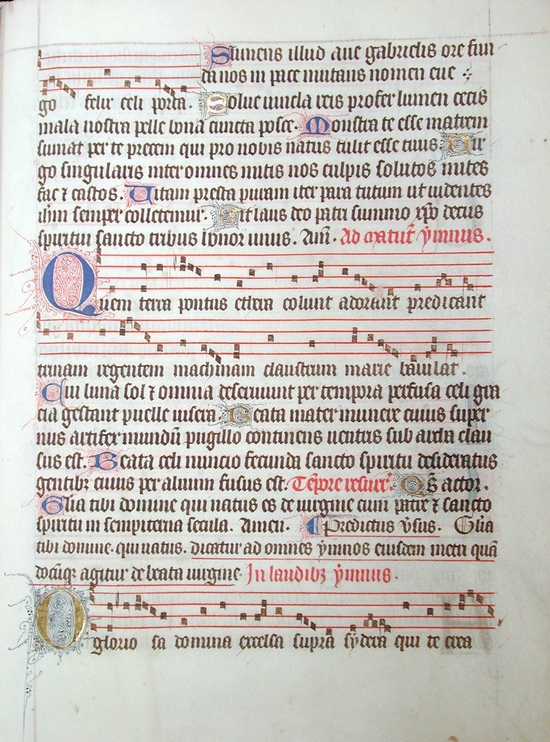


Here's that peek-through to the SSM Breviary for today:


Here's a bit from Wikipedia about the history of this feast:

An 11th-century Eastern Orthodox icon
of the Theotokos Panachranta,
i.e. the "all immaculate" Mary[15]
A feast of the Conception of the Most Holy and All Pure Mother of God was celebrated in Syria on 8 December perhaps as early as the 5th century. Note that the title of achrantos (spotless, immaculate, all-pure) refers to the holiness of Mary, not specifically to the holiness of her conception.[14]

By the 7th century the feast of her conception was widely celebrated in the East, under the name of the Conception (active) of Saint Anne. In the West it was known as the feast of the Conception (passive) of Mary, and was associated particularly with the Normans, whether these introduced it directly from the East[16] or took it from English usage.[17] The spread of the feast, by now with the adjective "Immaculate" attached to its title, met opposition on the part of some, on the grounds that sanctification was possible only after conception.[18] Critics included Saints Bernard of Clairvaux, Albertus Magnus and Thomas Aquinas. Other theologians defended the expression "Immaculate Conception", pointing out that sanctification could be conferred at the first moment of conception in view of the foreseen merits of Christ, a view held especially by Franciscans.[19]

Writers such as Mark Miravalle and Sarah Jane Boss interpret the existence of the feast as a strong indication of the Church's traditional belief in the Immaculate Conception.[20][21]

On 28 February 1476, Pope Sixtus IV, a Franciscan after whom the Sistine Chapel is named, authorized those dioceses that wished to introduce the feast to do so, and introduced it to his own diocese of Rome in 1477,[17] with a specially composed Mass and Office of the feast.[22] With his bull Cum praeexcelsa of 28 February 1477, in which he referred to the feast as that of the Conception of Mary, without using the word "Immaculate", he granted indulgences to those who would participate in the specially composed Mass or Office on the feast itself or during its octave, and he used the word "immaculate" of Mary, but applied instead the adjective "miraculous" to her conception.[23][24] On 4 September 1483, referring to the feast as that of "the Conception of Immaculate Mary ever Virgin", he condemned both those who called it mortally sinful and heretical to hold that the "glorious and immaculate mother of God was conceived without the stain of original sin" and those who called it mortally sinful and heretical to hold that "the glorious Virgin Mary was conceived with original sin", since, he said, "up to this time there has been no decision made by the Roman Church and the Apostolic See."[25] This decree was reaffirmed by the Council of Trent.[26]

One of the chief proponents of the doctrine was the Hungarian Franciscan Pelbartus Ladislaus of Temesvár. [27]

Pope Pius V, the Dominican Pope who in 1570 established the Tridentine Mass, included the feast (but without the adjective "Immaculate") in the Tridentine Calendar, but suppressed the existing special Mass for the feast, directing that the Mass for the Nativity of Mary (with the word "Nativity" replaced by "Conception") be used instead.[28] Part of that earlier Mass was revived in the Mass that Pope Pius IX ordered to be used on the feast and that is still in use.[29]

On 6 December 1708, Pope Clement XI made the feast of the Conception of Mary, at that time still with the Nativity of Mary formula for the Mass, a Holy Day of Obligation.[18] Until Pope Pius X reduced in 1911 the number of Holy Days of Obligation to 8, there were in the course of the year 36 such days, apart from Sundays.[30]

Here's another beautiful icon, a "Detail of a 13th century Theotokos Aeiparthenos icon, the Eleusa Theotokos of Tolga.   (Aeiparthenos = "Ever Virgin.")


Wednesday, December 4, 2013

A wonderful post at A Clerk of Oxford today:

Creation of the stars, BL Royal E IX, f. 3v

Among the Office Hymns for Advent is 'Conditor Alme Siderum', best known in translation as 'Creator of the stars of night'. Two years ago I posted a medieval English translation of this hymn written in the early fourteenth century by a Franciscan friar, William Herebert.  Herebert is an excellent translator and his version of the hymn is a good one; the opening phrase which renders God as 'holy wright' of the stars (starwright?) particularly sticks in the mind.  In this post I want to look at two more Middle English translations of this hymn, from the end of the fifteenth century, and so a little later than Herebert.

Here's the hymn sung in Latin:


And in English (rather fast!) by Ely Cathedral Choir:


Holy maker of sterres bright,
Of feithefull men eternall light,
Crist, that ayene mankynde hast bought,
Here oure prayers of buxum thought.

Having rewth, this worlde shulde be spilte
Thurgh the perell of dedly gilte,
Thou savedest fro grete doloure
To the gilty geving socoure.

This worlde drawing nyghe vnto nyght,
As spowse of bowre, thou came outright
Fro the clausure moost clenly dight
Of moder Mary, virgyne bright.

To whose grete myght, as it is right,
On knees boweth euery wight:
Alle heuenly and erthily thinge
Knowlege them meke to thy beknyng.

O holy lorde, we beseche the,
Of alle this worlde that iuge shall be,
Terme of oure lyfe defende vs froo
The darte of the fals fende, oure foo.

Lawde and honoure, ioye and vertue
To god and to his sonne Ihesue,
Also vnto the holigoost,
Bothe thre and one, of myghtis moost.

This from the carol collection of another Franciscan, the admirable James Ryman of Canterbury, who has left us a manuscript containing no fewer than 170 (!) English carols and songs on all kinds of religious topics.  The text of them all is online here.  This text is so simple it hardly needs glossing, but just in case, here's a literal version:

Holy maker of stars bright,
Of faithful men eternal light,
Christ, who again mankind hast bought, [bought again = redeemed]
Hear our prayers of humble thought.

Having pity that this world should be spilte [destroyed]
Through the peril of deadly guilt,
Thou savedest it from great dolour [sorrow]
To the guilty giving succour.

This world drawing nigh unto night,
As spouse from bower, thou came aright
From the enclosure most cleanly dight [made]
Of mother Mary, virgin bright.

To whose great might, as it is right,
On knees boweth every wight: [creature]
All heavenly and earthly thing
Acknowledge themselves meek at thy beckoning. [command]

O holy Lord, we beseech thee,
Of all this world who Judge shall be,
Throughout our life defend us fro [from]
The dart of the false fiend, our foe.

Laud and honour, joy and virtue
To God and to his Son Jesu,
Also unto the Holy Ghost,
Both three and one, of mights most. [greatest in power]

Most of the poems in Ryman's collection bear some relationship to a particular Latin text, but they vary quite a bit in how close that relationship is; often the English poem has only the loosest connection with the hymn that it quotes.  This, however, is a faithful translation - perhaps because it would be difficult to improve on the beauty of the original, with its stars and chambers and bridegrooms and the world's 'evening hour'.  I like the run of rhymes in verses 3-4, seven rhymes on 'ight' in just six lines (or eight, if you count 'nigh'); and 'drawing nigh unto night' finds an appropriately alliterative English echo of the Latin's 'vergente... vespere'.  In verse 3 this translation also preserves the hymn's quotation of Psalm 18 more precisely than the most common modern translation does: 'as spouse from bower' is the psalm and hymn's 'uti sponsus de thalamo'. 'In them hath he set a tabernacle for the sun, which cometh forth as a bridegroom out of his chamber, and rejoiceth as a giant to run his course...'


Read much more here.

Monday, December 2, 2013

The 2013 Hubble Space Telescope Advent Calendar

A yearly treat, at The Atlantic:  fantastic images, one each day, from the vast expanses of the universe, as seen through Hubble's eye.
It's time for my favorite holiday tradition: the 2013 Hubble Space Telescope Advent Calendar. Every day until Wednesday, December 25, this page will present an amazing new image of our universe from NASA's Hubble telescope. Be sure to bookmark this calendar and come back every day until Christmas, or follow on Twitter (@in_focus), Google+, Facebook, or Tumblr for daily updates. I hope you enjoy these amazing and awe-inspiring images and the efforts of the science teams who have brought them to Earth. Merry Christmas, and Peace on Earth to all. (Also, choosing the "1280px" viewing option below, if you can support it, is always a good option.) [25 photos (eventually)]

Here's the first image:


And its caption:
This year's first image: A composite image of visible-light observations by NASA's Hubble Space Telescope, combined with infrared data from the ground-based Large Binocular Telescope in Arizona to assemble a dramatic view of the well-known Ring Nebula. The Ring Nebula is the glowing remains of a Sun-like star, the smoldering core, called a white dwarf, is the tiny white dot in the center of the Nebula. The object is tilted toward Earth so that astronomers see the ring face-on. The Hubble observations reveal that the nebula's shape is more complicated than astronomers thought. The blue gas in the nebula's center is actually a football-shaped structure that pierces the red doughnut-shaped material. Hubble also uncovers the detailed structure of the dark, irregular knots of dense gas embedded along the inner rim of the ring. The faint, scallop-shaped material surrounding the ring was expelled by the star during the early stages of the planetary nebula formation. Most Sun-like stars become planetary nebulae at the end of their lives. Once a star consumes all of its hydrogen, the nuclear fuel that makes it shine, it expands to a red giant. The bloated star then expels its outer layers, exposing its hot core. Ultraviolet radiation from the core illuminates the discarded material, making it glow. The Ring Nebula is about 2,000 light-years away in the constellation Lyra. The nebula measures roughly one light-year across. (NASA, ESA, C.R. O'Dell, Vanderbilt University, and D. Thompson, Large Binocular Telescope Observatory)

Sunday, December 1, 2013

Ah!    It's come around again:  one of the most wonderful Sundays of the year.  And here's how it started:


I was thinking just before the Litany began that it might be good to write a new set of words; the litany sounds too 1662, maybe, and its concerns are not our concerns, mostly, I thought.  While singing it, though, I realized that - in spite of "the world, the flesh, and the devil" and the old-fashioned language - most of it is pretty good stuff, standard intercessory and penitential prayer, which we do all the time.   So even though it's a bit Tudor, it still works, mostly.  You can get all the words here.

Then, one of the best of all hymns, Sleepers wake.  You can listen to St. Peter's Chicago sing it, starting at around 7:45 in the video below:


What a fantastic text!  This one's from the 16th Century, too, written by Philip Nicolai (20th C. English translation by Carl P. Daw, Jr., though):
"Sleepers, wake!" A voice astounds us,
the shout of rampart-guards surrounds us:
"Awake, Jerusalem, arise!"
Midnight's peace their cry has broken,
their urgent summons clearly spoken:
"The time has come, O maidens wise!
Rise up, and give us light;
the Bridegroom is in sight.
Alleluia!
Your lamps prepare and hasten there,
that you the wedding feast may share."

Zion hears the watchman singing;
her heart with joyful hope is springing,
she wakes and hurries through the night.
Forth he comes, her bridegroom glorious
in strength of grace, in truth victorious:
her star is risen, her light grows bright.
Now come, most worthy Lord,
God's Son, Incarnate Word,
Alleluia!
We follow all and heed your call
to come into the banquet hall.

Lamb of God, the heavens adore you;
let saints and angels sing before you,
as harps and cymbals swell the sound.
Twelve great pearls, the city's portals:
through them we stream to join the immortals
as we with joy your throne surround.
No eye has known the sight,
no ear heard such delight:
Alleluia!
Therefore we sing to greet our King;
for ever let our praises ring.

The organ prelude in the video above comes from Bach's Cantata Wachet auf, ruft uns die Stimme, BWV 140; he used this hymn chorale by Philip Nicolai in that piece, too:


This different set of words may be how they sing it in England; here the Trinity College Cambridge Choir does it up nicely:


We had Lo, he comes with clouds descending last, and at a really crazy fast pace.  I can understand that, though, and I approve; this hymn can sound absolutely funereal if you drag it.  (Perhaps the choirmaster hates the hymn; it could have been that, too!)

In the video below, from Atonement in Chicago, it's the entrance hymn, though, and sung slowly and majestically.  It works fine to sing it more slowly here.


Lo! He comes with clouds descending,
Once for favored sinners slain;
Thousand thousand saints attending,
Swell the triumph of His train:
Hallelujah! Hallelujah! Hallelujah!
God appears on earth to reign.

Every eye shall now behold Him
Robed in dreadful majesty;
Those who set at naught and sold Him,
Pierced and nailed Him to the tree,
Deeply wailing, deeply wailing, deeply wailing,
Shall the true Messiah see.

The dear tokens of His passion
Still His dazzling body bears;
Cause of endless exultation
To His ransomed worshippers;
With what rapture, with what rapture, with what rapture
Gaze we on those glorious scars!

Yea, Amen! let all adore Thee,
High on Thine eternal throne;
Savior, take the power and glory,
Claim the kingdom for Thine own;
Alleluia, Alleluia, Alleluia
Thou shalt reign, and thou alone!

And the collect is this truly splendid one - my favorite of the year:
Almighty God, give us grace that we may cast away the works of darkness, and put upon us the armor of light, now in the time of this mortal life, in which thy Son Jesus Christ came to visit us in great humility; that in the last day, when he shall come again in his glorious Majesty, to judge both the quick and the dead, we may rise to the life immortal; through him who liveth and reigneth with thee and the Holy Ghost, now and ever. Amen.

A wonderful piece of religious rhetoric there, with all its resonances:  mystical allusions to light and dark, to weakness and power, to the mortal and the immortal, the temporal and eternal, the earthly and the cosmic.  Wow.

Advent 1 may be the only day of the year on which the hymnody completely blows away the readings!